


More than 370,000 Seirogan Toi-A anti-diarrhea tablets imported from Japan are being recalled, as the drug’s active pharmaceutical ingredient (API) manufacturing procedures are not aligned with the originally approved ones, the Food and Drug Administration (FDA) said, as it urged people not to use drugs arbitrarily.
The FDA on Tuesday afternoon said that on Tuesday last week it received a notification from Japan’s Pharmaceuticals and Medical Devices Agency (PMDA), saying that the API phellodendron bark extract used in 22 batches was manufactured using methods that were different from what had originally been registered and approved.
The FDA said that the PMDA asked the drug companies to recall the 22 batches, including one batch of Seirogan Toi-A anti-diarrhea tablets exported to Taiwan.
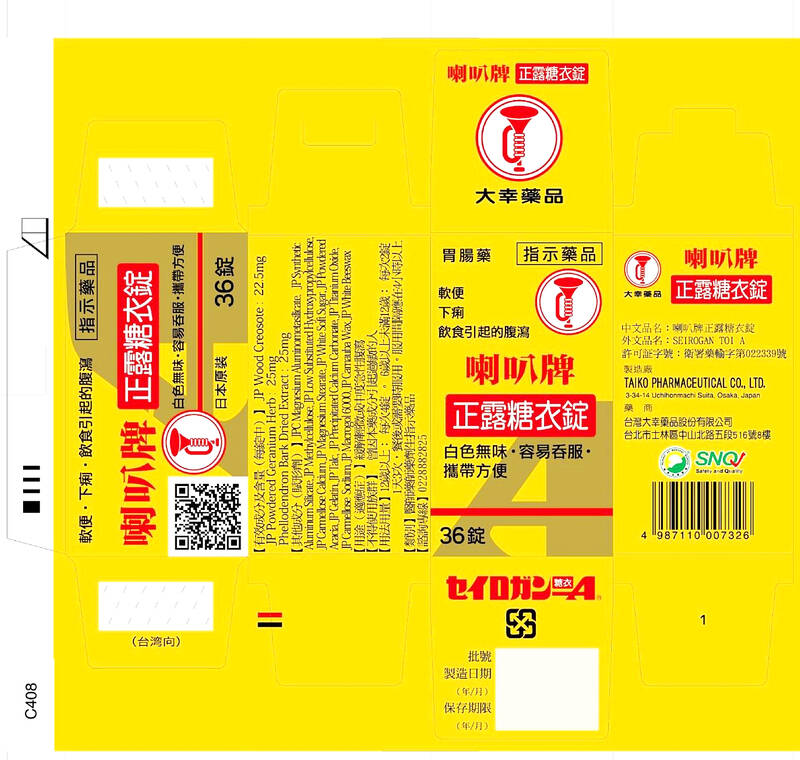
Photo courtesy of the Food and Drug Administration
The Seirogan Toi-A tablets are imported by Taiwan Taiko Pharmaceutical Co Ltd, and are used for the treatment of mild or moderate acute diarrhea and abnormal movement of the intestinal tract. They include three main APIs, including dried phellodendron bark extract.
The FDA said it issued a notice on Wednesday last week recalling the Seirogan Toi-A tablets from batch No. 41RM2, consisting of 374,328 tablets packaged as 24 tablets per box (4,437 boxes) and 36 tablets per box (7,440 boxes).
Hospitals and pharmacies have been informed to stop providing tablets from the batch, while Taiwan Taiko Pharmaceutical Co has been asked to recall the batch before Oct. 27, and to submit a report on its recall results and its follow-up preventive measures, the FDA said.
Meanwhile, the FDA yesterday urged people not to use drugs arbitrarily, saying that they are not a general commodity that can be casually acquired and used.
FDA Medical Products Division deputy head Wu Ming-mei (吳明美) said that some people are used to purchasing drugs on their own when ill, and sometimes friends and family provide leftover drugs from a previous illness.
There are also counterfeit or illegal drugs being sold on online platforms that are often delivered from other countries, she said, adding that according to the Pharmaceutical Affairs Act (藥事法), offenders that manufacture or import fake or illegal drugs could face up to 10 years in prison or a fine up to NT$100 million (US$3.09 million).
FDA Medical Products Division senior specialist Yang Bo-wen (楊博文) said the agency suggests that people avoid improper drug use including believing in other people’s recommendations about the miraculous effects of certain drugs, and instead to seek medical attention or ask a pharmacist.
People should avoid buying drugs from unknown sources and drugs that are not prescribed by doctors, Yang said, adding that they should avoid discontinuing use of prescription drugs on their own; sharing drugs with other people; and hoarding leftover ones.

NATIONAL SECURITY: Authorities are working to confirm the identities of the military personnel involved and investigating possible illegal conduct and regulatory violations Authorities are probing possible national security implications after Kinmen police and immigration officers on Sunday found a Chinese woman allegedly posing as a tourist while engaging in prostitution involving more than 10 military personnel. The woman, surnamed Chen (陳), has since been deported, authorities said, adding that investigators are still working to confirm the identities of those implicated, as the records only listed code names and aliases. The case stemmed from a report received by the Kinmen District Prosecutors’ Office on Friday last week from the Jinhu Precinct of the Kinmen County Police Bureau. On Sunday, police, along with the National Immigration

GLOBALGIVING: ‘ Caving to external pressure is not acceptable for an organization that has cultivated justice reform and human rights for 30 years,’ one NGO said A slew of non-government organizations (NGOs) have withdrawn from the GlobalGiving fundraising platform after it announced it would use “Chinese Taipei” instead of “Taiwan” from next month. The Taiwan Good Rice Association wrote on Facebook on Friday that it was informed on April 28 via a teleconference call of the change, which was made because the platform wanted to operate in China. Taiwan Good Rice is to terminate all cooperative relationships with GlobalGiving in response to the platform’s “unilateral and non-negotiable” decision to remove references to Taiwan, the NGO said. “Taiwan is in the official name of Taiwan Good Rice Association and the

HEAVY WEATHER: Typhoon Jangmi is due to crash straight into the Ryukyus as airlines look to shift flights to larger aircraft or cancel flights to Okinawa entirely Taiwan’s international air carriers announced flight adjustments over the weekend as Typhoon Jangmi is forecast to hit the Ryukyu Islands today and tomorrow. The Central Weather Administration (CWA) upgraded Jangmi from a tropical storm to a typhoon at 8am yesterday, with the eye located 580km south of Naha city. It was moving north at 19kph. Today, China Airlines’ CI-120, CI-121, CI-122 and CI-123 flights between Taoyuan and Naha, Okinawa, have been canceled as well as CI-132 and CI-133 between Kaohsiung and Naha. EVA Air’s BR-112, BR-113, BR-186 and BR-185 flights between Taoyuan and Naha are also canceled. Low-cost carrier Tigerair Taiwan canceled IT-230,

Chinese Nationalist Party (KMT) Chairwoman Cheng Li-wun (鄭麗文) yesterday briefed her party’s Central Standing Committee regarding her scheduled visit to the US between Monday next week and June 16, saying that her purpose would be to persuade the US that the Republic of China (ROC) Constitution was a “one China” constitution that would foster stable and peaceful cross-strait relations. The ROC Constitution is the most important defense for all Taiwanese citizens, as it upholds our democracy and has contributed to our robust economy, which aligns with international and US interests, she said. “We would not be troublemakers and drag the US under,”


 RSS
RSS