


Pictures of wheel cakes (車輪餅), a popular pastry in Taiwan, have been plastered on French social media accounts for the past few months, including posts by Paris-based influencers.
Wheel cakes evolved from imagawayaki, a Japanese pastry, during 50 years of colonization and have taken on a unique Taiwanese identity.
French daily Le Monde led reporting on the rising popularity of the snacks in France, following in the wake of bubble tea as the next Taiwanese snack fad.
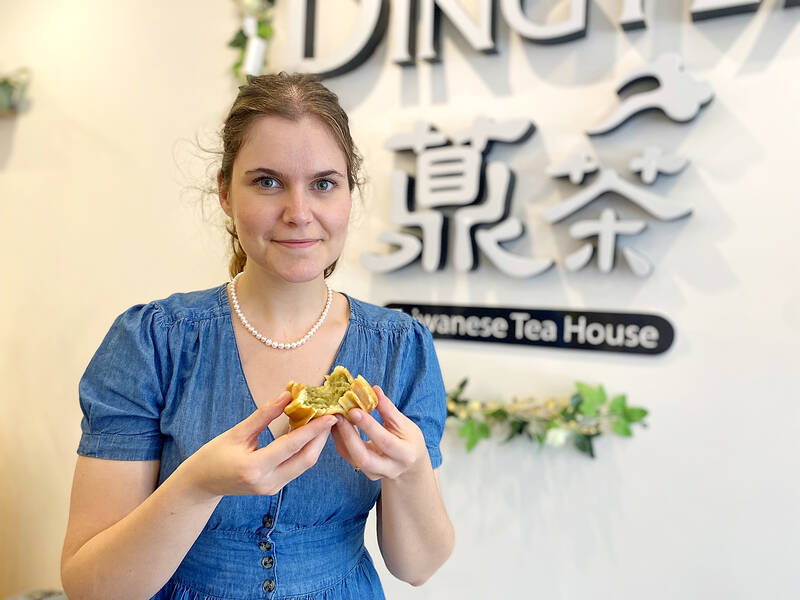
Photo: CNA
“Wheel cakes are a tradition after classes are over in elementary school in Taiwan,” Paris resident Chang Chiao-wei (張巧薇) said. “The practice is probably true for most Taiwanese.”
Chang is the Taiwanese owner of Parisian wheel cake boutique Ciao Roue, which Le Monde reported on after it began offering the Taiwanese snacks, which are a filled dessert made from a waffle-like batter cooked in cast iron pans.
Chang said that she loves wheel cakes and often introduces the “childhood snack for Taiwanese” to customers.
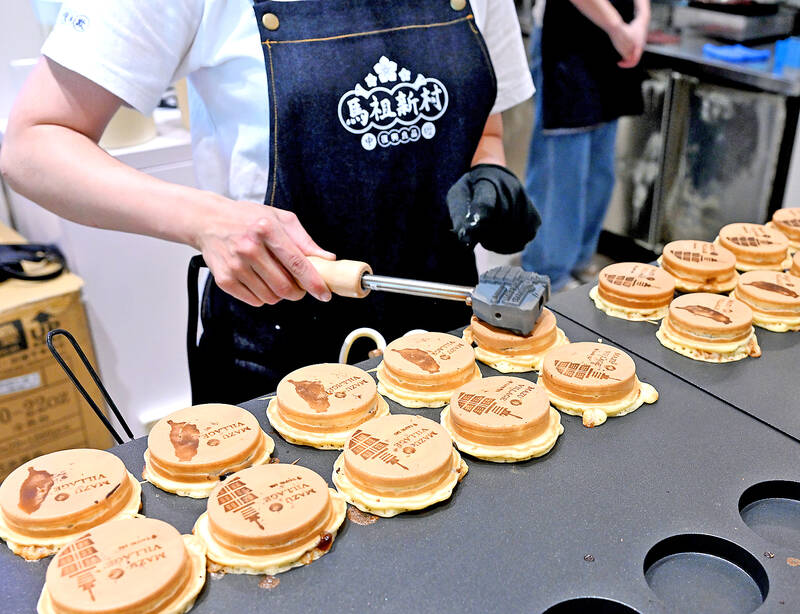
Photo: Taipei Times
She opened her shop in March last year because she wanted to build a place that would inspire childhood memories in her customers, one that brings back an aromatic sense of warmth and comfort, she said.
“My customers often say they want to visit Taiwan, which makes me proud to think that I helped with diplomatic outreach,” she said.
The Le Monde article that featured Ciao Rue invigorated influencers to visit the eatery, likely because the shape, size and fillings of wheel cakes are picture-perfect for social media.
The first wheel cakes in France were from Simplify, a shop opened by Taiwanese entrepreneur Lu Shu-yu (呂叔優) in May 2021.
Lu said she made the switch from working in tech to opening an eatery in the suburbs of Paris because she heard that French believed Taiwan does not have its own signature desserts.
There are many Taiwanese expats living in Paris who aim to promote Taiwanese cuisine across the country, she said.
“We wanted to feature something different so they [French] learn a little more about Taiwan’s food culture,” Lu said. “No one was making wheel cakes then, so we thought we’d cultivate the market first.”
Lu opened a second location, called Simplify Plus, in Paris in February.
“We can establish a new Taiwan specialty,” Lu said. “The reason we decided to open a branch in Paris is because we think it will lead to a new wave of fads.”
There are two or three new wheel cake shops in the works, Lu said.
Julie Van Dang, a Vietnamese who has lived in France for 20 years, backed up Lu’s comment.
Dang manages bubble tea franchise Ding Tea in Paris and started selling wheel cakes after patrons inquired about snacks that could be paired with bubble tea.
“More and more people are now familiar with Taiwanese culture,” Dang said.
“Taiwanese shops, restaurants and bubble tea houses keep popping up, which highlight both the market potential and the interest the French have for Taiwanese products,” she added.

Considering that most countries issue more than five denominations of banknotes, the central bank has decided to redesign all five denominations, the bank said as it prepares for the first major overhaul of the banknotes in more than 24 years. Central bank Governor Yang Chin-lung (楊金龍) is expected to report to the Legislative Yuan today on the bank’s operations and the redesign’s progress. The bank in a report sent to the legislature ahead of today’s meeting said it had commissioned a survey on the public’s preferences. Survey results showed that NT$100 and NT$1,000 banknotes are the most commonly used, while NT$200 and NT$2,000

The Centers for Disease Control (CDC) yesterday reported the first case of a new COVID-19 subvariant — BA.3.2 — in a 10-year-old Singaporean girl who had a fever upon arrival in Taiwan and tested positive for the disease. The girl left Taiwan on March 20 and the case did not have a direct impact on the local community, it said. The WHO added the BA.3.2 strain to its list of Variants Under Monitoring in December last year, but this was the first imported case of the COVID-19 variant in Taiwan, CDC Deputy Director-General Lin Ming-cheng (林明誠) said. The girl arrived in Taiwan on

South Korea is planning to revise its controversial electronic arrival card, a step Taiwanese officials said prompted them to hold off on planned retaliatory measures, a South Korean media report said yesterday. A Yonhap News Agency report said that the South Korean Ministry of Foreign Affairs is planning to remove the “previous departure place” and “next destination” fields from its e-arrival card system. The plan, reached after interagency consultations, is under review and aims to simplify entry procedures and align the electronic form with the paper version, a South Korean ministry official said. The fields — which appeared only on the electronic form

The Ministry of Foreign Affairs (MOFA) is suspending retaliation measures against South Korea that were set to take effect tomorrow, after Seoul said it is updating its e-arrival system, MOFA said today. The measures were to be a new round of retaliation after Taiwan on March 1 changed South Korea's designation on government-issued alien resident certificates held by South Korean nationals to "South Korea” from the "Republic of Korea," the country’s official name. The move came after months of protests to Seoul over its listing of Taiwan as "China (Taiwan)" in dropdown menus on its new online immigration entry system. MOFA last week


 RSS
RSS