


The Ministry of National Defense has completed the marksmanship refresher summer course for reservists, sources familiar with the matter said yesterday.
The refresher courses are conducted separately at the military’s regional basic training centers in Miaoli County, Taichung, Kaohsiung and Hualien County, with each event lasting a day and held on a Friday earlier this month, the sources said.
Reservists who left the service in the past 12 years could voluntarily pay NT$220 to take part in the course, but must make their own travel arrangements, they said.
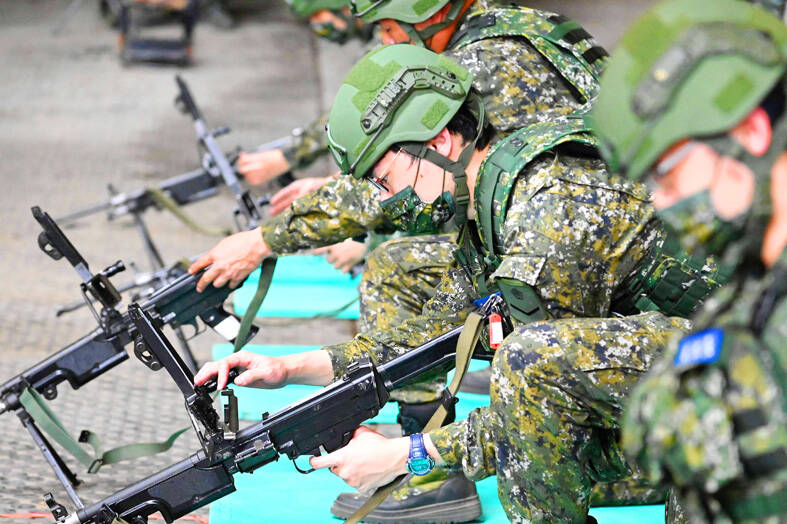
Photo: Sam Yeh, AFP
Participants were each given the latest combat uniform and a T-91 rifle, which they had to carry at all times and use in shooting and weapon maintenance drills, the sources said.
The courses, which were carried out with instructions from active service troops, included simulator training, manual exercises, shooting fundamentals, live-fire target practice at 25m, 75m, 175m and 300m, and an applied marksmanship certification drill at 175m, they said.
Each reservist fired 67 rounds through the course of the exercise, the sources said.
Trainees used a variety of shooting stances including the standing, half-kneel and prone positions, instead of shooting only from the prone position as was done traditionally, they said, adding that this change would increase soldier proficiency and adaptability.
The main challenges to the efficiency of the military’s refresher training program are a lack of suitable facilities and bottlenecks in the training pipeline, Institute for National Defense and Security Research analyst Hsu Chih-hsiang (許智翔) said.
The structural problem with insufficient training capacity is well-known, but lengthening the term of military service is sure to increase the pressure on the system, he said.
Taiwanese armed forces should expand the refresher courses to include the handling of light and medium machine guns, small unit tactics, simple anti-tank weapons and man-portable air defense systems, Hsu said.
Eligibility requirements should include older reservists if sign-up levels permit, Hsu added.
Democratic Progressive Party Legislator Lin Ching-yi (林靜儀), who observed one training session on Aug. 11 in Taichung, said she saw the participants were in good spirits and that some of them were women or had taken leave from work.
However, the Ministry of National Defense did not promote the refresher courses enough to get the message out to the public, she said, adding that defense officials should discuss ways of improving the program with lawmakers at the earliest opportunity.
Yunlin National Defense Education Association president Wang Shen-yuan (王伸元), who took part in the refresher course, said rising cross-strait tensions motivated many reserve soldiers to resharpen their skills.
The novel techniques taught in the applied marksmanship part of the training have been particularly instructive for reservists, he said.
The ministry should open more refresher training courses for a broader array of skills to get most of the popular support for the military, he said.

FUKUOKA SITUATION: Japanese media reported that the pathogen is expected to be identified by the summer, while the CDC downplayed the idea that it was hMPV A “mysterious cold-like illness” reported in Japan’s Fukuoka Prefecture does not seem to be a new disease, but Japanese authorities have been asked about the situation, the Centers for Disease Control (CDC) said yesterday. The Fukuoka Prefectural Medical Association on Wednesday told a news conference that a “mystery cold” that has become a hot topic on social media is “highly likely to be caused by some kind of viral infection,” Japan’s KBC News reported. “Many people are experiencing symptoms starting with a sore throat, followed by a runny nose, phlegm and a severe cough,” KBC News reported, citing association officials. Health authorities are

Nvidia Corp CEO Jensen Huang (黃仁勳) arrived in Taiwan yesterday ahead of upcoming AI and technology events, saying he plans to meet with clients and Taiwan Semiconductor Manufacturing Co Chairman C.C. Wei (魏哲家) during his visit. After landing at Taipei Songshan Airport, Huang posed for photos with fans and handed out Yakult drinks to reporters and supporters waiting at the scene, saying he has “a lot to do” during the trip. Asked about reports that Nvidia’s planned headquarters site in Taipei’s Beitou Shilin Technology Park could break ground on May 27, Huang said that if the company holds an event, he would

Carrefour Taiwan is to begin using a new name from the start of July, but it cannot divulge the name until then, the chairman of the supermarket chain's parent company said today. President Chain Store Co chairman Lo Chih-hsien (羅智先) was asked by reporters after a shareholders' meeting to confirm whether the company has settled on a new name for the supermarket brand. In March, the government-registered name of two Carrefour Taiwan branches was quietly changed to "Le Chia Kang" (樂家康) in Chinese, raising speculation that has been selected as the name. Lo said that because of local regulations and contractual obligations, the

The Philippines would likely be involved in any conflict over Taiwan due to its proximity to the democracy claimed by China, President Ferdinand Marcos Jr said, reiterating a stance that risks angering Beijing. “In the Philippines, we do not have a choice because Taiwan is so close to the Philippines and we have almost 200,000 Filipino nationals living and working in Taiwan,” Marcos said in an interview with Japanese media in Manila on Monday. The Philippine leader’s comments come ahead of a state visit to Japan next week, where he is to meet with Japanese Prime Minister Sanae Takaichi to discuss security


 RSS
RSS