


Chinese President Xi Jinping (習近平) underestimates the “devastating” impact conflict in the Taiwan Strait would have on his own power, as well as on China and the world, a former US intelligence director said on Monday, calling on the US to assure China of its support for the “status quo” on Taiwan to prevent conflict.
Former rear admiral Mike Studeman, a former commander of the US Office of Naval Intelligence and former director of the US National Maritime Intelligence Integration Office, made the comments at a Hudson Institute forum titled “A Requiem for Dominance: New US Strategies to Deter Aggression.”
“I think that if [Xi] tries to go after Taiwan, ultimately what will ensue will lead to the downfall of the chairman and the party secretary. And I think he underestimates this,” said Studeman, who retired last month from a career that involved visits to Taiwan in 2020 and last year.
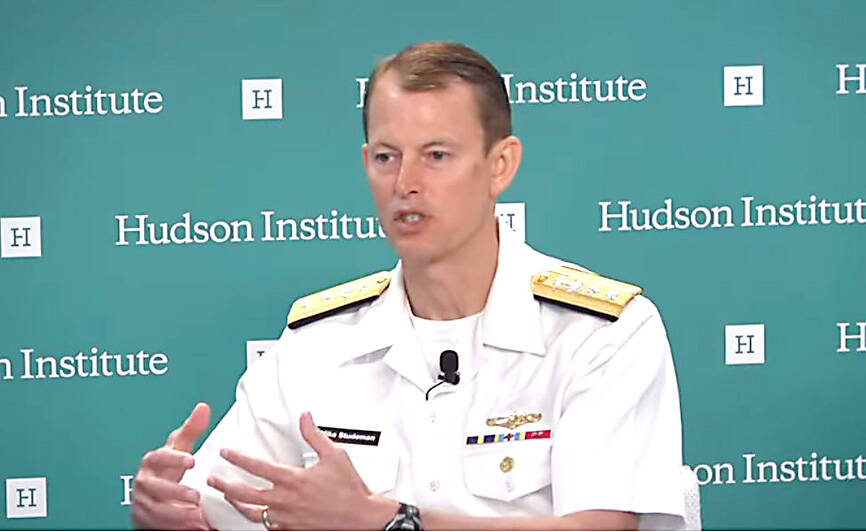
Photo: screen grab from Hudson Institute’s YouTube channel
As simulations show there would be no winner in a Taiwan Strait conflict, the US should focus on prevention, he said.
A prevention strategy includes having the capability to prevail in a conflict, but “at the same time, a lot of our efforts need to go into the shaping elements” to influence the kinds of actions taken, disincentivizing the most extreme moves, he added.
From Beijing’s perspective, it appears as though the US is walking away from its “one China” policy and Taiwan is moving toward de jure independence, but it never sees itself as being the cause of such actions, Studeman said.
“China doesn’t see that they’re at fault. What they just see is all these actions that are designed to contain them ... and they push harder,” he said.
Beijing’s unusual perception and closed authoritarian system then make it difficult to shape its actions, he said.
“Sometimes your best tool is not a big military platform or something made of steel,” he said. “That needs to be complementary to ... not integrated deterrence, but integrated assurance” that the US is not doing anything to change the “status quo” on Taiwan.
“If [China’s leaders] do not believe that we are in a ‘status quo’ environment, then we have a problem,” he said.
The desired outcome is to make Xi certain that action on Taiwan would elicit an international response that would scupper all of his other goals and desired legacy, Studeman added.
Yet communication between Beijing and the US has all but ceased, hampering US “shaping” influence and increasing the potential for misunderstanding.
“In Asia today there’s a lot of dry grass, so the potential for one spark to get spreading sooner is much higher if you don’t have the ability to shower cold water on it,” Studeman said.

Considering that most countries issue more than five denominations of banknotes, the central bank has decided to redesign all five denominations, the bank said as it prepares for the first major overhaul of the banknotes in more than 24 years. Central bank Governor Yang Chin-lung (楊金龍) is expected to report to the Legislative Yuan today on the bank’s operations and the redesign’s progress. The bank in a report sent to the legislature ahead of today’s meeting said it had commissioned a survey on the public’s preferences. Survey results showed that NT$100 and NT$1,000 banknotes are the most commonly used, while NT$200 and NT$2,000

The Centers for Disease Control (CDC) yesterday reported the first case of a new COVID-19 subvariant — BA.3.2 — in a 10-year-old Singaporean girl who had a fever upon arrival in Taiwan and tested positive for the disease. The girl left Taiwan on March 20 and the case did not have a direct impact on the local community, it said. The WHO added the BA.3.2 strain to its list of Variants Under Monitoring in December last year, but this was the first imported case of the COVID-19 variant in Taiwan, CDC Deputy Director-General Lin Ming-cheng (林明誠) said. The girl arrived in Taiwan on

South Korea is planning to revise its controversial electronic arrival card, a step Taiwanese officials said prompted them to hold off on planned retaliatory measures, a South Korean media report said yesterday. A Yonhap News Agency report said that the South Korean Ministry of Foreign Affairs is planning to remove the “previous departure place” and “next destination” fields from its e-arrival card system. The plan, reached after interagency consultations, is under review and aims to simplify entry procedures and align the electronic form with the paper version, a South Korean ministry official said. The fields — which appeared only on the electronic form

The Ministry of Foreign Affairs (MOFA) is suspending retaliation measures against South Korea that were set to take effect tomorrow, after Seoul said it is updating its e-arrival system, MOFA said today. The measures were to be a new round of retaliation after Taiwan on March 1 changed South Korea's designation on government-issued alien resident certificates held by South Korean nationals to "South Korea” from the "Republic of Korea," the country’s official name. The move came after months of protests to Seoul over its listing of Taiwan as "China (Taiwan)" in dropdown menus on its new online immigration entry system. MOFA last week


 RSS
RSS