


An initial agreement reached under the US-Taiwan Initiative on 21st-Century Trade was unanimously approved by six legislative committees at an extraordinary session yesterday.
On June 1, Taiwan and the US signed the first set of terms under the initiative, covering general principles related to customs and border procedures, regulatory practices and small businesses, which the two sides hope would facilitate bilateral trade and investment.
Under the agreement, which does not cover tariff reductions or exemptions, Taiwan and the US committed to facilitate bilateral trade and investment flows, promote anti-corruption measures, minimize unnecessary border formalities and encourage the development of small and medium-sized enterprises.
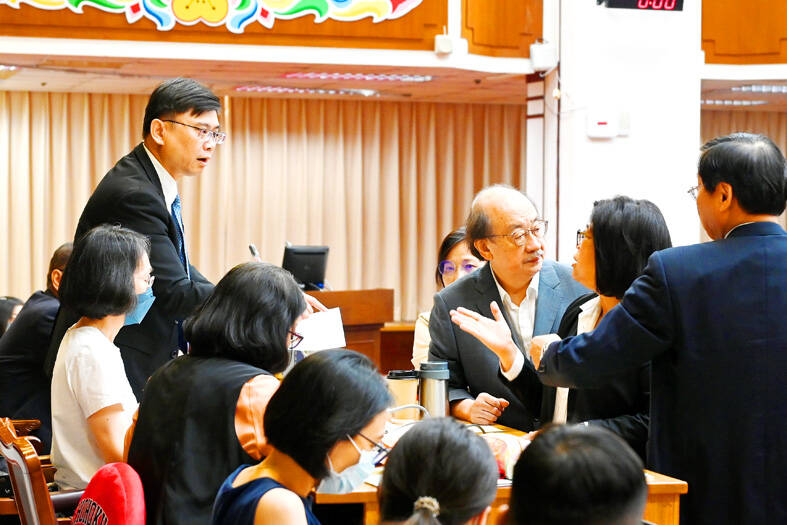
Photo: Wang Yi-sung, Taipei Times
It also stipulated the establishment of a “foundation” to enable both sides to address trade and investment challenges and opportunities.
The Legislative Yuan, which is holding an extraordinary session from Monday last week to Monday next week, completed committee discussions and a review of the agreement on Thursday last week.
Lawmakers yesterday approved the agreement at a joint meeting of six legislative committees, including the Economics, Internal Administration and Finance committees. It is now to be submitted to the full legislature for consideration.
Democratic Progressive Party caucus convener Ker Chien-ming (柯建銘) said the US-Taiwan Initiative on 21st-Century Trade is important because it is good for the country, relations between the two sides and national development.
The legislature approved a proposal by Chinese Nationalist Party (KMT) lawmakers that called on the Cabinet and government agencies to get feedback from legislators, experts and stakeholders before reaching an agreement on the remaining items under discussion.
As the initiative would henceforth focus on more sensitive topics, such as labor, environmental and agricultural issues, the Cabinet should make the details of discussions on those issues public, while taking into consideration the opinions of lawmakers, KMT caucus whip William Tseng (曾銘宗) said.
The aim is to make the deal more complete and beneficial to local businesses and Taiwan’s economic development, he said.
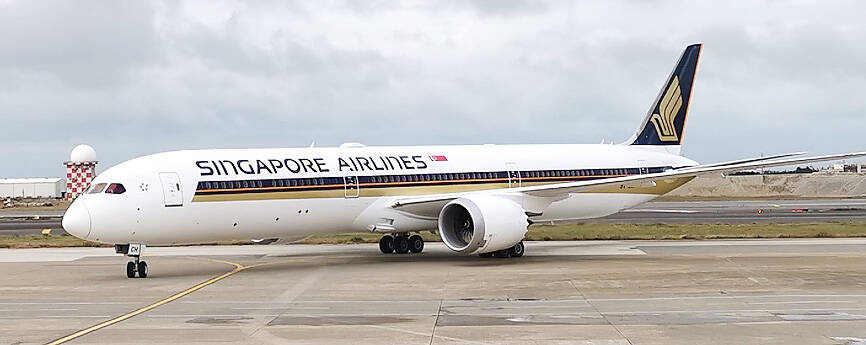
INCREASED CAPACITY: The flights on Mondays, Wednesdays, Fridays and Sundays would leave Singapore in the morning and Taipei in the afternoon Singapore Airlines is adding four supplementary flights to Taipei per week until May to meet increased tourist and business travel demand, the carrier said on Friday. The addition would raise the number of weekly flights it operates to Taipei to 18, Singapore Airlines Taiwan general manager Timothy Ouyang (歐陽漢源) said. The airline has recorded a steady rise in tourist and business travel to and from Taipei, and aims to provide more flexible travel arrangements for passengers, said Ouyang, who assumed the post in July last year. From now until Saturday next week, four additional flights would depart from Singapore on Monday, Wednesday, Friday
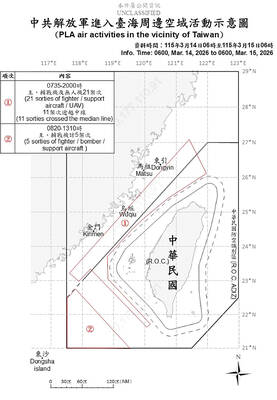
The Ministry of National Defense yesterday reported the return of large-scale Chinese air force activities after their unexplained absence for more than two weeks, which had prompted speculation regarding Beijing’s motives. China usually sends fighter jets, drones and other military aircraft around the nation on a daily basis. Interruptions to such routine are generally caused by bad weather. The Ministry of National Defense said it had detected 26 Chinese military aircraft in the Taiwan Strait over the previous 24 hours. It last reported that many aircraft on Feb. 25, when it spotted 30 aircraft, saying Beijing was carrying out another “joint combat

Taiwan successfully defended its women’s 540 kilogram title and won its first-ever men’s 640 kg title at the 2026 World Indoor Tug of War Championships in Taipei yesterday. In the women’s event, Taiwan’s eight-person squad reached the final following a round-robin preliminary round and semifinals featuring teams from Ukraine, Japan, Thailand, Vietnam, the Basque Country and South Korea. In the finals, they swept the Basque team 2-0, giving the team composed mainly of National Taiwan Normal University students and graduates its second championship in a row, and its fourth in five years. Team captain
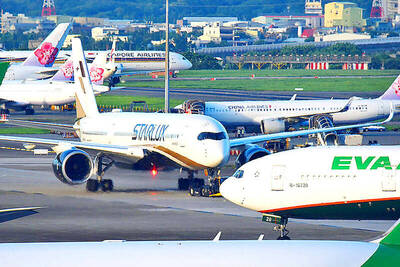
Taiwan’s three major international carriers are increasing booking fees, with EVA Airways having already increased the charge to US$28 per flight segment from US$25, while China Airlines (CAL) and Starlux Airlines are set to follow suit. Booking fees are charged by airlines through a global distribution system (GDS) and passed on to passengers. Carriers that apply the fees include CAL, EVA, Starlux and Tigerair Taiwan. A GDS is a computerized network operated by a company that connects airlines with travel agents and ticketing platforms, allowing reservations to be made and processed in real time. Major players include Amadeus, Sabre and Travelport. EVA Air began


 RSS
RSS