


As Taiwan’s molding and sculpture factories have gradually moved to China, and the skills of older masters are becoming lost among the younger generation, a group of action figure and collectable toy prototype designers in Taiwan who have been striving to preserve the hand-carving and molding skills, have reopened workshops, and they rebuilding Taiwan’s reputation by showing its works at major international toy fairs and expos.
Founding member and chief supervisor of Taiwan Sculptor Association, Lee Yong-cheng (李永丞), said that all products need an actual sample before going into mass production, and that the designer of the “prototype” of a thermos cup, a smartphone or a lamp is called an industrial designer or product developer.
In the past, a prototype designer for toys, action or model figures usually carved the prototype sample by hand, but with advanced technology, some also use 3D printing to make the sample models, he said, adding that the association has about 50 to 60 members, and more than 10,000 followers on its Facebook page.
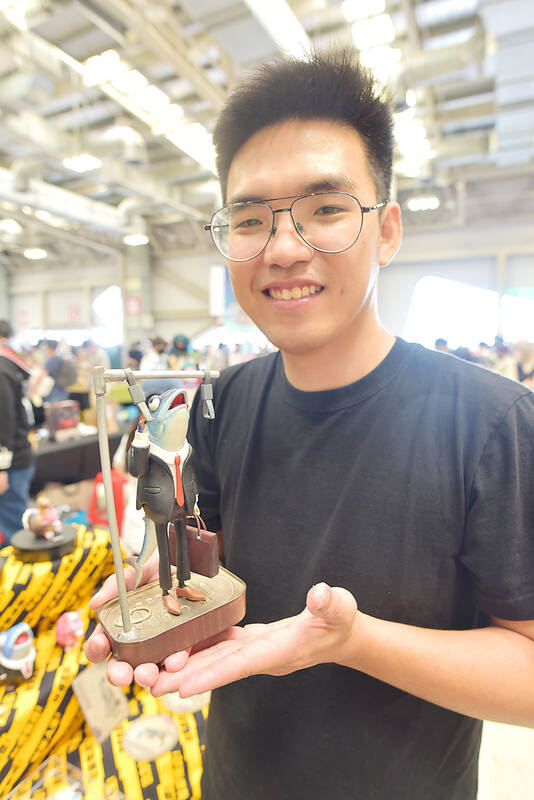
Photo: Wu Po-hsuan, Taipei Times
Another founding member, Yu Heng-hsin (余恒興), said a prototype designer’s work involves drawing, sculpting, understanding the human body structure, anatomy and biology. Yu added that in Taiwan there was an industry of molding, manufacturing, painting and exporting model figures, but it gradually moved to China about 20 years ago, so the traditional skills of clay sculpture and molding have withered.
However, about ten years ago, convenience stores began launching points-based rewards systems, allowing consumers to redeem points for toys, and a trend of collecting action figure and collectable toys began in the US and Japan, so a new generation of prototype designers stepped into the job, he said.
Unfortunately, the prototype designers in Taiwan only design the samples, and the products are produced in China, but as the labor cost in China has also been increasing in the last few years, some factories have moved to Southeast Asian countries, he added.
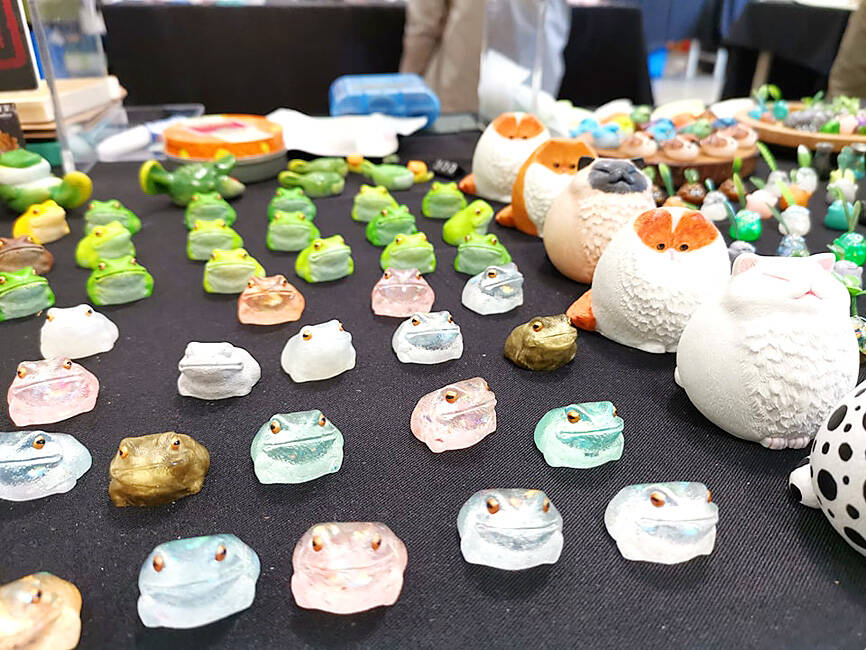
Photo: Wu Po-hsuan, Taipei Times
In view of this situation, Yu last year established a base factory in Taiwan, with the youngest employee being 43 years old. He said he had to train all employees, as no school departments teach the skills, but with his heart set on passing down Taiwan’s handicraft, he plans to gather other designers and together attend major international toy fairs and expos to promote Taiwanese brands next year.
Fancy Frontier exhibition project manager Tseng Jung-pei (曾蓉珮) said Taiwan began a platform to display prototype action figures and toys, and with the annual Taipei Toy Festival gathering people with the same hobbies, the designers established an association and held competitions. The Fancy Frontier competition has been held for the past 10 years, attracting many creators who have exhibited works of a wide range of styles.
The model figures and toys include crayfishes, bronze-like monsters, round animals and a working man with a salted-fish head.
The 47-year-old Yu said before becoming a toy figure prototype designer, he worked as an art designer at a comic publishing house and a game company, and later at a construction company that designed the National Museum of Marine Biology and Aquarium, where he became interested in crayfishes.
As he has never forgotten the challenge and sense of achievement of “turning something into a 3D object,” he left a 3D printing company last year and founded a workshop (甲霸研究所) to materialize his love for crayfish into toy figures called Crayfish Monster World (螯蝦怪基斯).
Prototype designer Jiang Ting-wei (江庭威), founder of the Partner Toys workshop, said he became a prototype designer nine years ago because he loves animals, but could not keep them as pets, so he made them into model figures, and his works are mainly living creatures, that are characterized by being “round and cute.”
Prototype designer Tu Hsun (圖勳), founder of Hsun Craft Studio, said he began designing toy figures about seven years ago. His creations used to be derivative work of monsters and game characters, but he recently created his own brand of monsters inspired by the artistic styles of the Bronze Age in China.
Cheng Chao-yu (鄭超宇), a 30-year-old new prototype designer, said he has an educational background in the fine arts. He started trying 3D printing in the past two years, and has attended some model figure competitions.
His main creation is called “Salted Fish Life (鹹魚人生),” depicting the wary life of an office worker, trying to survive in a big city, he said, adding that he hopes people who buy his toy figures would feel as if they have a salted-fish man accompanying them when they are working overtime.
Trips for more than 100,000 international and domestic air travelers could be disrupted as China launches a military exercise around Taiwan today, Taiwan’s Civil Aviation Administration (CAA) said yesterday. The exercise could affect nearly 900 flights scheduled to enter the Taipei Flight Information Region (FIR) during the exercise window, it added. A notice issued by the Chinese Civil Aviation Administration showed there would be seven temporary zones around the Taiwan Strait which would be used for live-fire exercises, lasting from 8am to 6pm today. All aircraft are prohibited from entering during exercise, it says. Taipei FIR has 14 international air routes and
Taiwan lacks effective and cost-efficient armaments to intercept rockets, making the planned “T-Dome” interception system necessary, two experts said on Tuesday. The concerns were raised after China’s military fired two waves of rockets during live-fire drills around Taiwan on Tuesday, part of two-day exercises code-named “Justice Mission 2025.” The first wave involved 17 rockets launched at 9am from Pingtan in China’s Fujian Province, according to Lieutenant General Hsieh Jih-sheng (謝日升) of the Office of the Deputy Chief of the General Staff for Intelligence at the Ministry of National Defense. Those rockets landed 70 nautical miles (129.6km) northeast of Keelung without flying over Taiwan,
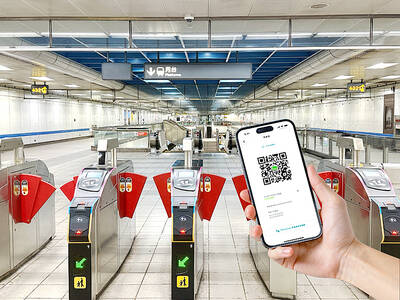
City buses in Taipei and New Taipei City, as well as the Taipei MRT, would on Saturday begin accepting QR code payments from five electronic payment providers, the Taipei Department of Transportation said yesterday. The new option would allow passengers to use the “transportation QR code” feature from EasyWallet, iPass Money, iCash Pay, Jkopay or PXPay Plus. Passengers should open their preferred electronic payment app, select the “transportation code” — not the regular payment code — unlock it, and scan the code at ticket readers or gates, General Planning Division Director-General Liu Kuo-chu (劉國著) said. People should move through the
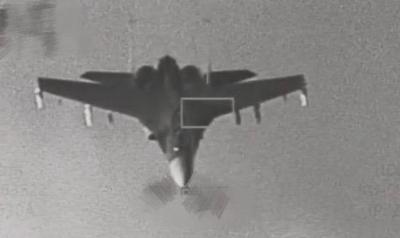
The Ministry of National Defense (MND) today released images of the military tracking China’s People's Liberation Army (PLA) movements during the latest round of Chinese drills around Taiwan. The PLA began "Justice Mission 2025" drills today, carrying out live-fire drills, simulated strikes on land and maritime targets, and exercises to blockade the nation's main ports. The exercises are to continue tomorrow, with the PLA announcing sea and air space restrictions for five zones around Taiwan for 10 hours starting from 8:30am. The ministry today released images showing a Chinese J-16 fighter jet tracked by a F-16V Block 20 jet and the


 RSS
RSS