


The Fisheries Research Institute on Friday said it had completed an experiment to artificially inseminate narrow-barred Spanish mackerels at sea, successfully reproducing fries.
The institute said it would continue to develop technology geared toward raising the mackerels and making the fish a flagship product for Taiwan.
The narrow-barred Spanish mackerel is a migratory species and has long been a favorite among Taiwanese.
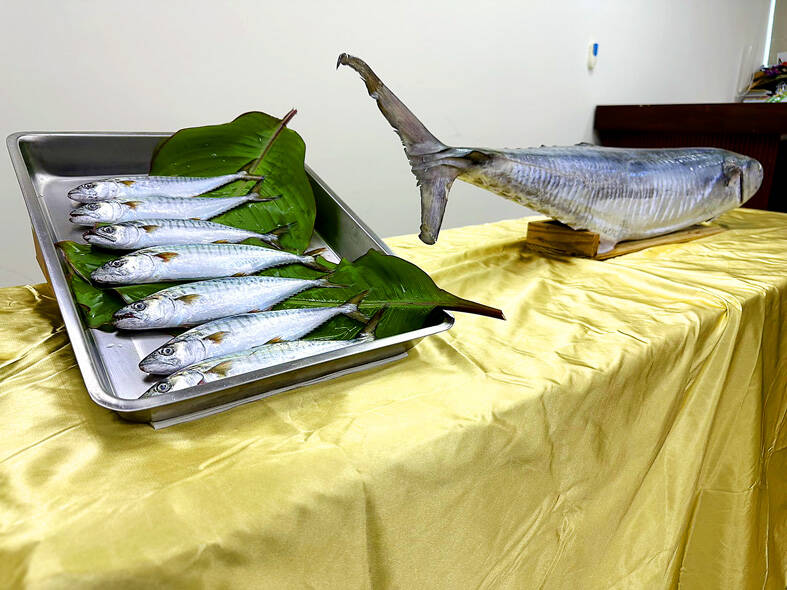
Photo: Yang Yuan-ting, Taipei Times
However, due to changes in the maritime environment, the total catch around Taiwan has dropped from 3,200 tonnes in 2001 to about 500 tonnes last year.
The increasing scarcity of the mackerels has driven the price to NT$1,300 per kilogram, the institute said, adding that the price tends to spike around Lunar New Year, reaching about NT$1,500 per kilogram.
Other countries, such as Japan and Saudi Arabia, have also considered developing the technology to artificially inseminate the narrow-barred Spanish mackerel.
However, the fish, which has proved to be aggressive and has no scales to protect it, often failed to live long enough after leaving the water, it said, making it very difficult to extract its gonads, the Littoral Marine Resource Research Center director Weng Chin-hsing (翁進興) said.
The institute, working with fishers in Penghu County, has captured the fish and obtained its gonads, he said.
The fry grew to 7 to 15cm within 45 days, the center said.
While artificial insemination was successful, the center found that the fries were extraordinarily aggressive and would attempt to eat other fries in the group it said, adding that the fish developed teeth as early as their fifth day.
With its larger pool, a Tainan facility had achieved a 0.2 percent survival rate for the fry, Weng said, adding that the center hoped to increase the survival rate to 50 to 70 percent.
Institute director Chang Chin-yi (張錦宜) said that it would trial a project to raise 10cm narrow-barred Spanish mackerel fry off Penghu County in an attempt to repopulate the species.
Chang added that net cages would be the ideal method of raising the fish.
The captain of the Peng Shan No. 100, Tsai Tsung-wei (蔡宗衛), who helped the institute with its experiments, said three generations of his family had been fishers in the Penghu area, adding that he remembered in his grandfather’s time, the narrow-barred Spanish mackerel population in the area had already decreased.
He is helping the institute in the hope of restoring the fish population in the area and allowing mackerel catches to make his vocation sustainable, he said.
Additional reporting by CNA
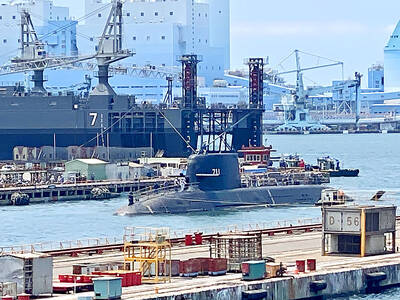
AGING: While Japan has 22 submarines, Taiwan only operates four, two of which were commissioned by the US in 1945 and 1946, and transferred to Taiwan in 1973 Taiwan would need at least 12 submarines to reach modern fleet capabilities, CSBC Corp, Taiwan chairman Chen Cheng-hung (陳政宏) said in an interview broadcast on Friday, citing a US assessment. CSBC is testing the nation’s first indigenous defense submarine, the Hai Kun (海鯤, Narwhal), which is scheduled to be delivered to the navy next month or in July. The Hai Kun has completed torpedo-firing tests and is scheduled to undergo overnight sea trials, Chen said on an SET TV military affairs program. Taiwan would require at least 12 submarines to establish a modern submarine force after assessing the nation’s operational environment and defense

A white king snake that frightened passengers and caused a stir on a Taipei MRT train on Friday evening has been claimed by its owner, who would be fined, Taipei Rapid Transit Corp (TRTC) said yesterday. A person on Threads posted that he thought he was lucky to find an empty row of seats on Friday after boarding a train on the Bannan (Blue) Line, only to spot a white snake with black stripes after sitting down. Startled, he jumped up, he wrote, describing the encounter as “terrifying.” “Taipei’s rat control plan: Release snakes on the metro,” one person wrote in reply, referring
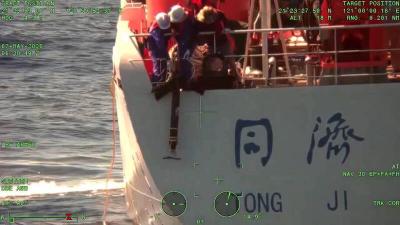
The coast guard today said that it had disrupted "illegal" operations by a Chinese research ship in waters close to the nation and driven it away, part of what Taipei sees a provocative pattern of China's stepped up maritime activities. The coast guard said that it on Thursday last week detected the Chinese ship Tongji (同濟號), which was commissioned only last year, 29 nautical miles (54km) southeast of the southern tip of Taiwan, although just outside restricted waters. The ship was observed lowering ropes into the water, suspected to be the deployment of scientific instruments for "illegal" survey operations, and the coast

Taiwan’s two cases of hantavirus so far this year are on par with previous years’ case numbers, and the government is coordinating rat extermination work, so there should not be any outbreaks, Centers for Disease Control (CDC) Director-General Philip Lo (羅一鈞) said today in an interview with the Liberty Times (the Taipei Times’ sister newspaper). An increase in rat sightings in Taipei and New Taipei City has raised concerns about the spread of hantavirus, as rats can carry the disease. In January, a man in his 70s who lived in Taipei’s Daan District (大安) tested positive posthumously for hantavirus, Taiwan’s


 RSS
RSS