


The National Communications Commission (NCC) yesterday approved the assignment of channel 86 to Mirror TV, which would be available to 2.63 million viewers, or about 56.9 percent of the national audience, in a move opposed by some lawmakers.
NCC Deputy Chairman Wong Po-tsung (翁柏宗) asked to recuse himself from the vote, and two commissioners abstained, with the channel assignment passing unanimously.
NCC Chief Secretary Huang Wen-che (黃文哲) said the commission asked Mirror TV shareholders, having placed part or all of their shares in a trust, to sign an affidavit that they had not transferred the shares to anyone else.
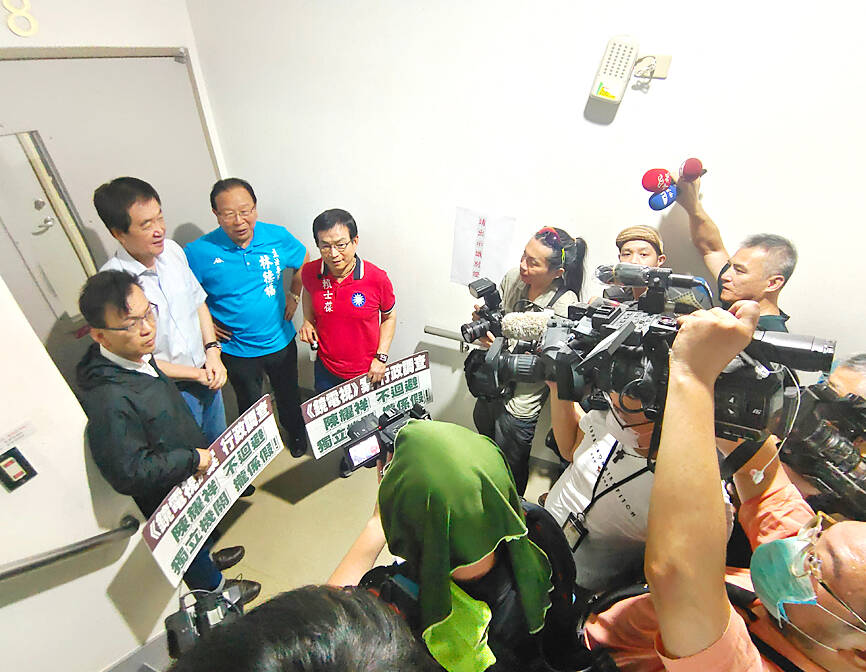
Photo: Wang Yi-sung, Taipei Times
Should shareholders refuse to sign the affidavit, or if it is not delivered to the NCC, it would mean that any application to change board members, supervisory members or the CEO would automatically be denied, the commission said.
However, that would not prevent Mirror TV from being assigned channel 86, it added.
Mirror TV’s eight shareholders are Mirror Media founder Pei Wei (裴偉), who owns 12.5 percent of its shares, worth NT$250 million (US$8.05 million); Hanlin Yucheng Group, Crowell Construction chairman Su Yung-ping (蘇永平), Chairworks Development chairperson Chu Shao-hua (朱邵華) and Inventec Group founder Yeh Kou-i (葉國一), who each hold 15 percent of shares worth NT$300 million; Yageo chairman Pierre Chen (陳泰銘) and WIN Semiconductors chairman Dennis Chen (陳進財), who each own 10 percent of shares worth NT$200 million; and Jay San Lyn Group chairman Chu Wen-yu (祝文宇), who owns 7.5 percent of shares worth NT$150 million.

Photo: CNA
Prior to the vote, New Power Party Legislator Chen Jiau-hua (陳椒華) protested in front of the NCC building in Taipei, calling the approval “the arrogance of the empowered.”
She said that the NCC was politically pressured to approve the channel assignment, adding that it was suspicious that the commission placed the Mirror TV discussion on the schedule without reason, especially as three of the channel’s board members and a supervisory member quit last year.
Questions about Mirror TV’s registered capital also need to be further investigated, she said.
NCC Chairman Chen Yaw-shyang (陳耀祥) was pandering to the government holding the vote, and the decision undermined the commission’s legitimacy as an independent agency, she said.
Chen Jiau-hua urged people to vote the Democratic Progressive Party out of power next year if the commission approved the channel assignment.
Meanwhile, Chinese Nationalist Party (KMT) legislators attempted to enter the meeting venue, but were denied entry.
The NCC — seemingly learning from a previous KMT protest on May 3 — put up barricades in front of the building and programmed the elevators not to stop at floors eight and nine, which is where the meeting room and the commissioners’ offices are located respectively.
KMT lawmakers said that Chen Yaw-shyang, a defendant in a case involving Mirror TV in which he was accused of malfeasance, should not have reviewed the case and should resign immediately.
The Taiwan People’s Party legislative caucus yesterday said that the legislature had barred the Mirror TV case from proceeding until more was known about investigations into the company, adding that Chen Yaw-shyang’s forcing through an approval during a legislative recess was inappropriate.
Additional reporting by Huang Ching-hsuan

NATIONAL SECURITY: Authorities are working to confirm the identities of the military personnel involved and investigating possible illegal conduct and regulatory violations Authorities are probing possible national security implications after Kinmen police and immigration officers on Sunday found a Chinese woman allegedly posing as a tourist while engaging in prostitution involving more than 10 military personnel. The woman, surnamed Chen (陳), has since been deported, authorities said, adding that investigators are still working to confirm the identities of those implicated, as the records only listed code names and aliases. The case stemmed from a report received by the Kinmen District Prosecutors’ Office on Friday last week from the Jinhu Precinct of the Kinmen County Police Bureau. On Sunday, police, along with the National Immigration

REASONS FOR TRAVEL: An assistant professor said that proposed amendments to penalize drivers if they used drugs overseas would not deter people from traveling People who operate a motor vehicle under the influence of marijuana would have their driver’s license revoked, even if they used the substance while overseas, the Ministry of Transportation and Communications said yesterday, citing proposed amendments to the Road Traffic Management and Penalty Act (道路交通管理處罰條例). The amendments would also authorize the government to revoke the licenses of people determined to have used Category 1 or Category 2 narcotics, even if they were not operating a vehicle while under the influence of drugs, as well as ban them from taking the license test for three years, the ministry said. People aged 18 or

GLOBALGIVING: ‘ Caving to external pressure is not acceptable for an organization that has cultivated justice reform and human rights for 30 years,’ one NGO said A slew of non-government organizations (NGOs) have withdrawn from the GlobalGiving fundraising platform after it announced it would use “Chinese Taipei” instead of “Taiwan” from next month. The Taiwan Good Rice Association wrote on Facebook on Friday that it was informed on April 28 via a teleconference call of the change, which was made because the platform wanted to operate in China. Taiwan Good Rice is to terminate all cooperative relationships with GlobalGiving in response to the platform’s “unilateral and non-negotiable” decision to remove references to Taiwan, the NGO said. “Taiwan is in the official name of Taiwan Good Rice Association and the

HEAVY WEATHER: Typhoon Jangmi is due to crash straight into the Ryukyus as airlines look to shift flights to larger aircraft or cancel flights to Okinawa entirely Taiwan’s international air carriers announced flight adjustments over the weekend as Typhoon Jangmi is forecast to hit the Ryukyu Islands today and tomorrow. The Central Weather Administration (CWA) upgraded Jangmi from a tropical storm to a typhoon at 8am yesterday, with the eye located 580km south of Naha city. It was moving north at 19kph. Today, China Airlines’ CI-120, CI-121, CI-122 and CI-123 flights between Taoyuan and Naha, Okinawa, have been canceled as well as CI-132 and CI-133 between Kaohsiung and Naha. EVA Air’s BR-112, BR-113, BR-186 and BR-185 flights between Taoyuan and Naha are also canceled. Low-cost carrier Tigerair Taiwan canceled IT-230,


 RSS
RSS