


Major public events have axed entertainer Aaron Yan (炎亞綸) from their programs, including the Beer Rock Festival in Kaohsiung and the Taiwan International Balloon Festival in Taitung County, following allegations of sexual misconduct that have also cost him several commercial endorsements.
The Public Television Service network has also terminated its contract with Yan, who was the host of a current affairs show, and the Ministry of Culture reportedly dropped him as the host of the annual Golden Bell Awards for television and radio in October.
This follows earlier moves by organizations such as the Taiwan’s Junior Chamber International, which withdrew its recognition of Yan as one of “Ten Outstanding Young Persons” last year.

Photo: Hu Shun-hsiang, Taipei Times
Yan, 37, began his career in 2005 as a member of the Taiwanese boy band Fahrenheit (飛輪海) and expanded in acting, attracting a huge following at home, as well as China and Southeast Asian countries.
Public prosecutors have initiated a probe into allegations of exploitation of a minor and secretly filming a sexual partner, Internet celebrity Chiu Yao-le (邱耀樂), who was 16 at the time.
As speculation swirled about the allegations, Chiu, who uses the nickname Raku on YouTube, convened a press conference in Taipei on Wednesday, but Yan upstaged it by barging into the event, and bowing twice in apology to Chiu.
Chiu, who broke down in tears and did not look at Yan, later said he could not accept the apology.
After that, Yan lost several commercial endorsements, including food delivery service UberEats, cosmetics and clothing companies.
The Taitung County Government said it has replaced Yan as the closing ceremony performer of its hot balloon festival at the end of August, saying that Yan’s involvement in the sexual harassment allegations “does not conform to the event’s image of positive energy, sunshine and health fitness.”
The organizers of Kaohsiung’s Beer Rock Festival also dropped Yan from his scheduled performance on July 8.
The #MeToo allegations have also spread to academic circles, with two teachers at National Taiwan College of Performing Arts being suspended from classroom and administrative work as of yesterday.
The Taipei-based college convened a committee meeting after students filed complaints of sexual assault by Lee Tung-chun (李菄峻), dubbed the “Prince of Hakka Opera” (客家戲曲王子), and another teacher surnamed Wang (王).
Lee had previously been involved in a controversy, when he was identified as the teacher in a 2017 video physically assaulting students at his opera class.
He was seen in the video hitting a female student in the head, then knocking her to the ground with a flying kick. He apologized in public and received a major demerit as punishment.
Lee has denied the sexual harassment allegations, saying they were trying to tarnish his reputation with false accusations.
Lee was accused of sexual assault, according to a public post at a site frequented by the theatrical school community. Former male students alleged that when they were asked to go to Lee’s house for acting lessons years ago, he had groped them or forced them to engage in sexual acts.
Lee said he has hired a lawyer to file a defamation lawsuit, but vowed to cooperate with the investigation to clear his name.

UPGRADE: The Kang Ding-class frigate is replacing its Chaparall missiles with Tien Chien II and Hua Yang VLS, which would provide it with long-range, 360° air defense Taiwan plans to produce 1,200 to 1,376 Hai Chien II missiles (海劍二, Sea Sword II) — also known as TC-2N — to serve as the standard air defense system of the navy’s surface combatant fleet, a source said yesterday. Last week, the Hai Chien II, the naval version of the Tien Kung II missile (天劍二, Sky Sword II), completed a live-fire test in waters off the National Chungshan Institute of Science and Technology’s Jiupeng facility (九鵬) in Pingtung County’s Manjhou Township (滿州). The MIM72 Chaparral and other dated air defense missiles that currently arm Taiwanese ships have inadequate range to combat Chinese

REASONS FOR TRAVEL: An assistant professor said that proposed amendments to penalize drivers if they used drugs overseas would not deter people from traveling People who operate a motor vehicle under the influence of marijuana would have their driver’s license revoked, even if they used the substance while overseas, the Ministry of Transportation and Communications said yesterday, citing proposed amendments to the Road Traffic Management and Penalty Act (道路交通管理處罰條例). The amendments would also authorize the government to revoke the licenses of people determined to have used Category 1 or Category 2 narcotics, even if they were not operating a vehicle while under the influence of drugs, as well as ban them from taking the license test for three years, the ministry said. People aged 18 or

HEAVY WEATHER: Typhoon Jangmi is due to crash straight into the Ryukyus as airlines look to shift flights to larger aircraft or cancel flights to Okinawa entirely Taiwan’s international air carriers announced flight adjustments over the weekend as Typhoon Jangmi is forecast to hit the Ryukyu Islands today and tomorrow. The Central Weather Administration (CWA) upgraded Jangmi from a tropical storm to a typhoon at 8am yesterday, with the eye located 580km south of Naha city. It was moving north at 19kph. Today, China Airlines’ CI-120, CI-121, CI-122 and CI-123 flights between Taoyuan and Naha, Okinawa, have been canceled as well as CI-132 and CI-133 between Kaohsiung and Naha. EVA Air’s BR-112, BR-113, BR-186 and BR-185 flights between Taoyuan and Naha are also canceled. Low-cost carrier Tigerair Taiwan canceled IT-230,
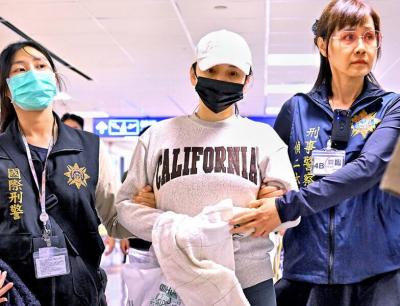
Johanne Liou (劉喬安), a Taiwanese woman who shot to unwanted fame during the Sunflower movement protests in 2014, returned to Taiwan last night after being deported from the US. She is to stand trial in Taiwan for charges involving embezzlement, fraud and drug crimes. The Criminal Investigation Bureau (CIB) said it took her into custody at Taiwan Taoyuan International Airport and would first question her before transferring her to the New Taipei District Prosecutors’ Office. She was arrested upon disembarking a flight from San Francisco that landed shortly before 7pm. Liou absconded to the US in 2019 after jumping bail


 RSS
RSS