


The Forestry Bureau has failed to impose measures to protect macaques, which were removed from the country’s protected species list in 2019, three Control Yuan members said on Saturday.
Macaques were removed from Taiwan’s list of protected species in 2019, but due to a lack of supporting measures, incidents of harassment, hunting and capture of the animals continue to occur, Control Yuan members Yeh Ta-hua (葉大華), Pasuya Poiconu (浦忠成) and Tien Chiu-chin (田秋堇) said.
The three members submitted a report on the conditions macaques face, in which they called on the Council of Agriculture — which oversees the Forestry Bureau — to review and improve laws governing the protection of wildlife, including macaques.
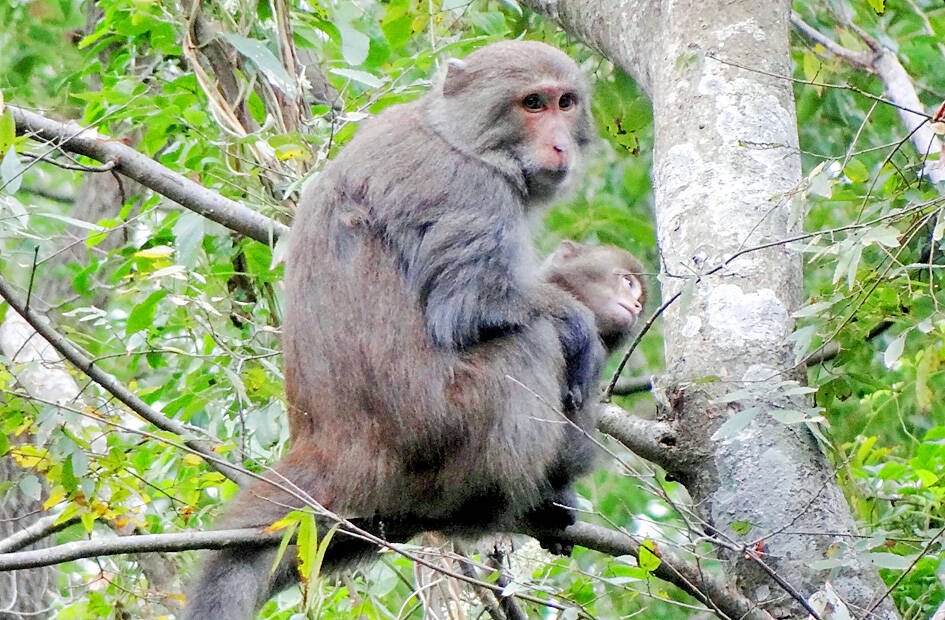
Photo: Yu Tai-lang, Taipei Times
The members said that although there are laws that prevent the public from owning and raising animals classified as protected — except where permission is granted, such as for zoos — no such laws exist for non-protected wild animals.
The lack of such laws has resulted in people capturing macaques to raise them privately, and in some cases killing females to capture their infants, they said.
The members said their investigation uncovered 151 cases of people raising macaques, with some reportedly buying the animals for NT$50,000 to NT$60,000 each.
People selling the animals said that killing macaque mothers was necessary to capture their infants, the members said.
The members reported having found macaques kept in “harsh conditions,” including in small cages or tied down with iron chains, which “limited their range of activities.”
Some owners of macaques limited the amount of water given to them, as they believed that doing so would prevent them from growing too large, the members said, adding that this harms the mental and physical development of the animals.
The members said that although the macaques are no longer on the protected species list, they are unique to Taiwan and should be protected by law.
The habitats of macaques overlap with those of humans in several parts of Taiwan proper, which in many cases has been used as an excuse for their capture — particularly in areas where the animals affect local agriculture, the report said.
Although Article 21 of the Wildlife Conservation Act (野生動物保育法) stipulates that wild animals can be hunted or slaughtered, the Council of Agriculture has not clearly established criteria to determine whether wild animals are “harmful to agricultural and forestry crops, poultry, livestock or aquaculture,” leaving local governments to interpret the law on a case-by-case basis, they said.
The report made suggestions about the rescue and release of macaques into the wild, including the potential to release the animals on Taiwan’s uninhabited islands.
The members have commissioned National Pingtung University of Science and Technology to study the feasibility of that option, they said.
The report said that no survey of the macaque population has been conducted since 2000, when there were an estimated 10,404 groups of macaques accounting for its population of 260,000 in Taiwan.
A new survey should be conducted to better understand how the macaque population has changed over the two decades, and how human activities have affected the animal, it said.

Chinese spouse and influencer Guan Guan’s (關關) residency permit has been revoked for repeatedly posting pro-China videos that threaten national security, the National Immigration Agency confirmed today. Guan Guan has said many controversial statements in her videos posted to Douyin (抖音), including “the red flag will soon be painted all over Taiwan” and “Taiwan is an inseparable part of China,” and expressing hope for expedited reunification. The agency last year received multiple reports alleging that Guan Guan had advocated for armed reunification. After verifying the reports, the agency last month issued a notice requiring her to appear and explain her actions. Guan

GIVE AND TAKE: Blood demand continues to rise each year, while fewer young donors are available due to the nation’s falling birthrate, a doctor said Blood donors can redeem points earned from donations to obtain limited edition Formosan black bear travel mugs, the Kaohsiung Blood Center said yesterday, as it announced a goal of stocking 20,000 units of blood prior to the Lunar New Year. The last month of the lunar year is National Blood Donation Month, when local centers seek to stockpile blood for use during the Lunar New Year holiday. The blood demand in southern Taiwan — including Tainan and Kaohsiung, as well as Chiayi, Pingtung, Penghu and Taitung counties — is about 2,000 units per day, the center said. The donation campaign aims to boost

The Kaohsiung Tourism Bureau audited six hotels in an effort to prevent price gouging ahead of Korean band BTS’ concert tour in the city scheduled for Nov. 19, 21 and 22 this year. The bureau on Friday said that the audits — conducted in response to allegations of unfair pricing posted on social media — found no wrongdoing. These establishments included the local branches of Chateau de Chine, Hotel Nikko, My Humble House, and Grand Hai Lai, it said, adding that the Consumer Protection Commission would have penalized price gougers had the accusations been substantiated. The bureau said the Tourism Development Act
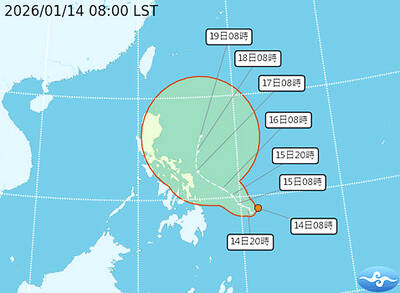
BACK TO WINTER: A strong continental cold air mass would move south on Tuesday next week, bringing colder temperatures to northern and central Taiwan A tropical depression east of the Philippines could soon be upgraded to be the first tropical storm of this year, the Central Weather Administration (CWA) said yesterday, adding that the next cold air mass is forecast to arrive on Monday next week. CWA forecaster Cheng Jie-ren (鄭傑仁) said the first tropical depression of this year is over waters east of the Philippines, about 1,867km southeast of Oluanpi (鵝鑾鼻), and could strengthen into Tropical Storm Nokaen by early today. The system is moving slowly from northwest to north, and is expected to remain east of the Philippines with little chance of affecting Taiwan,


 RSS
RSS