


Taiwan has donated US$5 million to Lithuanian-led reconstruction projects in Ukraine, a Lithuanian government investment agency said on Wednesday.
The funds would be spent rebuilding a school in Borodianka and a kindergarden in Irpin, the Central Project Management Agency said in a statement.
The Lithuanian government has spent 9.8 million euros (US$10.6 million) on the projects and the Taiwanese contribution would be used to purchase educational equipment, it said.
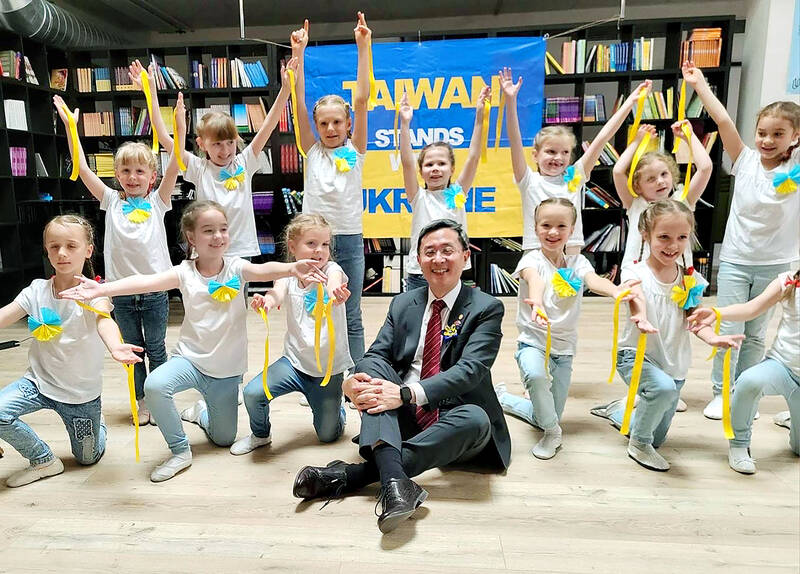
Photo courtesy of the Taipei Representative Office in Bratislava via CNA
“Taiwan sees Ukraine as our own image on a different continent. We both face authoritarian regimes which do not shy from using force to impose their world view,” Deputy Minister of Foreign Affairs Roy Lee (李淳) said when announcing the donation in Vilnius.
“If one day Taiwan is facing an increased level of military intimidation from China, we will be looking for your assistance as well, just as we are helping Ukraine,” he said.
China last year downgraded its diplomatic ties with Lithuania, and told multinationals to sever ties with Lithuania or face being shut out of the Chinese market, after the opening of a representative office by Taiwan in Vilnius.
In response, the EU launched a challenge at the WTO, accusing China of discriminatory trade practices against Lithuania that it says threaten the integrity of the EU single market.
The challenge was joined by the US, the UK and Australia.
Meanwhile, the National Institute for Cyber Security and the Lithuanian Innovation Agency on Thursday signed a memorandum of understanding (MOU) that seeks to mutually boost the digital resilience of both nations.
The MOU was signed by Lithuanian Innovation Agency Director Romualda Stragiene and National Institute for Cyber Security head Ho Chuan-te (何全德) using an external communication adapter during a videoconference.
Minister of Digital Affairs Audrey Tang (唐鳳), who was also present at the ceremony, said the use of the adapter marked a bilateral milestone as it was issued by the Ministry of Digital Affairs and recognized by Lithuania.
In addition to strengthening mutual digital resilience, the memorandum also aims to boost bilateral cooperation and talent exchanges, Tang said.
Tang said she hopes the MOU would advance tangible partnerships between the two nations, which are both on the frontline of opposing authoritarian regimes.
Tang met with Lithuanian Minister of the Economy and Innovation Ausrine Armonaite in January, when they exchanged ideas on topics such as satellite technology, cybersecurity and financial technology, which led to the MOU.
While Tang served as Taiwan’s observer at the ceremony, her counterpart was Lithuanian Vice Minister of Economy and Innovation Karolis Zemaitis.

FUKUOKA SITUATION: Japanese media reported that the pathogen is expected to be identified by the summer, while the CDC downplayed the idea that it was hMPV A “mysterious cold-like illness” reported in Japan’s Fukuoka Prefecture does not seem to be a new disease, but Japanese authorities have been asked about the situation, the Centers for Disease Control (CDC) said yesterday. The Fukuoka Prefectural Medical Association on Wednesday told a news conference that a “mystery cold” that has become a hot topic on social media is “highly likely to be caused by some kind of viral infection,” Japan’s KBC News reported. “Many people are experiencing symptoms starting with a sore throat, followed by a runny nose, phlegm and a severe cough,” KBC News reported, citing association officials. Health authorities are

Nvidia Corp CEO Jensen Huang (黃仁勳) arrived in Taiwan yesterday ahead of upcoming AI and technology events, saying he plans to meet with clients and Taiwan Semiconductor Manufacturing Co Chairman C.C. Wei (魏哲家) during his visit. After landing at Taipei Songshan Airport, Huang posed for photos with fans and handed out Yakult drinks to reporters and supporters waiting at the scene, saying he has “a lot to do” during the trip. Asked about reports that Nvidia’s planned headquarters site in Taipei’s Beitou Shilin Technology Park could break ground on May 27, Huang said that if the company holds an event, he would

The Ministry of Finance this afternoon announced the winning numbers for the March-April uniform invoice lottery. The winning number for the NT$10 million (US$318,060) special prize is 19531471, and the winning number for the NT$2 million grand prize is 85941329. Three numbers were drawn for the NT$200,000 first prize: 07225810, 20231230 and 83518781. Those with receipts matching the last seven digits of any of the first-prize numbers will win the NT$40,000 second prize, while those matching the last six digits will win the NT$10,000 third prize. Those whose receipts match the last five digits of the first-prize numbers can claim the NT$4,000 fourth prize,
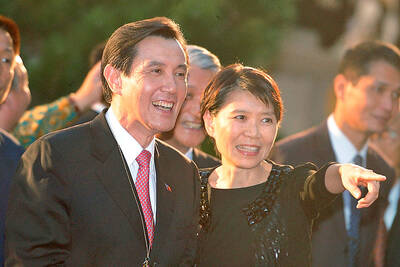
Former president Ma Ying-jeou (馬英九) yesterday expressed “shock and regret” over a statement issued by his wife without his consent, and rejected her assertion that his eldest sister, Ma Yi-nan (馬以南), would manage his medical care or act as his spokesperson amid an ongoing embezzlement probe into his foundation. Ma Ying-jeou in a statement said he was shocked by a statement by his wife, Chou Mei-ching (周美青), regarding his affairs. Ma Yi-nan “must not” be in charge of his healthcare and other personal affairs, nor can she be allowed to represent the Ma family, the former president said. He said he was also


 RSS
RSS