


The government must have a potential trade agreement with the US reviewed by the Legislative Yuan first to ensure transparency, the TW-US Citizen Watch Alliance said yesterday.
The alliance, composed of labor, environmental and human rights groups in Taiwan, submitted petitions on the issue to the Executive Yuan, the Legislative Yuan and the American Institute in Taiwan yesterday afternoon.
On Friday last week, the Office of Trade Negotiations of the Executive Yuan issued a statement saying that Taiwan and the US would soon sign an agreement on five issues to conclude the first phase of the trade negotiations for the Taiwan-US Initiative on 21st-Century Trade. These are: trade facilitation, good regulatory practices, domestic service regulations, anti-corruption issues, and small and medium-sized enterprises.
Both governments will continue negotiations over at least seven other topics, with the goal of completing all negotiations by the end of this year, the statement said.
On the legal status of the agreement, the Executive Yuan said it is an “executive agreement.”
“We believe that it would be in violation of the Conclusion of Treaties Act (條約締結法) and not be in accordance with procedural justice should this trade agreement be categorized as an executive agreement,” the alliance said.
The act stipulates that an executive agreement only needs to be signed and sent to the Legislative Yuan for future reference, while a treaty must be reviewed and approved by the Legislative Yuan after it was signed, with few exceptions, the alliance said.
Article 3 further stipulates that international agreements that “involve national defense, foreign affairs, financial matters, economic interests, or other issues of national interest” are considered treaties, it said.
Taiwan has signed 12 trade agreements with other countries, all of which have been submitted to the Legislative Yuan for review as treaties, it said.
“Unless the initiative is really not that important, we cannot think of any reason why the final signed document should not be sent to the Legislative Yuan for review,” the alliance said.
Although the government has tried to solicit the public’s input on the initiative by placing the topic on the Public Policy Online Participation Network Platform, it drew only 33 comments as only very brief introductions of the trade agreement was provided, it said.
The agreement is an important issue, but what has been done so far hardly meets the criteria of public participation and information transparency, it said.
Chinese Nationalist Party legislators Johnny Chiang (江啟臣), Lee Guei-min (李貴敏) and Wu Sz-huai (吳斯懷) said not having the agreement reviewed by lawmakers goes against the Democratic Progressive Party’s (DPP) long-standing principle of transparency and responsibility to the people.
“Although the issues tackled in the first phase of trade negotiations do not involve custom tariffs, the DPP government should not be afraid of legislative oversight when it signs such a great treaty with the US,” they said.
The agreement will automatically take effect if it is signed after the legislative session ends on Wednesday next week, Chiang said.
“However, people know nothing about the trade agreement. The Office of Trade Negotiations should brief lawmakers on the details of the agreement and invite civic groups to attend a hearing on this matter,” he said.
Taiwan People’s Party caucus deputy director Oliver Hsu (徐文路) said the voice of civic groups should be heard as the agreement covers finance, environment and workers’ issues.

More than half of the bamboo vipers captured in Tainan in the past few years were found in the city’s Sinhua District (新化), while other districts had smaller catches or none at all. Every year, Tainan captures about 6,000 snakes which have made their way into people’s homes. Of the six major venomous snakes in Taiwan, the cobra, the many-banded krait, the brown-spotted pit viper and the bamboo viper are the most frequently captured. The high concentration of bamboo vipers captured in Sinhua District is puzzling. Tainan Agriculture Bureau Forestry and Nature Conservation Division head Chu Chien-ming (朱健明) earlier this week said that the
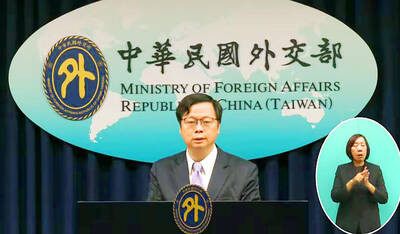
NAMING SPAT: The foreign ministry called on Denmark to propose an acceptable solution to the erroneous nationality used for Taiwanese on residence permits Taiwan has revoked some privileges for Danish diplomatic staff over a Danish permit that lists “Taiwan” as “China,” Eric Huang (黃鈞耀), head of the Ministry of Foreign Affairs’ Department of European Affairs, told a news conference in Taipei yesterday. Reporters asked Huang whether the Danish government had responded to the ministry’s request that it correct the nationality on Danish residence permits of Taiwanese, which has been listed as “China” since 2024. Taiwan’s representative office in Denmark continues to communicate with the Danish government, and the ministry has revoked some privileges previously granted to Danish representatives in Taiwan and would continue to review

Kenting National Park service technician Yang Jien-fon (楊政峰) won a silver award in World Grand Prix Photography Awards Spring Season for his photograph of two male rat snakes intertwined in combat. Yang’s colleagues at Kenting National Park said he is a master of nature photography who has been held back by his job in civil service. The awards accept entries in all four seasons across six categories: architectural and urban photography, black-and-white and fine art photography, commercial and fashion photography, documentary and people photography, nature and experimental photography, and mobile photography. Awards are ranked according to scores and divided into platinum, gold and
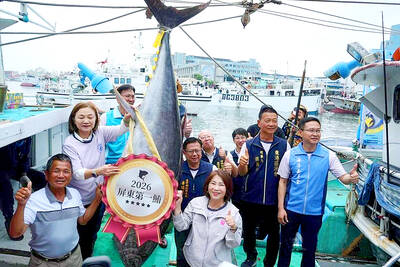
The first bluefin tuna of the season, brought to shore in Pingtung County and weighing 190kg, was yesterday auctioned for NT$10,600 (US$333.5) per kilogram, setting a record high for the local market. The auction was held at the fish market in Donggang Fishing Harbor, where the Siaoliouciou Island-registered fishing vessel Fu Yu Ching No. 2 delivered the “Pingtung First Tuna” it had caught for bidding. Bidding was intense, and the tuna was ultimately jointly purchased by a local restaurant and a local company for NT$10,600 per kilogram — NT$300 ,more than last year — for a total of NT$2.014 million. The 67-year-old skipper


 RSS
RSS