


There would be a “chilling effect” on freedom of expression caused by China’s detention of Taiwan-based publisher Li Yanhe (李延賀), people from the publishing, academia and arts sectors said yesterday.
Former minister of culture Cheng Li-chiun (鄭麗君) and former National Palace Museum director Wu Mi-cha (吳密察) were among about 350 people who signed a statement calling on Beijing to “ensure the rights [of Li] according to Chinese law.”
Li, the editor-in-chief of Gusa Press, is being investigated by Chinese state security officials for “suspected activities endangering national security,” China’s Taiwan Affairs Office (TAO) said on April 26.
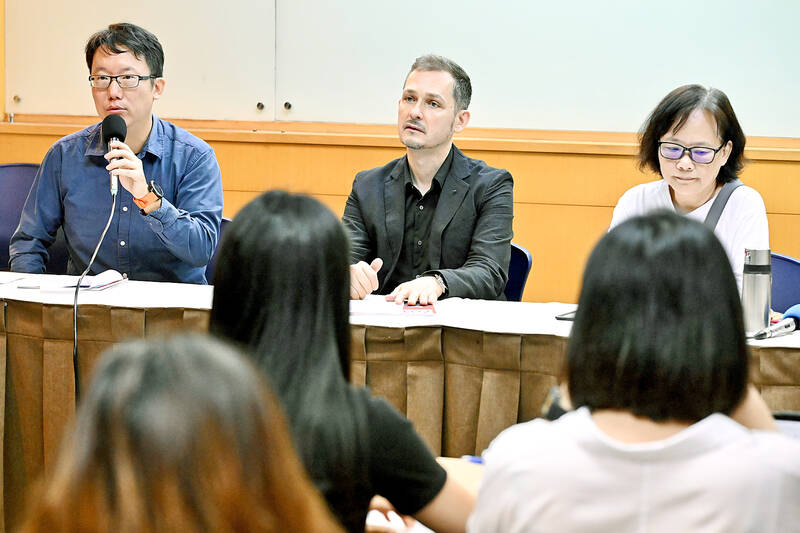
Photo: George Tsorng, Taipei Times
The signatories said that Li’s detention and the subsequent investigation would have a “chilling effect” on Taiwan’s publishing sector and “damage normal cultural exchanges across the Taiwan Strait.”
They urged Beijing to announce the results of the investigation into Li “as soon as possible.”
Following Li’s detention, TAO spokeswoman Zhu Fenglian (朱鳳蓮) said that his legal rights would be protected in accordance with the law.
However, the TAO has so far not provided further details about the state of Li’s health and his whereabouts.
Li was reportedly arrested by police in Shanghai in late March, shortly after he arrived in China to visit his family and deal with residency-related issues.
At a news conference in Taipei yesterday, Wang Chia-hsuan (王家軒), a former editor at Gusa Press, said that the detention of Li on national security grounds had caused many working in the publishing and cultural sectors in Taiwan to begin warning each other against traveling to China.
Chang Cheng (張正), the founder of New Taipei City-based Brilliant Time Bookstore, said that while they fully respected the wishes of Li’s family to keep the incident low-key, there was a need for people to voice their concern.
“We think the cultural, media and academic circles can no longer feign ignorance” over Li’s circumstances, Chang said.
Others who also signed the statement included Rex How (郝明義), founder and chairman of Locus Publishing Co; Kuo Chung-hsing (郭重興), founder of the Book Republic Publishing Group; Chien Chi-chong (簡志忠), founder of the Eurasian Publishing Group; and Jan Hung-tze (詹宏志), founder and publisher of Business Next Media Corp.
They were joined by award-winning writers Li Ang (李昂), Ping Lu (平路) and Wu Ming-yi (吳明益), as well as filmmakers Wang Shau-di (王小棣) and Ko I-chen (柯一正).
In an article read aloud by Wang Chia-hsuan, Jan, who is also chairman of online shopping platform PChome, said it would be “violent, ridiculous and out of date” for the Chinese government to convince itself that books published by Li Yanhe’s publishing house in Taiwan would endanger the national security of China.
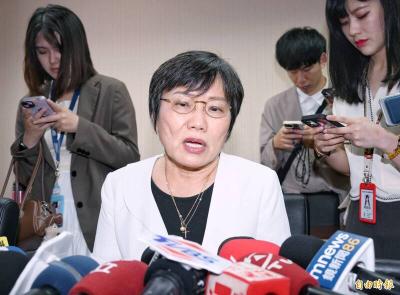
Chinese Nationalist Party (KMT) Chairman Eric Chu (朱立倫), spokeswoman Yang Chih-yu (楊智伃) and Legislator Hsieh Lung-chieh (謝龍介) would be summoned by police for questioning for leading an illegal assembly on Thursday evening last week, Minister of the Interior Liu Shyh-fang (劉世芳) said today. The three KMT officials led an assembly outside the Taipei City Prosecutors’ Office, a restricted area where public assembly is not allowed, protesting the questioning of several KMT staff and searches of KMT headquarters and offices in a recall petition forgery case. Chu, Yang and Hsieh are all suspected of contravening the Assembly and Parade Act (集會遊行法) by holding
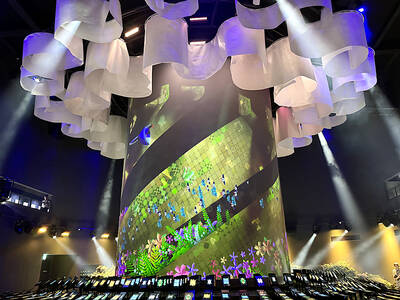
PRAISE: Japanese visitor Takashi Kubota said the Taiwanese temple architecture images showcased in the AI Art Gallery were the most impressive displays he saw Taiwan does not have an official pavilion at the World Expo in Osaka, Japan, because of its diplomatic predicament, but the government-backed Tech World pavilion is drawing interest with its unique recreations of works by Taiwanese artists. The pavilion features an artificial intelligence (AI)-based art gallery showcasing works of famous Taiwanese artists from the Japanese colonial period using innovative technologies. Among its main simulated displays are Eastern gouache paintings by Chen Chin (陳進), Lin Yu-shan (林玉山) and Kuo Hsueh-hu (郭雪湖), who were the three young Taiwanese painters selected for the East Asian Painting exhibition in 1927. Gouache is a water-based
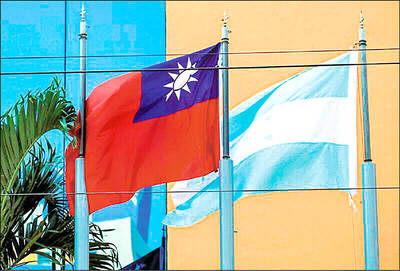
Taiwan would welcome the return of Honduras as a diplomatic ally if its next president decides to make such a move, Minister of Foreign Affairs Lin Chia-lung (林佳龍) said yesterday. “Of course, we would welcome Honduras if they want to restore diplomatic ties with Taiwan after their elections,” Lin said at a meeting of the legislature’s Foreign Affairs and National Defense Committee, when asked to comment on statements made by two of the three Honduran presidential candidates during the presidential campaign in the Central American country. Taiwan is paying close attention to the region as a whole in the wake of a

OFF-TARGET: More than 30,000 participants were expected to take part in the Games next month, but only 6,550 foreign and 19,400 Taiwanese athletes have registered Taipei city councilors yesterday blasted the organizers of next month’s World Masters Games over sudden timetable and venue changes, which they said have caused thousands of participants to back out of the international sporting event, among other organizational issues. They also cited visa delays and political interference by China as reasons many foreign athletes are requesting refunds for the event, to be held from May 17 to 30. Jointly organized by the Taipei and New Taipei City governments, the games have been rocked by numerous controversies since preparations began in 2020. Taipei City Councilor Lin Yen-feng (林延鳳) said yesterday that new measures by


 RSS
RSS