


The employment Gold Card program is to be expanded to attract more foreigners with critical skills to cover a wider range of industries, the Executive Yuan said yesterday.
A national-level foreign talent recruitment services center, tentatively named Talent Taiwan, is to be opened to facilitate the enlargement of the work visa program by the end of the year, the Cabinet told a post-meeting news conference.
The program expansion builds on the basis of previous successes and its implementation is to be supplemented by measures aimed at attracting foreigners to study in Taiwan, the National Development Council said in a news release.

Photo courtesy of the Executive Yuan
Taiwan is pushing to recruit workers with critical skills through educational initiatives to attract international students, legal reforms to encourage foreign students to work in Taiwan after graduation, and improved financial, housing and educational services for foreign residents, it said.
As of March last year, the nation had close to 55,000 skilled foreign workers, and 7,000 Gold Cards were granted to workers with critical skills in sectors including semiconductors, offshore wind power, finance, and arts and culture, the council said.
An array of educational initiatives are being implemented to boost the domestic supply of highly skilled workers, it said.
Last year, the number of Taiwanese undergraduate and graduate students in STEM majors rose to about 6,600, while 10 universities established research institutions on artificial intelligence, semiconductors and other key fields via business-academic collaborations, it said.
Additionally, 10 education-to-employment initiatives were approved to prepare a workforce for the six core strategic industries: information and digital technology, cybersecurity, precision health, green and renewable energy, national defense and strategic stockpile, it said.
The government continued to promote Mandarin-English bilingual education by funding universities and scholarships for 400 students and postdocs studying abroad over the past two years, the council said.
Separately, the Ministry of Digital Affairs on Tuesday posted a notice of a new policy that would enable foreign information technology (IT) professionals to apply for Gold Cards regardless of educational attainment, if they have eight years of on-the-job experience.
The policy was prompted by the urgent demand for qualified workers in software development, IT services, digital content creation and e-commerce, it said.
The notice period for the policy has been shortened to 30 days, in which the public could voice their opinion about the measures before its implementation, it said.
Eligible professionals would be able to apply for Gold Cards by submitting verifiable records of work experience, including employment by a recognized international platform, examples of work, or digital participation in charitable or social causes, it said.
Cardholders would be granted an open work permit and the right to be enrolled in the National Health Insurance program with their dependents after getting employed or starting a business, the ministry said.
They would be entitled to a 50 percent tax break on income of more than NT$3 million (US$97,599) earned during the first five years of working in Taiwan and visa or residence permits for their dependents and family members, it said.
People with a doctoral degree in digital science from a top-ranking university, a degree in digital science plus four years of work experience, or those recently employed in the digital field with a salary of NT$160,000 or more per month would also be eligible for the Gold Card, it said.
The ministry continues to collaborate with other government agencies and enterprises to secure supply of workers, ease the sector’s ability to recruit internationally and promote industrial upgrade, it said.
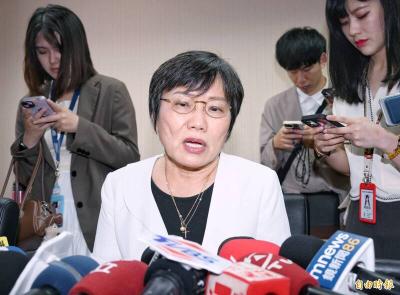
Chinese Nationalist Party (KMT) Chairman Eric Chu (朱立倫), spokeswoman Yang Chih-yu (楊智伃) and Legislator Hsieh Lung-chieh (謝龍介) would be summoned by police for questioning for leading an illegal assembly on Thursday evening last week, Minister of the Interior Liu Shyh-fang (劉世芳) said today. The three KMT officials led an assembly outside the Taipei City Prosecutors’ Office, a restricted area where public assembly is not allowed, protesting the questioning of several KMT staff and searches of KMT headquarters and offices in a recall petition forgery case. Chu, Yang and Hsieh are all suspected of contravening the Assembly and Parade Act (集會遊行法) by holding

PRAISE: Japanese visitor Takashi Kubota said the Taiwanese temple architecture images showcased in the AI Art Gallery were the most impressive displays he saw Taiwan does not have an official pavilion at the World Expo in Osaka, Japan, because of its diplomatic predicament, but the government-backed Tech World pavilion is drawing interest with its unique recreations of works by Taiwanese artists. The pavilion features an artificial intelligence (AI)-based art gallery showcasing works of famous Taiwanese artists from the Japanese colonial period using innovative technologies. Among its main simulated displays are Eastern gouache paintings by Chen Chin (陳進), Lin Yu-shan (林玉山) and Kuo Hsueh-hu (郭雪湖), who were the three young Taiwanese painters selected for the East Asian Painting exhibition in 1927. Gouache is a water-based
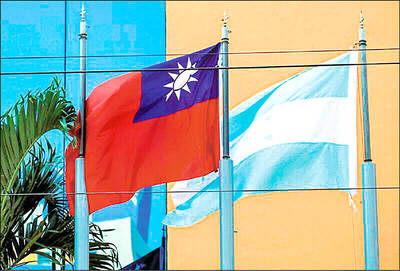
Taiwan would welcome the return of Honduras as a diplomatic ally if its next president decides to make such a move, Minister of Foreign Affairs Lin Chia-lung (林佳龍) said yesterday. “Of course, we would welcome Honduras if they want to restore diplomatic ties with Taiwan after their elections,” Lin said at a meeting of the legislature’s Foreign Affairs and National Defense Committee, when asked to comment on statements made by two of the three Honduran presidential candidates during the presidential campaign in the Central American country. Taiwan is paying close attention to the region as a whole in the wake of a

OFF-TARGET: More than 30,000 participants were expected to take part in the Games next month, but only 6,550 foreign and 19,400 Taiwanese athletes have registered Taipei city councilors yesterday blasted the organizers of next month’s World Masters Games over sudden timetable and venue changes, which they said have caused thousands of participants to back out of the international sporting event, among other organizational issues. They also cited visa delays and political interference by China as reasons many foreign athletes are requesting refunds for the event, to be held from May 17 to 30. Jointly organized by the Taipei and New Taipei City governments, the games have been rocked by numerous controversies since preparations began in 2020. Taipei City Councilor Lin Yen-feng (林延鳳) said yesterday that new measures by


 RSS
RSS