


The nation must improve its maritime surveillance capabilities, as China might be planning to impose an “underwater denial zone” to stymie submarine activity, a military expert said on Sunday.
In the eight days between April 16 and Sunday, the Ministry of National Defense detected five incursions by Chinese People’s Liberation Army (PLA) Harbin Z-9 anti-submarine helicopters east and southeast of the nation’s air defense identification zone.
On Sunday, Monday and Wednesday last week, they were found southeast of the nation, then on Saturday and Sunday operated further north above the waters east of Hualien County.
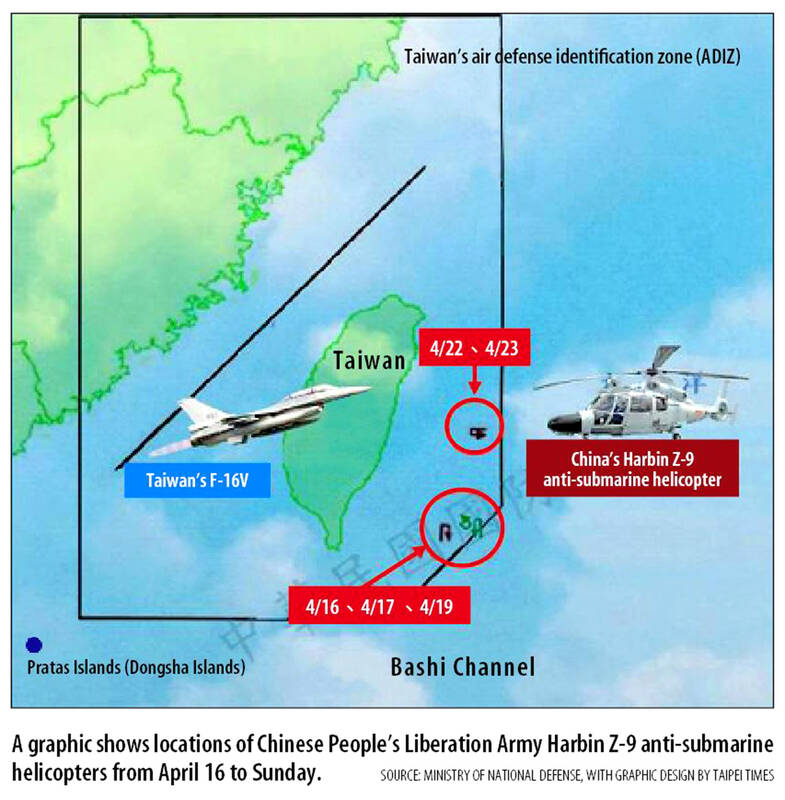
The Harbin Z-9 might have been operated by a Type 054A frigate stationed nearby, the main anti-submarine ship in the PLA fleet, Institute of National Defense and Security Research fellow Su Tzu-yun (蘇紫雲) said.
Unlike the shallow basins to the nation’s west and southwest, the oceanic terrain off the east coast is complex, composed of ridges, trenches and basins, Su said.
The area has therefore become a hotspot for surveillance conducted by PLA anti-submarine aircraft, he said.
The information found on these missions would be valuable for PLA submarines to predict the movements of Taiwanese submarines, he said.
Asked why the PLA has been ramping up helicopter activity, Su said it might be related to naval training, as sea conditions are optimal in mid-to-late April.
It could also be an acceleration of operations east of Taiwan, as the PLA might be aiming to turn the waters to the east and southwest into “underwater denial zones,” he said.
The experience of the operating frigates could also be used as reference for larger amphibious ships in advance assessments for transport and attack helicopter missions, he said.
As an island nation, Taiwan has not invested enough into surveying its surrounding waters, Su said.
The data could be useful not just for military purposes, but also for the marine economy and fishing industry, he said.
If the nation improves its maritime surveillance capabilities, it could also assist strategic cooperation with like-minded partners, he added.
In related news, Premier Chen Chien-jen (陳建仁) yesterday said that Taiwan has no plan to arm its citizens, in response to a proposal by a US presidential candidate earlier this month to “put a gun in every Taiwanese household.”
Entrepreneur Vivek Ramaswamy made the comment on April 14 at an annual National Rifle Association (NRA) gathering in Indianapolis, Indiana.
“You want China not to invade Taiwan? Here is something we can do: The NRA can open its branch next time in Taiwan,” the Republican candidate said. “And you want to stop [Chinese President] Xi Jinping (習近平) from invading Taiwan, put a gun in every Taiwanese household, have them defend themselves. Let’s see what Xi Jinping does then.”
The international community has always been concerned with maintaining peace in the region and in the Taiwan Strait, Chen told reporters at an event in Taichung.
Suggestions such as Ramaswamy’s are made in the hopes of instilling a defensive mindset among Taiwanese, “but the situations are different in Taiwan and the US,” he said.
“We do not have any such plan,” Chen added.
The idea of keeping emergency stockpiles of weapons is being discussed, but Taiwan must have an autonomous defense force, he said.
Additional reporting by Hsu Kuo-chen

REASONS FOR TRAVEL: An assistant professor said that proposed amendments to penalize drivers if they used drugs overseas would not deter people from traveling People who operate a motor vehicle under the influence of marijuana would have their driver’s license revoked, even if they used the substance while overseas, the Ministry of Transportation and Communications said yesterday, citing proposed amendments to the Road Traffic Management and Penalty Act (道路交通管理處罰條例). The amendments would also authorize the government to revoke the licenses of people determined to have used Category 1 or Category 2 narcotics, even if they were not operating a vehicle while under the influence of drugs, as well as ban them from taking the license test for three years, the ministry said. People aged 18 or

GLOBALGIVING: ‘ Caving to external pressure is not acceptable for an organization that has cultivated justice reform and human rights for 30 years,’ one NGO said A slew of non-government organizations (NGOs) have withdrawn from the GlobalGiving fundraising platform after it announced it would use “Chinese Taipei” instead of “Taiwan” from next month. The Taiwan Good Rice Association wrote on Facebook on Friday that it was informed on April 28 via a teleconference call of the change, which was made because the platform wanted to operate in China. Taiwan Good Rice is to terminate all cooperative relationships with GlobalGiving in response to the platform’s “unilateral and non-negotiable” decision to remove references to Taiwan, the NGO said. “Taiwan is in the official name of Taiwan Good Rice Association and the

HEAVY WEATHER: Typhoon Jangmi is due to crash straight into the Ryukyus as airlines look to shift flights to larger aircraft or cancel flights to Okinawa entirely Taiwan’s international air carriers announced flight adjustments over the weekend as Typhoon Jangmi is forecast to hit the Ryukyu Islands today and tomorrow. The Central Weather Administration (CWA) upgraded Jangmi from a tropical storm to a typhoon at 8am yesterday, with the eye located 580km south of Naha city. It was moving north at 19kph. Today, China Airlines’ CI-120, CI-121, CI-122 and CI-123 flights between Taoyuan and Naha, Okinawa, have been canceled as well as CI-132 and CI-133 between Kaohsiung and Naha. EVA Air’s BR-112, BR-113, BR-186 and BR-185 flights between Taoyuan and Naha are also canceled. Low-cost carrier Tigerair Taiwan canceled IT-230,
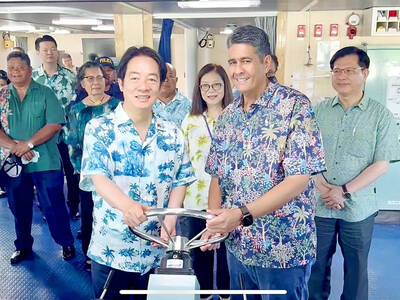
MULTIPRONGED APPROACH: China has sought to pressure Palau across a number of fronts, but the island nation has staunchly resisted overtures to ditch Taiwan Palau has been firm in backing Taiwan despite Chinese pressure that uses tourism economics, cyberattacks and criminal infiltration as tools to threaten the Pacific ally into renouncing its recognition of Taiwan as a sovereign state. The Presidential Office yesterday announced that Vice President Hsiao Bi-khim (蕭美琴) would visit Palau from Saturday to Wednesday next week at the invitation of Palauan President Surangel Whipps Jr. Whipps in April said in an interview that China had outspokenly asked Palau to “denounce Taiwan.” “And we have said: ‘We have no enemies, but nobody tells us who our friends are,’” he said. Whipps has told reporters multiple times


 RSS
RSS