


Vice President William Lai (賴清德) should tell Taiwanese how he plans to avoid a war with China and seek peace if he is elected president, rather than following existing cross-strait policies, former vice president Annette Lu (呂秀蓮) said yesterday.
Lu made the remarks during a forum in Taipei, where she and other experts talked about the “humiliation” that Taiwan experienced after the signing of the Treaty of Shimonoseki on April 17, 1895, that ended the First Sino-Japanese War of 1894-1895, as well as issues related to cross-strait peace.
In the treaty, the Qing Dynasty ceded to Japan sovereignty of the Penghu Islands, Taiwan and the Liaodong Peninsula.
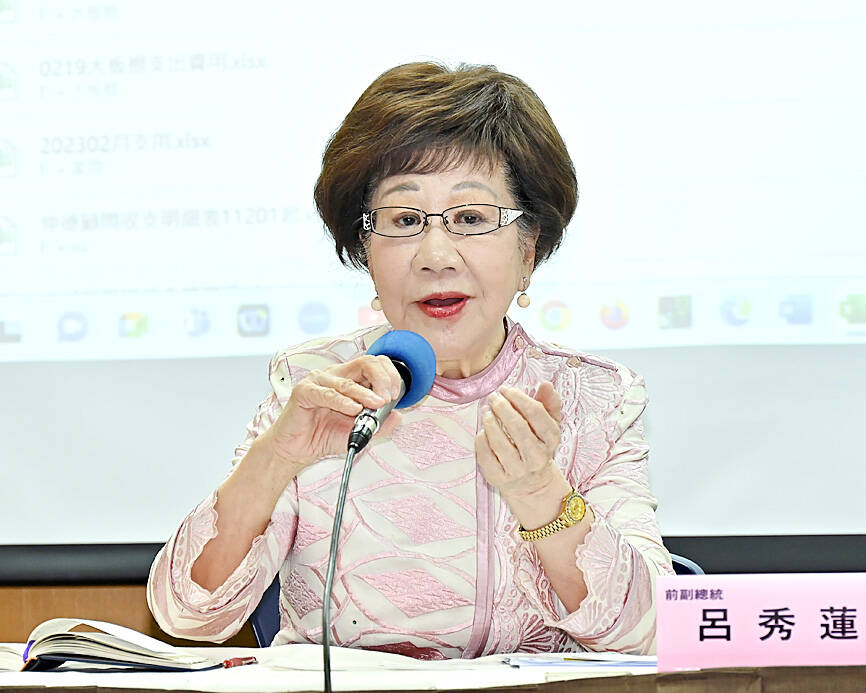
Photo: Tu Chien-jung, Taipei Times
“Taiwan is a democracy, meaning no political party can govern forever. The Democratic Progressive Party [DPP] must face this reality with a more modest attitude and tell people what Taiwan’s core interests are,” Lu said.
“I also want to tell Vice President Lai that, while he respects President Tsai Ing-wen (蔡英文), he needs to present his own mission for the country in the next few years if he is elected president, rather than simply saying that he would adhere to past or current policies,” she added.
The DPP last week named Lai as its candidate for the presidential election next year.
Lu said that Lai, as a potential leader of Taiwan, needs to plan ahead, instead of dwelling on the past.
“The next leader, regardless of their party affiliation, should understand Taiwan’s tragic history, and identify potential crises and challenges facing the nation in the near future, both at home and abroad,” Lu said.
“If they only want to be president and cannot see the challenges ahead, we voters must vote responsibly, rather than voting out of passion,” she said.
As the next four years would be crucial to Taiwan’s survival, Taiwanese should consider whether there is a third path to consider, in addition to unification with or independence from China, Lu said.
Regarding Tsai’s visit to the US and former president Ma Ying-jeou’s (馬英九) visit to China, Lu said the seemingly well-intentioned trips worsened the division between pro-China and pro-US camps in Taiwan.
People need to ask whether the nation’s fate should be decided by Beijing, Washington, the DPP, the Chinese Nationalist Party (KMT) or the 23.5 million Taiwanese, Lu said.
“Taiwanese should firmly tell the world that Beijing and Washington should not get Taiwan involved in their competition,” she said, adding that Taiwanese leaders should express that sentiment to the international community.
The Chinese government has said in its Third White Paper on Taiwan that “signing the Treaty of Shimonoseki epitomized the humiliation that Chinese have experienced in history, and left an indelible pain among people in Taiwan and in China.”
Therefore, Beijing should stop reiterating that Taiwan is “an indivisible territory of China,” Lu said.
“Both sides should stop the debate over unification with or independence from China and recognize that an independent Taiwan is an inevitable development of history,” she said.
Lu also addressed waishengren (Mainlanders, 外省人) — people who came from China with the KMT after the Chinese Civil War, and their offspring.
Ancestors of the majority of Taiwanese were forcefully separated from China after the Qing Dynasty ceded Taiwan to Japan in the Treaty of Shimonoseki, she said.
“Mainlanders should stop treating the issues related to Taiwan as a continuation of the Chinese Civil War. Nor should China attempt to take Taiwan back because the KMT fled to the country in 1949,” she said.
“Taiwan is a free country, and those who miss their motherland are free to leave, but we are talking about the future of 23.5 million people. They should not use this historic baggage and restrict the potential development of our next generation,” she added.

LOUD AND PROUD Taiwan might have taken a drubbing against Australia and Japan, but you might not know it from the enthusiasm and numbers of the fans Taiwan might not be expected to win the World Baseball Classic (WBC) but their fans are making their presence felt in Tokyo, with tens of thousands decked out in the team’s blue, blowing horns and singing songs. Taiwanese fans have packed out the Tokyo Dome for all three of their games so far and even threatened to drown out home team supporters when their team played Japan on Friday. They blew trumpets, chanted for their favorite players and had their own cheerleading squad who dance on a stage during the game. The team struggled to match that exuberance on the field, with
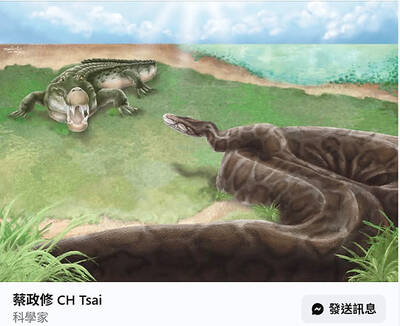
Taiwanese paleontologists have discovered fossil evidence that pythons up to 4m long inhabited Taiwan during the Pleistocene epoch, reporting their findings in the international scientific journal Historical Biology. National Taiwan University (NTU) Institute of Ecology and Evolutionary Biology associate professor Tsai Cheng-hsiu (蔡政修) led the team that discovered the largest snake fossil ever found in Taiwan. The single trunk vertebra was discovered in Tainan at the Chiting Formation, dated to between 400,000 and 800,000 years ago in the Middle Pleistocene, the paper said. The area also produced Taiwan’s first avian fossil, as well as crocodile, mammoth, saber-toothed cat and rhinoceros fossils, it said. Discoveries

Taiwanese paleontologists have discovered fossil evidence that pythons up to 4m long inhabited Taiwan during the Pleistocene epoch, reporting their findings in the international scientific journal Historical Biology. National Taiwan University (NTU) Institute of Ecology and Evolutionary Biology associate professor Tsai Cheng-hsiu (蔡政修) led the team that discovered the largest snake fossil ever found in Taiwan. A single trunk vertebra was discovered in Tainan at the Chiting Formation, dated to between 800,000 to 400,000 years ago in the Middle Pleistocene, the paper said. The area also produced Taiwan’s first avian fossil, as well as crocodile, mammoth, sabre-toothed cat and rhinoceros fossils, it said. Discoveries
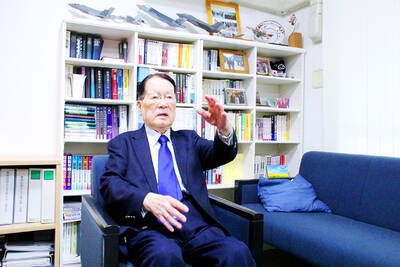
Whether Japan would help defend Taiwan in case of a cross-strait conflict would depend on the US and the extent to which Japan would be allowed to act under the US-Japan Security Treaty, former Japanese minister of defense Satoshi Morimoto said. As China has not given up on the idea of invading Taiwan by force, to what extent Japan could support US military action would hinge on Washington’s intention and its negotiation with Tokyo, Morimoto said in an interview with the Liberty Times (sister paper of the Taipei Times) yesterday. There has to be sufficient mutual recognition of how Japan could provide


 RSS
RSS