


Two Taipei city councilors yesterday accused the city government of allowing the Chinese Communist Party’s (CCP) “united front” campaign to creep into schools, revealing that Taipei Municipal Dunhua Elementary School’s choir had recorded a song expressing nostalgia for China, which was screened during a Chinese state television channel’s Lunar New Year special.
Democratic Progressive Party (DPP) Taipei City Councilor Chien Shu-pei (簡舒培) said parents had told her that the school administration late last year informed them that a television station had invited the choir members to be cast in a music video.
However, they did not expect the music video, which was recorded on the school’s campus on Jan. 12, to feature in a TV special titled “North-South Happy Reunion, Cross-Strait Reunion Dinner — 2023 Children’s New Year Greetings” (南北大歡聚兩岸小圍爐—2023萌寶大拜年) as part of the Fujian Radio Film and TV Group’s 2023 Lunar New Year Celebration shows, she said.
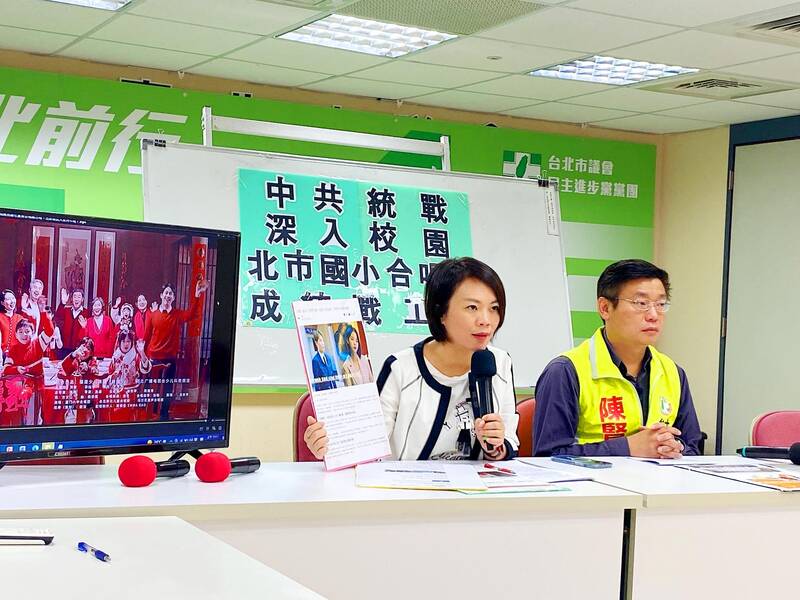
Photo: CNA
The song the choir was asked to sing was We Sing the Same Song (我們同唱一首歌) — the same controversial song that Taiwanese singers Jam Hsiao (蕭敬騰) and Ouyang Nana (歐陽娜娜) performed for China Central Television’s Lunar New Year Celebration concert last year, Chien said.
The Mainland Affairs Council (MAC) at the time had said that it was a Chinese “united front” propaganda song, she said.
“Politics should stay out of school campuses,” DPP Taipei City Councilor Chen Hsien-wei (陳賢蔚) said, adding that the Chinese music video production company had provided sheet music with simplified Chinese characters on it, and children in the choir had to write traditional Chinese characters on it because they could not read it.
He asked whether the Taipei Department of Education and the school administration had neglected their duties by allowing children to become tools of the CCP’s “united front” tactics.
Taipei Mayor Chiang Wan-an (蔣萬安) has just come into office and children in Taipei are already being used for CCP propaganda, Chien said.
The school was contacted and the video was recorded after Chiang became mayor, so it was his incompetence that allowed the CPP’s “united front” campaign to enter a school campus, she said.
The city government should set up standard operation procedures to deal with projects between China and schools in the city, she added.
Taipei Department of Education Deputy Director Chen Su-hui (陳素慧) said that when the school received the invitation from Fujian Radio Film and TV Group, it discussed the lyrics with the group and obtained consent from the children’s parents.
The television station had edited the footage afterward, so that it did not represent the school’s original intention, she said.
There are guidelines requiring that student interactions be based on academic exchanges, so the department would reiterate the guidelines, Chen said.
Separately, in response to media reports that Beijing wants to send a giant panda to Taipei Zoo, Chien said on Facebook on Monday that she was surprised Chiang is unaware of the CPP’s “united front” tactics and would be glad to accept the animal.
The CPP is using the giant panda as a political tool for its “united front” campaign, but Chiang is casually cooperating, raising concerns about his ability to deal with municipal administration and cross-strait issues, she said.

NATIONAL SECURITY: Authorities are working to confirm the identities of the military personnel involved and investigating possible illegal conduct and regulatory violations Authorities are probing possible national security implications after Kinmen police and immigration officers on Sunday found a Chinese woman allegedly posing as a tourist while engaging in prostitution involving more than 10 military personnel. The woman, surnamed Chen (陳), has since been deported, authorities said, adding that investigators are still working to confirm the identities of those implicated, as the records only listed code names and aliases. The case stemmed from a report received by the Kinmen District Prosecutors’ Office on Friday last week from the Jinhu Precinct of the Kinmen County Police Bureau. On Sunday, police, along with the National Immigration

GLOBALGIVING: ‘ Caving to external pressure is not acceptable for an organization that has cultivated justice reform and human rights for 30 years,’ one NGO said A slew of non-government organizations (NGOs) have withdrawn from the GlobalGiving fundraising platform after it announced it would use “Chinese Taipei” instead of “Taiwan” from next month. The Taiwan Good Rice Association wrote on Facebook on Friday that it was informed on April 28 via a teleconference call of the change, which was made because the platform wanted to operate in China. Taiwan Good Rice is to terminate all cooperative relationships with GlobalGiving in response to the platform’s “unilateral and non-negotiable” decision to remove references to Taiwan, the NGO said. “Taiwan is in the official name of Taiwan Good Rice Association and the

HEAVY WEATHER: Typhoon Jangmi is due to crash straight into the Ryukyus as airlines look to shift flights to larger aircraft or cancel flights to Okinawa entirely Taiwan’s international air carriers announced flight adjustments over the weekend as Typhoon Jangmi is forecast to hit the Ryukyu Islands today and tomorrow. The Central Weather Administration (CWA) upgraded Jangmi from a tropical storm to a typhoon at 8am yesterday, with the eye located 580km south of Naha city. It was moving north at 19kph. Today, China Airlines’ CI-120, CI-121, CI-122 and CI-123 flights between Taoyuan and Naha, Okinawa, have been canceled as well as CI-132 and CI-133 between Kaohsiung and Naha. EVA Air’s BR-112, BR-113, BR-186 and BR-185 flights between Taoyuan and Naha are also canceled. Low-cost carrier Tigerair Taiwan canceled IT-230,

Chinese Nationalist Party (KMT) Chairwoman Cheng Li-wun (鄭麗文) yesterday briefed her party’s Central Standing Committee regarding her scheduled visit to the US between Monday next week and June 16, saying that her purpose would be to persuade the US that the Republic of China (ROC) Constitution was a “one China” constitution that would foster stable and peaceful cross-strait relations. The ROC Constitution is the most important defense for all Taiwanese citizens, as it upholds our democracy and has contributed to our robust economy, which aligns with international and US interests, she said. “We would not be troublemakers and drag the US under,”


 RSS
RSS