

Several civic groups gathered in front of the Legislative Yuan in Taipei on Children’s Day yesterday to express their support for the Ministry of Justice’s proposed amendment to the Civil Code banning any form of parental discipline that inflicts “physical or mental violence.”
The ministry last month published its proposed amendment to Article 1085 of the Civil Code for public comment, which removed the wording “punish” from the article, changing it to “when protecting and educating children, parents should consider their age and development level, respect their personality and may not use physical or mental violence on them.”
The groups said they support the amendment, but they also urged the government to continue assisting parents in learning positive reinforcement techniques.
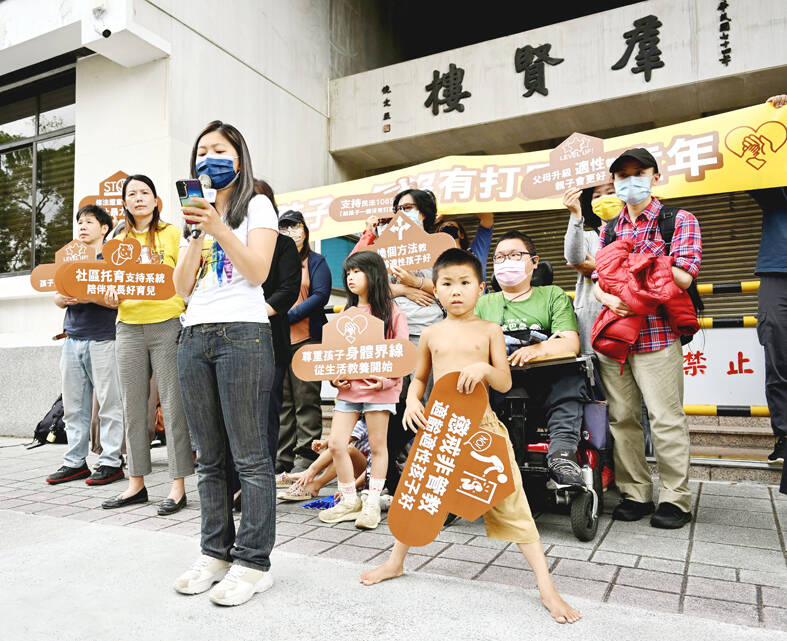
Photo: Lo Pei-de, Taipei Times
Association of Parents Participating in Education director Min Po-ling (閔柏陵) said they gathered opinions from more than 200 parents who are trying positive parenting on the difficulties they encountered when trying to communicate with their children without scolding or applying corporal punishment.
The main difficulties include parents finding it hard to control their emotions when facing trouble, feeling frustrated and overwhelmed from not knowing what to do, and feeling pressure from others who think they are not responsible parents if they do not punish their child, she said.
They also include parents accidentally hitting their child in a moment of exasperation, as they would sometimes have flashbacks of their own childhood experiences; having the urge to hit their child when they are feeling tired and have no support; and feeling that positive reinforcement takes too much time, she added.
However, she said many of the parents also said that while positive parenting takes more time and the idea that hitting children is “more effective” often pops up in their minds, after insisting on the new method for a period of time they received positive feedback from their children.
Pediatrician Lee Chia-yen (李佳燕) said that every child is an individual who needs to be respected, but corporal punishment causes physical pain and mental damage, denies children their dignity and will only cause fear instead of educating them.
It will also not let parents understand their child’s problems and harms the bond between a parent and their child, Lee said.
Lee Shan (李珊), the director of a positive parenting parent-child center in Taipei, said most parents do not want to punish their children, but they do not know what other methods to use, so she urged the government to set up more positive parenting parent-child centers across the nation, offering more play space and parenting courses.
Garden of Hope Foundation executive director Wang Yue-hao (王玥好) said discussion about the proposed amendment is often viewed as a competition between the rights of children and parents, but the amendment is actually upgrading the idea of “punishment” to “protecting rights” as the government promotes positive parenting approaches.
Taiwan Obasang Political Equality Party member Shen Pei-ling (沈佩玲) said the government should allocate a budget and invite civic groups to assist parents in applying a positive approach to educating children.
Democratic Progressive Party (DPP) Legislator Chen Pei-yu (陳培瑜) said that on her way to the news conference she saw a news report that there were 46,859 reports of child abuse last year, which is shocking, but it is a social problem, as many parents feel helpless when taking care of their children.
She urged the government to continue assisting parents in learning positive parenting skills, providing childcare services so they can rest at times and improve the social environment so that more people are willing to raise children.

A Hualien pomelo farmer refused to sell to China after the country announced it would permit more Taiwanese pomelo imports, prompting widespread support from Taiwanese consumers, who rallied to buy his fruit. China’s Taiwan Affairs Office last month said that China’s General Administration of Customs registered an additional 79 Taiwanese pomelo orchards and packing facilities in Hualien County, allowing more Taiwanese producers to export pomelos to China. “I am a Hualien fruit farmer and I refuse to sell to China,” Liu Tzu-hao (劉子豪) from Ruisui Township (瑞穗) said in an online post. Liu is a well-known farmer in the community and has served

A Chinese military drone was spotted conducting reconnaissance off Taitung County as President William Lai (賴清德) visited Pingtung County this morning to inspect a drill of the armed forces’ precision-strike capabilities, prompting the military to closely monitor its actions. Today was the final day of a three-day military exercise at Jioupeng Base (九鵬基地) to test the joint combat capabilities of the armed forces and coast guard. The exercise began on Wednesday simulating air defense interception and yesterday tested long-range strike capabilities and new air defense weapons. This morning, the military conducted a final exercise involving air defense, anti-ship and drone operations. Military sources said

UPDATE: The submarine would need to undergo combined systems testing and crew training for navy personnel before it is ready for mission, an expert said Taiwan’s first domestically built submarine, the Hai Kun (Narwhal, 海鯤), could be delivered to the navy as early as next month, military expert and Taiwan Association for Security and Development chairman Chi Tung-yun (紀東昀) said yesterday. The submarine was yesterday morning observed departing for its 21st sea trial and its 15th submerged test. The vessel missed the initial delivery deadline of November last year due to “testing delays,” its primary contractor, shipbuilder CSBC Corp, Taiwan, said in June. The contractor also cited “political pressure from China” in procuring critical equipment. All testing operations are in the final stages, with the

OCT. 31: The antiviral drugs Tamiflu and Eraflu have been distributed to about 4,000 medical facilities nationwide for people in seven groups who develop flu-like symptoms As the domestic influenza epidemic enters its peak season and continues to escalate, the Centers for Disease Control (CDC) yesterday announced that publicly funded influenza antiviral drugs for seven eligible groups have been extended to Oct. 31, allowing those who develop flu-like symptoms to receive the medication without undergoing a rapid influenza test. The CDC has extended the expanded use of flu antiviral drugs to seven groups: healthcare and influenza-prevention personnel; residents and staff at nursing homes, long-term care facilities and similar institutions; kindergarten and daycare workers and home-based caregivers; students from kindergarten through high school, vocational high school and the


 RSS
RSS