


Taiwan should work toward averting a US-China war by maintaining positive ties that are equally centered between both countries, an anti-war group of 37 active and retired academics urged in a statement.
The document, which discussed global issues along with Taiwanese matters, was initiated by National Yang Ming Chiao Tung University professor emeritus Fu Daiwei (傅大為) and presented at a news conference on Monday.
It appealed for a ceasefire in Ukraine, along with negotiations to stop the war; an end to “American militarism and economic sanctions” against Russia; and for Taiwan to focus on social welfare and climate change mitigation, rather than on military and war spending.
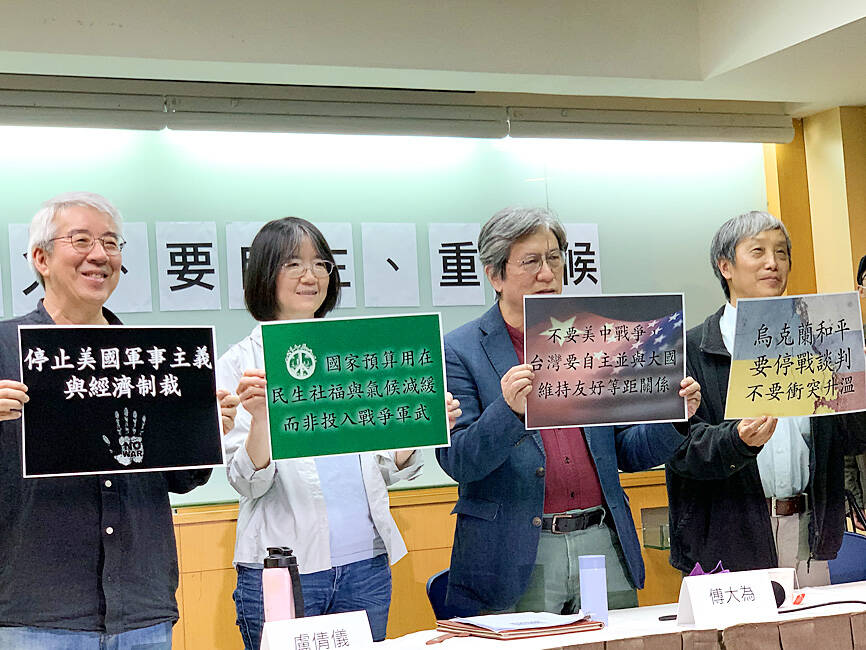
Photo courtesy of the Taiwan Anti-war Statement Working Group via CNA
The statement also said that to avert a war between the US and China, Taiwan should maintain positive and “equidistant” relations with both countries.
China’s constant threats against Taiwan were driven in large part by US “provocations” and Taiwan’s “knee-jerk” support for its programs and initiatives, Fu said.
This pattern has become a cycle, and Taiwan should adopt a policy of “equidistant diplomacy,” or signaling of neutrality, toward the two superpowers to lower the risk of war, he said.
Lu Chien-yi (盧倩儀), a research fellow at Academia Sinica’s Institute of European and American Studies, said that US militarism has come at a significant cost to its own people, citing cuts to social services, crumbling infrastructure and a drop in life expectancy.
“If politicians in Taiwan try to imitate these cuts to social welfare and the climate change budget, should we just blindly accept it?” she asked.
Taiwanese use a “strange logic” to describe China as the only threat, Lu said, adding that this “dangerous habit” has been reinforced by government officials who try to tamp down public skepticism of the US.
While China wants to “swallow” Taiwan, the US could end up “sacrificing” Taiwan in a potential war, and neither outcome is better than the other, Lu said.
Feng Chien-san (馮建三), a professor at National Chengchi University’s (NCCU) College of Communications, made a similar statement about the situation in Ukraine.
He said that Russia’s invasion of Ukraine was “an ignorant crime,” but the responsibility for the suffering and continued bloodshed was not Russia’s alone.
The US and its allies pushed for NATO’s eastward expansion when they knew this had been a long-time red line for Russia, and have blocked efforts to reach a diplomatic ceasefire since the war began, he said.
Retired NCCU communications professor Kuo Li-hsin (郭力昕) said that while the group’s statement is bound to provoke strong opinions, he hopes it provides a starting point for public debate.
“In a society that prides itself on democracy and freedom of speech, we hope there can be more deep thought and dialogue” on the issues that it raises, he said.
Some commentators said that the statement was excessively tolerant toward China.
Representative to Germany Shieh Jhy-wei (謝志偉) wrote on Facebook that the academics had their antiwar message “backward,” as the real threats of aggression and invasion come from Russia and China.
Wu Hsin-tai (吳欣岱), head of the Taipei chapter of the Taiwan Statebuilding Party, criticized the academics for promoting “naive appeasement” of China, while turning a blind eye to its aim of annexing Taiwan.

Yangmingshan National Park authorities yesterday urged visitors to respect public spaces and obey the law after a couple was caught on a camera livestream having sex at the park’s Qingtiangang (擎天崗) earlier in the day. The Shilin Police Precinct in Taipei said it has identified a suspect and his vehicle registration number, and would summon him for questioning. The case would be handled in accordance with public indecency charges, it added. The couple entered the park at about 11pm on Thursday and began fooling around by 1am yesterday, the police said, adding that the two were unaware of the park’s all-day live

Yangmingshan National Park’s Qingtiangang (擎天崗) nature area has gone viral after a park livestream camera observed a couple in the throes of intimate congress, which was broadcast live on YouTube, drawing large late-night crowds and sparking a backlash over noise, bright lights and disruption to wildlife habitat. The area’s livestream footage appeared to show a couple engaging in sexual activity on a picnic table in the park on Friday last week, with the uncensored footage streamed publicly online. The footage quickly spread across social media, prompting a tide of visitors to travel to the site to “check in” and recreate the

A former soldier and an active-duty army officer were yesterday indicted for allegedly selling classified military training materials to a Chinese intelligence operative for a total of NT$79,440. The Taipei District Prosecutors’ Office indicted Chen Tai-yin (陳泰尹) and Lee Chun-ta (李俊達) for contravening the National Security Act (國家安全法) and the Anti-Corruption Act (貪污治罪條例). Chen left the military in September 2013 after serving alongside then-staff sergeant Lee, now an army lieutenant, at the 21st Artillery Command of the army’s Sixth Corps from 2011 to 2013, according to the indictment. Chen met a Chinese intelligence operative identified as “Wang” (王) through a friend in November

Minister of Digital Affairs Lin Yi-ching (林宜敬) yesterday cited regulatory issues and national security concerns as an expert said that Taiwan is among the few Asian regions without Starlink. Lin made the remarks on Facebook after funP Innovation Group chief executive officer Nathan Chiu (邱繼弘) on Friday said Taiwan and four other countries in Asia — China, North Korea, Afghanistan and Syria — have no access to Starlink. Starlink has become available in 166 countries worldwide, including Ukraine, Malaysia, the Philippines and Vietnam, in the six years since it became commercial, he said. While China and North Korea block Starlink, Syria is not


 RSS
RSS