


The nation’s COVID-19 mortality rate is relatively low and the vaccination rate relatively high compared with Organisation for Economic Co-operation and Development (OECD) countries, the Central Epidemic Command Center (CECC) said yesterday, after a professor criticized the nation’s COVID-19 death rate.
In a review of data from the 38 OECD countries, along with Taiwan and Singapore, Taiwan ranked sixth-lowest in COVID-19 mortality and case-fatality rates, said Deputy Minister of Health and Welfare Victor Wang (王必勝), who heads the center.
At the CECC’s daily news briefing in Taipei, Wang displayed charts illustrating Taiwan’s placement among OECD nations on COVID-19-related metrics.
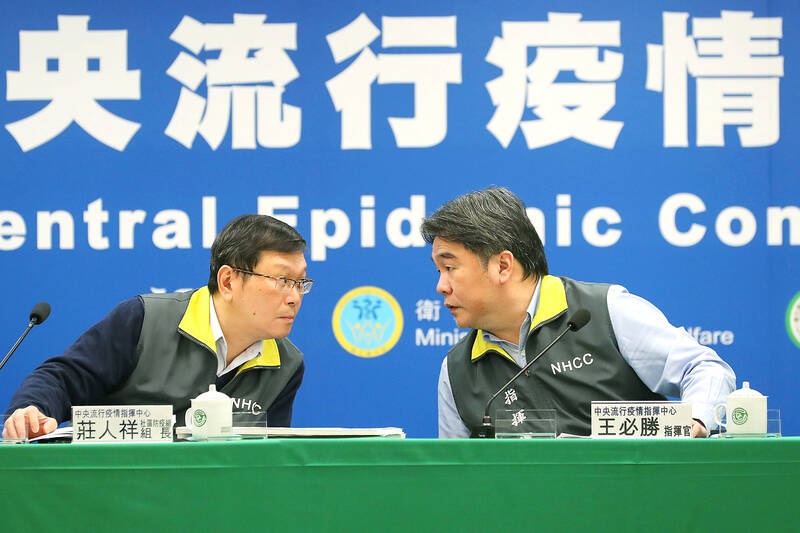
Photo: CNA
The presentation followed remarks on Saturday by a public health professor who said that the CECC had missed opportunities to lower the mortality rate among people infected with the Omicron variant of SARS-CoV-2.
Chan Chang-chuan (詹長權), a professor at National Taiwan University’s College of Public Health, wrote on Facebook that the center had failed to implement suggestions from public health specialists, adding that COVID-19 was one of the top 10 causes of death last year, and would continue to be this year if Taiwan cannot effectively reduce COVID-19 deaths.
Chan said that as of Saturday there were 17,453 COVID-19-related deaths, including 16,587 deaths likely from Omicron, and that monthly confirmed deaths in the past several months have exceeded 900.
Wang’s charts showed that Taiwan’s COVID-19 mortality rate is 742.2 per 1 million people, higher only than those of Iceland, South Korea, Japan, New Zealand and Singapore, the rates of which range from 681.5 to 284.7 per million.
Hong Kong’s COVID-19 mortality rate is 1,814.1 per million, while Germany’s is 2,054.8, Italy’s is 3,131.7 and the US’ is 3,456.1.
Taiwan’s COVID-19 case-fatality rate is 0.18 percent, higher only than those of Australia, New Zealand, South Korea, Iceland and Singapore, with rates from 0.17 percent to 0.08 percent, the CECC’s charts showed.
Hong Kong’s is 0.47 percent, Italy’s is 0.74 percent, the UK’s is 0.85 percent and the US’ is 1.11 percent.
The data show that Taiwan’s performance is reasonable, Wang said.
With the pandemic entering its late stages, some countries have stopped conducting mass testing and reporting daily infections, so the numbers might not be accurate, but Taiwan continues to report daily cases and deaths, he said.
The criteria for determining COVID-19 associated deaths differs among countries, but Taiwan counts all cases that had COVID-19 infection listed on the death certificate, even if the main cause of death was a chronic illness or comorbidity, he added.
Taiwan’s first-dose COVID-19 vaccination rate is the fourth-highest on the list, at 91.48 percent, and its booster vaccination rate is third-highest, Wang said.
Taiwan and CECC members have been working hard to keep deaths low and boost vaccination coverage, he said, adding that there is always room to improve.
The center welcomes the suggestions of members on the center’s specialists panel, the Advisory Committee on Immunization Practices and National Vaccine Injury Compensation Program committee, as well as many other experts, including Chan, he said.
Regarding improving the nation’s first-dose vaccination rate, Wang said the rate among elderly people is not high enough.
More than half of those whose deaths were related to COVID-19 were unvaccinated, and more than two-thirds did not get a booster shot.
The first-dose vaccination rate among people aged 65 or older is 86.7, said Centers for Disease Control (CDC) Deputy Director-General Philip Lo (羅一鈞), who is deputy head of the CECC’s medical response division.
About 545,000 people in the age group are still not vaccinated, he said.

Yangmingshan National Park authorities yesterday urged visitors to respect public spaces and obey the law after a couple was caught on a camera livestream having sex at the park’s Qingtiangang (擎天崗) earlier in the day. The Shilin Police Precinct in Taipei said it has identified a suspect and his vehicle registration number, and would summon him for questioning. The case would be handled in accordance with public indecency charges, it added. The couple entered the park at about 11pm on Thursday and began fooling around by 1am yesterday, the police said, adding that the two were unaware of the park’s all-day live

A former soldier and an active-duty army officer were yesterday indicted for allegedly selling classified military training materials to a Chinese intelligence operative for a total of NT$79,440. The Taipei District Prosecutors’ Office indicted Chen Tai-yin (陳泰尹) and Lee Chun-ta (李俊達) for contravening the National Security Act (國家安全法) and the Anti-Corruption Act (貪污治罪條例). Chen left the military in September 2013 after serving alongside then-staff sergeant Lee, now an army lieutenant, at the 21st Artillery Command of the army’s Sixth Corps from 2011 to 2013, according to the indictment. Chen met a Chinese intelligence operative identified as “Wang” (王) through a friend in November

Minister of Digital Affairs Lin Yi-ching (林宜敬) yesterday cited regulatory issues and national security concerns as an expert said that Taiwan is among the few Asian regions without Starlink. Lin made the remarks on Facebook after funP Innovation Group chief executive officer Nathan Chiu (邱繼弘) on Friday said Taiwan and four other countries in Asia — China, North Korea, Afghanistan and Syria — have no access to Starlink. Starlink has become available in 166 countries worldwide, including Ukraine, Malaysia, the Philippines and Vietnam, in the six years since it became commercial, he said. While China and North Korea block Starlink, Syria is not

Yangmingshan National Park’s Qingtiangang (擎天崗) nature area has gone viral after a park livestream camera observed a couple in the throes of intimate congress, which was broadcast live on YouTube, drawing large late-night crowds and sparking a backlash over noise, bright lights and disruption to wildlife habitat. The area’s livestream footage appeared to show a couple engaging in sexual activity on a picnic table in the park on Friday last week, with the uncensored footage streamed publicly online. The footage quickly spread across social media, prompting a tide of visitors to travel to the site to “check in” and recreate the


 RSS
RSS