


Ma Ying-jeou (馬英九) and Taipei Mayor Chiang Wan-an (蔣萬安) of the Chinese Nationalist Party (KMT) do not have genuine concern for the 228 Incident, nor are they willing to seek the truth regarding its atrocities, an executive at an advocacy group said on Friday.
“Ma and Chiang Wan-an speak about their concern for victims and of their regret for what happened, but it is all for show,” Taiwan 228 Care Association chairman Wang Wen-hong (王文宏) said in response to a speech Ma gave earlier in the day.
“They only talk superficially about the events of the 228 Massacre, but have never offered a genuine apology,” Wang said.
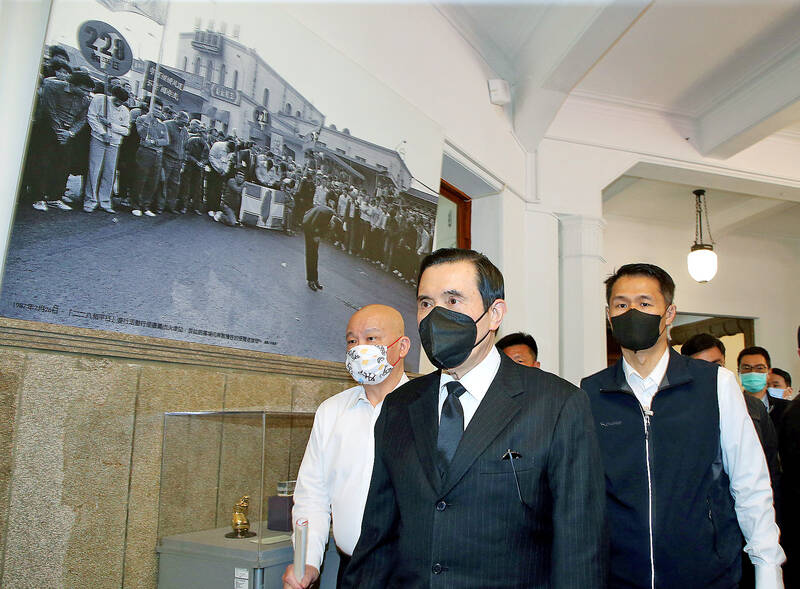
Photo: CNA
On Friday, Ma attended an event in Taipei to commemorate the work of democracy advocate Liao Chin-ping (廖進平), who was arrested in the capital in the aftermath of the 228 Incident in 1947 and was apparently executed by the then-KMT government.
In a speech, Ma touted his work to bring justice and compensation to people who were killed in the 228 Incident and their families.
“It is popular to speak of ‘transitional justice’ today, but I started work three decades ago to deliver justice for those who were killed, and for their families to receive compensation,” Ma said.
“In doing so, we helped make great strides to promote harmony among ethnic groups, to ensure peace and stability in society,” he said.
Ma said that when he was minister of justice from 1993 to 1996 and Taipei mayor from 1998 to 2006, he was a member of the Executive Yuan’s 228 Incident Taskforce, which implemented statutes to compensate people affected by the 228 Incident and address situations of wrongful imprisonment from that time.
Later, he helped establish the Memorial Foundation of 228, he said.
However, Wang said that Ma represents the former KMT regime.
He upholds the party’s colonial oppression, which has denied freedom and human rights since the KMT lost the Chinese Civil War and began its illegal military occupation of Taiwan, Wang said.
“Ma, Chiang and the KMT have never held the party’s previous leaders responsible, including Chiang Kai-shek (蔣介石) and other officials and military commanders, for the killings, torture and other atrocities inflicted upon innocent Taiwanese,” Wang said.
“Many people are still seeking the truth about their family members,” he said. “They want to know who ordered the killings, who the murderers were — the executioners — but Ma, Chiang Wan-an and the party always say to forgive and forget, and that people must look ahead and let go of the past.”
“The KMT persists in efforts to hide or destroy documents to conceal the party’s dark past from the public,” he said.
Wang was born in 1947. His father was a city councilor in Kaohsiung who tried to mediate between civilians and the KMT’s military forces, but was killed by KMT troops 32 days after Wang was born.
Chiang Wan-an is proud of his status as a purported member of the fourth generation of the Chiang political dynasty, but he has not shown remorse or apologized for the deaths of tens of thousands of Taiwanese by KMT military officials and their troops from China, Wang said.
“One of the Taiwan 228 Care Association’s requests is that the Chiang Kai-shek Memorial Hall in Taipei be permanently closed, and that the statues of Chiang Kai-shek and [his son, former president] Chiang Ching-kuo (蔣經國) be removed from Cihu (慈湖) in Taoyuan’s Dasi District (大溪),” he said.
“Moreover, the embalmed bodies of the two should be buried,” he added.
These steps would show that the KMT is serious about coming to terms with its past and restoring a semblance of justice for those who died and their families, he said.

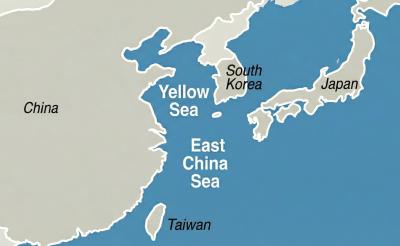
China has reserved offshore airspace in the Yellow Sea and East China Sea from March 27 to May 6, issuing alerts usually used to warn of military exercises, although no such exercises have been announced, the Wall Street Journal (WSJ) reported yesterday. Reserving such a large area for 40 days without explanation is an “unusual step,” as military exercises normally only last a few days, the paper said. These alerts, known as Notice to Air Missions (Notams), “are intended to inform pilots and aviation authorities of temporary airspace hazards or restrictions,” the article said. The airspace reserved in the alert is
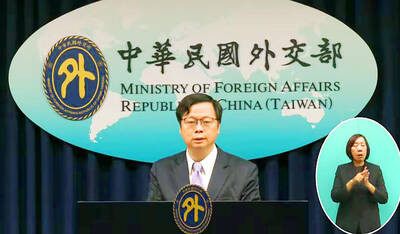
NAMING SPAT: The foreign ministry called on Denmark to propose an acceptable solution to the erroneous nationality used for Taiwanese on residence permits Taiwan has revoked some privileges for Danish diplomatic staff over a Danish permit that lists “Taiwan” as “China,” Eric Huang (黃鈞耀), head of the Ministry of Foreign Affairs’ Department of European Affairs, told a news conference in Taipei yesterday. Reporters asked Huang whether the Danish government had responded to the ministry’s request that it correct the nationality on Danish residence permits of Taiwanese, which has been listed as “China” since 2024. Taiwan’s representative office in Denmark continues to communicate with the Danish government, and the ministry has revoked some privileges previously granted to Danish representatives in Taiwan and would continue to review
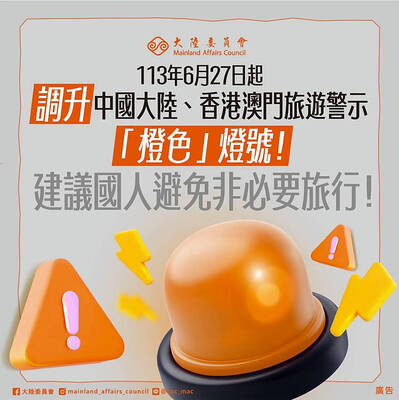
More than 6,000 Taiwanese students have participated in exchange programs in China over the past two years, despite the Mainland Affairs Council’s (MAC) “orange light” travel advisory, government records showed. The MAC’s publicly available registry showed that Taiwanese college and university students who went on exchange programs across the Strait numbered 3,592 and 2,966 people respectively. The National Immigration Agency data revealed that 2,296 and 2,551 Chinese students visited Taiwan for study in the same two years. A review of the Web sites of publicly-run universities and colleges showed that Taiwanese higher education institutions continued to recruit students for Chinese educational programs without
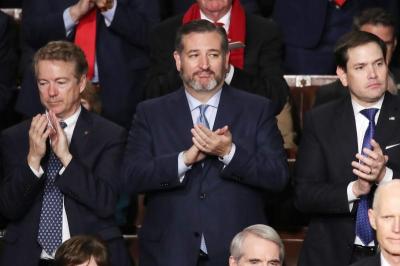
A bipartisan group of US senators has introduced a bill to enhance cooperation with Taiwan on drone development and to reduce reliance on supply chains linked to China. The proposed Blue Skies for Taiwan Act of 2026 was introduced by Republican US senators Ted Cruz and John Curtis, and Democratic US senators Jeff Merkley and Andy Kim. The legislation seeks to ease constraints on Taiwan-US cooperation in uncrewed aerial systems (UAS), including dependence on China-sourced components, limited access to capital and regulatory barriers under US export controls, a news release issued by Cruz on Wednesday said. The bill would establish a "Blue UAS


 RSS
RSS