


A suspected Chinese surveillance drone took longer than usual to cross the continental US due to sudden stratospheric warming over the arctic, Central Weather Bureau Director-General Cheng Ming-dean (鄭明典) said yesterday.
The balloon was first detected over Billings, Montana, on Wednesday after likely traversing western Canada. It was shot down by the US on Saturday over the Atlantic Ocean off the coast of South Carolina. The FBI has gathered parts of the balloon for analysis. China has denied it was a surveillance balloon and protested its destruction.
The object likely took seven days to cross Canada and the continental US, a journey that should normally have taken about two days, Cheng said in a social media post.
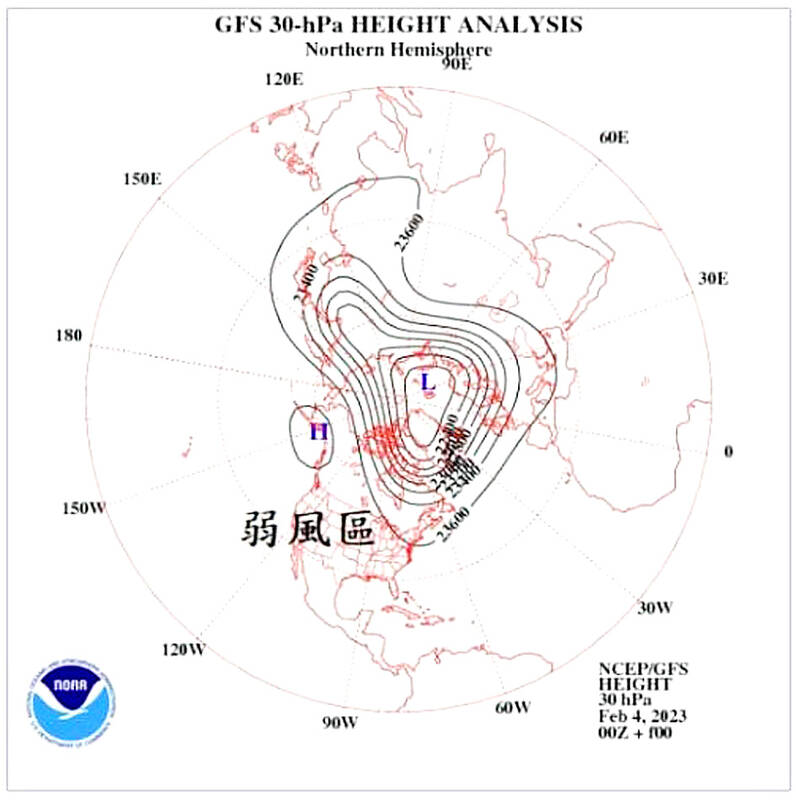
Photo: Screen grab from Cheng Ming-dean’s Facebook page
Sudden stratospheric warming occurs when stratospheric temperatures increase in the winter, and the winds that normally blow from west to east around the pole weaken dramatically and even reverse direction, Cheng said.
Such an event took place over the past week, significantly shifting the position of high-altitude westerlies, he said, adding that a weak westerly wind blew across the continental US during the period, slowing down the Chinese balloon.
If the balloon had not been shot down, it would have encountered strong winds after reaching the Atlantic and been quickly blown toward Europe, he said.
Cheng on Saturday said that an object similar to the suspected Chinese surveillance balloon appeared over Taipei twice in the past 18 months — in September 2021 and March last year — hovering in the sky for two to three hours each time.
The government at the time did not comment on the sightings.

South Korean K-pop girl group Blackpink are to make Kaohsiung the first stop on their Asia tour when they perform at Kaohsiung National Stadium on Oct. 18 and 19, the event organizer said yesterday. The upcoming performances will also make Blackpink the first girl group ever to perform twice at the stadium. It will be the group’s third visit to Taiwan to stage a concert. The last time Blackpink held a concert in the city was in March 2023. Their first concert in Taiwan was on March 3, 2019, at NTSU Arena (Linkou Arena). The group’s 2022-2023 “Born Pink” tour set a

CPBL players, cheerleaders and officials pose at a news conference in Taipei yesterday announcing the upcoming All-Star Game. This year’s CPBL All-Star Weekend is to be held at the Taipei Dome on July 19 and 20.

The Taiwan High Court yesterday upheld a lower court’s decision that ruled in favor of former president Tsai Ing-wen (蔡英文) regarding the legitimacy of her doctoral degree. The issue surrounding Tsai’s academic credentials was raised by former political talk show host Dennis Peng (彭文正) in a Facebook post in June 2019, when Tsai was seeking re-election. Peng has repeatedly accused Tsai of never completing her doctoral dissertation to get a doctoral degree in law from the London School of Economics and Political Science (LSE) in 1984. He subsequently filed a declaratory action charging that

The Hualien Branch of the High Court today sentenced the main suspect in the 2021 fatal derailment of the Taroko Express to 12 years and six months in jail in the second trial of the suspect for his role in Taiwan’s deadliest train crash. Lee Yi-hsiang (李義祥), the driver of a crane truck that fell onto the tracks and which the the Taiwan Railways Administration's (TRA) train crashed into in an accident that killed 49 people and injured 200, was sentenced to seven years and 10 months in the first trial by the Hualien District Court in 2022. Hoa Van Hao, a


 RSS
RSS