


A retired rear admiral and a former lawmaker have been detained for allegedly contravening the National Security Act (國家安全法), the Kaohsiung District Court said yesterday, in the latest spying scandal to hit the military’s upper echelons.
Hsia Fu-hsiang (夏復翔), who served as deputy head of the navy’s political warfare department, and former Taiwan Solidarity Union legislator Lo Chih-ming (羅志明) were deemed flight risks and taken into custody yesterday, the court said.
The court reversed a decision allowing bail earlier this month, citing the risk that the duo could collude with witnesses.
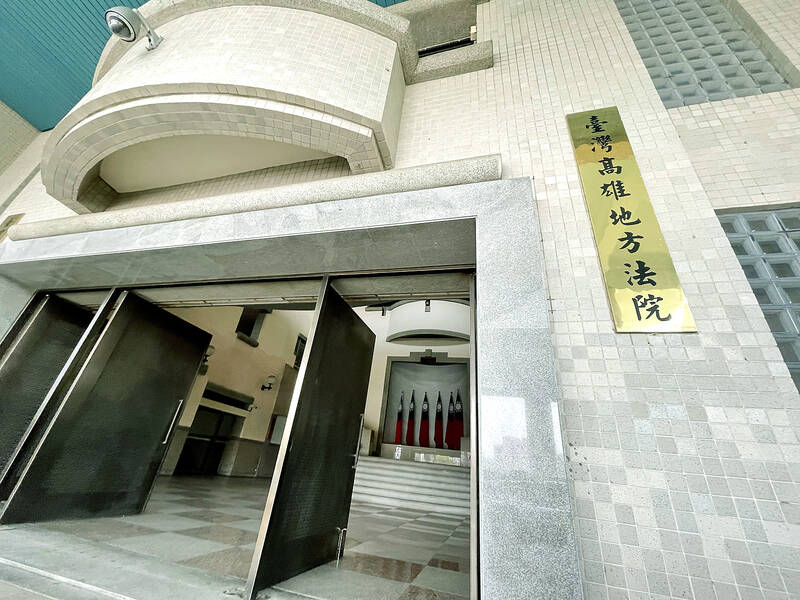
Photo: Huang Liang-chieh, Taipei Times
“The defendants arranged witnesses to go to mainland China and [the trips] were very likely linked to promoting unification” with China, it said in a statement without providing further details of the probe.
Lo allegedly recruited Hsia, and the pair used their connections to arrange for retired military officers to visit China as part a bid to develop a spying network in Taiwan.
Their case surfaced shortly after prosecutors launched an investigation into a retired air force colonel suspected of recruiting at least six active-duty officers in the air force and the navy for Beijing in eight years.
There have been a number of cases involving former senior Taiwanese military officials accused of developing spying networks for China in recent years.
A retired major general in the air force earlier this month received a four-year suspended sentence for accepting meals and trips offered by a Hong Kong businessman allegedly acting on behalf of Beijing, after the court said he showed remorse and had no previous criminal record.

Considering that most countries issue more than five denominations of banknotes, the central bank has decided to redesign all five denominations, the bank said as it prepares for the first major overhaul of the banknotes in more than 24 years. Central bank Governor Yang Chin-lung (楊金龍) is expected to report to the Legislative Yuan today on the bank’s operations and the redesign’s progress. The bank in a report sent to the legislature ahead of today’s meeting said it had commissioned a survey on the public’s preferences. Survey results showed that NT$100 and NT$1,000 banknotes are the most commonly used, while NT$200 and NT$2,000

The Centers for Disease Control (CDC) yesterday reported the first case of a new COVID-19 subvariant — BA.3.2 — in a 10-year-old Singaporean girl who had a fever upon arrival in Taiwan and tested positive for the disease. The girl left Taiwan on March 20 and the case did not have a direct impact on the local community, it said. The WHO added the BA.3.2 strain to its list of Variants Under Monitoring in December last year, but this was the first imported case of the COVID-19 variant in Taiwan, CDC Deputy Director-General Lin Ming-cheng (林明誠) said. The girl arrived in Taiwan on

South Korea is planning to revise its controversial electronic arrival card, a step Taiwanese officials said prompted them to hold off on planned retaliatory measures, a South Korean media report said yesterday. A Yonhap News Agency report said that the South Korean Ministry of Foreign Affairs is planning to remove the “previous departure place” and “next destination” fields from its e-arrival card system. The plan, reached after interagency consultations, is under review and aims to simplify entry procedures and align the electronic form with the paper version, a South Korean ministry official said. The fields — which appeared only on the electronic form

The Ministry of Foreign Affairs (MOFA) is suspending retaliation measures against South Korea that were set to take effect tomorrow, after Seoul said it is updating its e-arrival system, MOFA said today. The measures were to be a new round of retaliation after Taiwan on March 1 changed South Korea's designation on government-issued alien resident certificates held by South Korean nationals to "South Korea” from the "Republic of Korea," the country’s official name. The move came after months of protests to Seoul over its listing of Taiwan as "China (Taiwan)" in dropdown menus on its new online immigration entry system. MOFA last week


 RSS
RSS