


The Central Epidemic Command Center (CECC) prioritizes saving lives, but Pfizer-BioNTech’s COVID-19 vaccine procurement contract does not allow for Taiwan to switch undelivered doses for the new Omicron BA.4/BA.5-adapted bivalent vaccine, Deputy Minister of Health and Welfare Victor Wang (王必勝), who heads the center, said yesterday.
On the sidelines of the National Taiwan University Cancer Center’s fourth anniversary event on Monday, Hon Hai Precision Industry Co founder Terry Gou (郭台銘) told reporters that the government must prioritize people’s lives, because from his experience purchasing vaccines, he does not believe the government is doing so.
“When Taiwan needed vaccines the most, Taiwan Semiconductor Manufacturing Co, the Buddhist Compassion Relief Tzu Chi Foundation and I, approved by her majesty President Tsai Ing-wen (蔡英文), worked hard to import the Pfizer-BioNTech vaccine,” he said. “If the vaccine could have arrived two months earlier, I believe [COVID-19-related] deaths would have been significantly reduced.”

Photo: Lo Hsin-chen, Taipei Times
He said his 97-year-old mother had received three Pfizer-BioNTech vaccine shots, but she cannot receive the new Pfizer-BioNTech bivalent vaccine booster, as they are not available in Taiwan.
“I must stress again that we most certainly treat people’s lives as a top priority,” Wang said at the Centers for Disease Control yesterday.
Taiwan has imported nearly 23 million doses of the Pfizer-BioNTech vaccine — about 15 million donated by the private sector and about 7.66 million purchased by the government — as well as 26 million doses of the Moderna vaccine — about 6 million doses last year and 20 million doses this year, he said.
Wang said that there are still about 300,000 doses of the adult Pfizer-BioNTech vaccine and 700,000 doses of the children’s vaccine available to administer.
All of the scheduled Pfizer-BioNTech vaccine doses have arrived in Taiwan, he said.
However, about two months ago, when about 1 million doses had yet to be delivered, the CECC had tried to switch them with the new bivalent vaccine, but the original procurement contract did not include the option to exchange vaccines for newer types and the request was denied, he said.
Taiwan’s procurement contract with Moderna is for 20 million doses this year and 15 million doses next year, and the company has agreed to allow undelivered doses to be switched with next-generation vaccines, Wang said.
The supply of the Moderna vaccine is also more flexible, as the vaccine maker is willing to deliver more doses when demand is higher or postpone delivery if people are less willing to get vaccinated, he said.
There are still about 4 million doses of Moderna’s Omicron-adapted bivalent vaccine available, and the center would be launching campaigns to encourage more people to get vaccinated, as recently there have been only about 20,000 to 30,000 doses administered per day, Wang said.
The Pfizer-BioNTech and the Moderna bivalent vaccines are mRNA vaccines approved by the Advisory Committee on Immunization Practices for use as a booster shot, and there is no evidence of there being a significant difference in their efficacy or side effects.
The CECC yesterday reported 17,080 new local COVID-19 cases, 51 imported cases and 18 deaths. The local caseload was 0.2 percent lower than on Tuesday last week.
Of the 18 deaths, 11 people were unvaccinated, while 15 had not received a booster shot, CECC data showed.

Yangmingshan National Park authorities yesterday urged visitors to respect public spaces and obey the law after a couple was caught on a camera livestream having sex at the park’s Qingtiangang (擎天崗) earlier in the day. The Shilin Police Precinct in Taipei said it has identified a suspect and his vehicle registration number, and would summon him for questioning. The case would be handled in accordance with public indecency charges, it added. The couple entered the park at about 11pm on Thursday and began fooling around by 1am yesterday, the police said, adding that the two were unaware of the park’s all-day live

A former soldier and an active-duty army officer were yesterday indicted for allegedly selling classified military training materials to a Chinese intelligence operative for a total of NT$79,440. The Taipei District Prosecutors’ Office indicted Chen Tai-yin (陳泰尹) and Lee Chun-ta (李俊達) for contravening the National Security Act (國家安全法) and the Anti-Corruption Act (貪污治罪條例). Chen left the military in September 2013 after serving alongside then-staff sergeant Lee, now an army lieutenant, at the 21st Artillery Command of the army’s Sixth Corps from 2011 to 2013, according to the indictment. Chen met a Chinese intelligence operative identified as “Wang” (王) through a friend in November

Minister of Digital Affairs Lin Yi-ching (林宜敬) yesterday cited regulatory issues and national security concerns as an expert said that Taiwan is among the few Asian regions without Starlink. Lin made the remarks on Facebook after funP Innovation Group chief executive officer Nathan Chiu (邱繼弘) on Friday said Taiwan and four other countries in Asia — China, North Korea, Afghanistan and Syria — have no access to Starlink. Starlink has become available in 166 countries worldwide, including Ukraine, Malaysia, the Philippines and Vietnam, in the six years since it became commercial, he said. While China and North Korea block Starlink, Syria is not
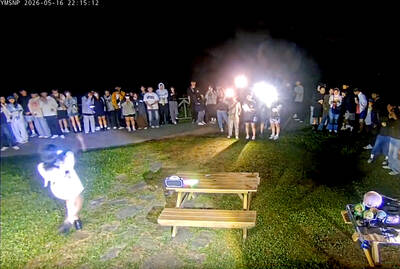
Yangmingshan National Park’s Qingtiangang (擎天崗) nature area has gone viral after a park livestream camera observed a couple in the throes of intimate congress, which was broadcast live on YouTube, drawing large late-night crowds and sparking a backlash over noise, bright lights and disruption to wildlife habitat. The area’s livestream footage appeared to show a couple engaging in sexual activity on a picnic table in the park on Friday last week, with the uncensored footage streamed publicly online. The footage quickly spread across social media, prompting a tide of visitors to travel to the site to “check in” and recreate the


 RSS
RSS