


Annexing Taiwan would be Beijing’s first step toward global domination, former US deputy national security adviser Matthew Pottinger said on Monday.
Pottinger made the remarks in an online seminar, titled “The View of the Taiwan Strait from the US-Japan Alliance,” held by the RAND Corporation, Radio Free Asia reported.
The world lacks understanding of Chinese President Xi Jinping’s (習近平) long-term ambitions for the world, which is not only to remove US influence in the Asia-Pacific region, but also to put international order under Chinese control, he said.

Photo: AP
If the international community wants to prevent a war in the Taiwan Strait, the US, Japan and other countries should “dent China’s confidence in wars” and let it know that invading Taiwan would be “very likely to fail and take ages,” he added.
Pottinger called on the US and Japan to “make a clearer promise to Taiwan regarding its security” so that Beijing would not think that the US is too afraid to make a promise and resort to force against Taiwan.
Taiwan has to show the will to safeguard its land, freedom and sovereignty, which is the decisive factor in deterring China from using force, he added.
“No war results from accidents,” he said, adding that wars usually break out because the aggressor is too optimistic about its power and thinks the benefits of starting a conflict outweigh those of solving problems peacefully.
Taiwan should provide more comprehensive military training to its recruits to show China the possible costs of an invasion, he said.
Cortez Cooper, a senior researcher on international and national security issues at the RAND Corporation, pointed to Taiwan’s strategic importance.
Taiwan is crucial to Japan and the US’ allies in the region, as it is in the middle of the first island chain, which straddles crucial international shipping routes, he said.
In addition, the international community relies heavily on Taiwan’s semiconductor industry, he said, adding that the nation is also the “beacon of democracy in Asia.”
Beijing has no intention of solving cross-strait issues peacefully, which is evident in its control of Hong Kong, so the US cannot let Taiwan fall into the hands of an authoritarian regime, he said.
Asked whether the adoption of clear strategies on Taiwan by the US and Japan might exacerbate cross-strait tensions, Cooper said that letting Beijing know that the US and Japan have made promises to Taiwan can “effectively deter China’s expansion.”
Yasuhiro Matsuda, a professor of international politics at the University of Tokyo, said the US has a responsibility to protect Taiwan.
If China annexed Taiwan, Japan would have doubts over the US’ security promises and defense capability, Matsuda added.
Separately, Deputy Minister of Foreign Affairs Tsai Ming-yen (蔡明彥) told Sky News on Monday that “China is using the Taiwan Strait as a playground” to test the bottom line of the international community.
China has taken more abrasive and provocative actions against Taiwan, including sending fighter jets into the skies around Taiwan and launching large-scale military drills near the country, which showed its ambition to unilaterally change the “status quo” across the Taiwan Strait, he said.
China’s ambition poses threats not only to Taiwan, but also to the rest of the world, he added.
Additional reporting by Lu Yi-hsuan

UPGRADE: The Kang Ding-class frigate is replacing its Chaparall missiles with Tien Chien II and Hua Yang VLS, which would provide it with long-range, 360° air defense Taiwan plans to produce 1,200 to 1,376 Hai Chien II missiles (海劍二, Sea Sword II) — also known as TC-2N — to serve as the standard air defense system of the navy’s surface combatant fleet, a source said yesterday. Last week, the Hai Chien II, the naval version of the Tien Kung II missile (天劍二, Sky Sword II), completed a live-fire test in waters off the National Chungshan Institute of Science and Technology’s Jiupeng facility (九鵬) in Pingtung County’s Manjhou Township (滿州). The MIM72 Chaparral and other dated air defense missiles that currently arm Taiwanese ships have inadequate range to combat Chinese

REASONS FOR TRAVEL: An assistant professor said that proposed amendments to penalize drivers if they used drugs overseas would not deter people from traveling People who operate a motor vehicle under the influence of marijuana would have their driver’s license revoked, even if they used the substance while overseas, the Ministry of Transportation and Communications said yesterday, citing proposed amendments to the Road Traffic Management and Penalty Act (道路交通管理處罰條例). The amendments would also authorize the government to revoke the licenses of people determined to have used Category 1 or Category 2 narcotics, even if they were not operating a vehicle while under the influence of drugs, as well as ban them from taking the license test for three years, the ministry said. People aged 18 or
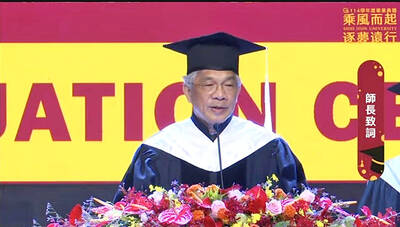
Shih Hsin University President Chen Ching-he (陳清河) yesterday issued a public apology for comments made in his commencement speech last week, stating that he has asked the school to suspend his duties and halt his wages for two months as a show of contrition. At the commencement ceremony on May 30, Chen said, “If you don’t manage your time well, or your own emotions, or your health, then I am telling every one of you — put a quick end to ‘you,’ because the world has no need for ‘you.’” The comments have sparked significant controversy online, and Chen through an open
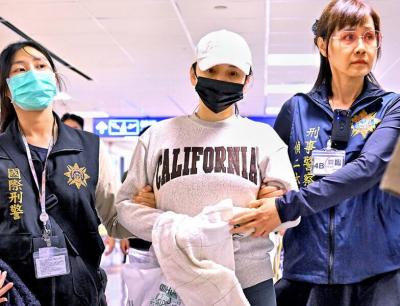
Johanne Liou (劉喬安), a Taiwanese woman who shot to unwanted fame during the Sunflower movement protests in 2014, returned to Taiwan last night after being deported from the US. She is to stand trial in Taiwan for charges involving embezzlement, fraud and drug crimes. The Criminal Investigation Bureau (CIB) said it took her into custody at Taiwan Taoyuan International Airport and would first question her before transferring her to the New Taipei District Prosecutors’ Office. She was arrested upon disembarking a flight from San Francisco that landed shortly before 7pm. Liou absconded to the US in 2019 after jumping bail


 RSS
RSS