


Taiwan and Palau on Sunday signed a memorandum of understanding (MOU) in Taoyuan to boost bilateral cooperation between their Austronesian ethnic groups.
Council of Indigenous Peoples Minister Icyang Parod and Palauan Minister of Human Resources, Culture, Tourism and Development Ngiraibelas Tmetuchl signed the pact at a ceremony witnessed by Palauan President Surangel Whipps Jr, who arrived in Taiwan on Wednesday, leading a Palauan delegation for a state visit and to attend yesterday’s Double Ten National Day celebrations.
Lauding his deep ties with Palau, Icyang said he had visited the Pacific country four times and had met with several Palauan delegations on their visits to Taiwan.
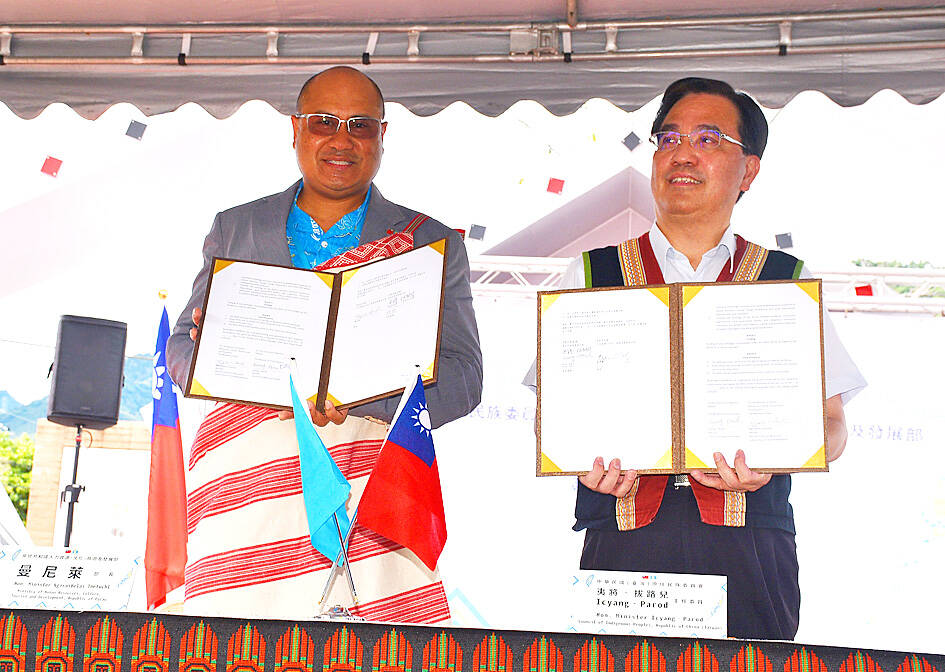
Photo: Lee Jung-ping, Taipei Times
Tmetuchl and his tourism development team had also visited indigenous communities in Hualien and Taitung counties to gain an understanding of Taiwan’s policies in promoting aboriginal tourism, Icyang said.
Taiwan’s indigenous peoples, which comprise about 1 percent of the population, are Austronesian, and share ethnic and linguistic ties with other Austronesian people in countries across Southeast Asia and the Pacific, such as Palau.
Bilateral exchanges continued even during the COVID- 19 pandemic, Icyang said, adding that the MOU inked on Sunday would open a window for more comprehensive cooperation between the two countries on the sustainable development of their respective Austronesian communities.
Tmetuchl said that his and Icyang’s government agencies had maintained cooperative ties and engaged in exchanges for more than 10 years and achieving sustainable development for indigenous peoples was of great importance.
He said that through cooperation and exchanges, Palau had a better understanding of how to incorporate indigenous cultures into travel and tourism.
Tmetuchl suggested that developing close ties between indigenous tribal groups in the two countries could be forged through sisterhood ties.
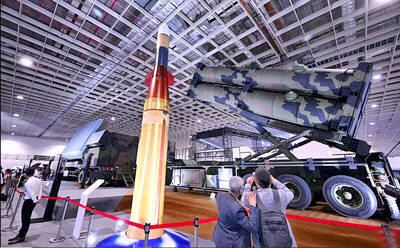
Taiwan is to commence mass production of the Tien Kung (天弓, “Sky Bow”) III, IV and V missiles by the second quarter of this year if the legislature approves the government’s NT$1.25 trillion (US$39.78 billion) special defense budget, an official said yesterday. Commenting on condition of anonymity, a defense official with knowledge of the matter said that the advanced systems are expected to provide crucial capabilities against ballistic and cruise missiles for the proposed “T-Dome,” an advanced, multi-layered air defense network. The Tien Kung III is an air defense missile with a maximum interception altitude of 35km. The Tien Kung IV and V
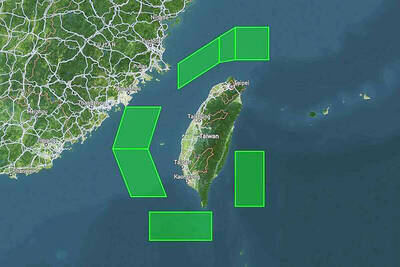
The disruption of 941 flights in and out of Taiwan due to China’s large-scale military exercises was no accident, but rather the result of a “quasi-blockade” used to simulate creating the air and sea routes needed for an amphibious landing, a military expert said. The disruptions occurred on Tuesday and lasted about 10 hours as China conducted live-fire drills in the Taiwan Strait. The Civil Aviation Administration (CAA) said the exercises affected 857 international flights and 84 domestic flights, affecting more than 100,000 travelers. Su Tzu-yun (蘇紫雲), a research fellow at the government-sponsored Institute for National Defense and Security Research, said the air
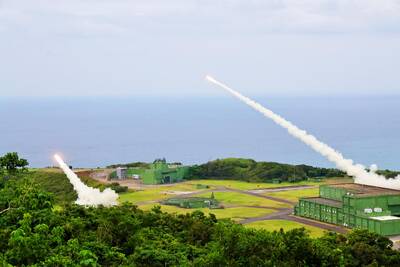
Taiwan lacks effective and cost-efficient armaments to intercept rockets, making the planned “T-Dome” interception system necessary, two experts said on Tuesday. The concerns were raised after China’s military fired two waves of rockets during live-fire drills around Taiwan on Tuesday, part of two-day exercises code-named “Justice Mission 2025.” The first wave involved 17 rockets launched at 9am from Pingtan in China’s Fujian Province, according to Lieutenant General Hsieh Jih-sheng (謝日升) of the Office of the Deputy Chief of the General Staff for Intelligence at the Ministry of National Defense. Those rockets landed 70 nautical miles (129.6km) northeast of Keelung without flying over Taiwan,
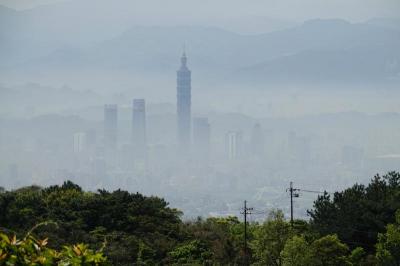
A strong continental cold air mass is to bring pollutants to Taiwan from tomorrow, the Ministry of Environment said today, as it issued an “orange” air quality alert for most of the country. All of Taiwan except for Hualien and Taitung counties is to be under an “orange” air quality alert tomorrow, indicating air quality that is unhealthy for sensitive groups. In China, areas from Shandong to Shanghai have been enveloped in haze since Saturday, the ministry said in a news release. Yesterday, hourly concentrations of PM2.5 in these areas ranged from 65 to 160 micrograms per cubic meter (mg/m³), and pollutants were


 RSS
RSS