


On a sleepy Sunday morning, 50 anonymous young men and women have wandered into a nondescript Taipei office for training with the Kuma Academy. The one-day course includes cross-strait geopolitics and strategy, invasion scenarios and disinformation. Later, they are taught the difference between the opposing armies’ uniforms and how to tie a tourniquet.
The citizen warriors are being trained with a NT$1 billion (US$31.58 million) donation from businessman Robert Tsao (曹興誠). He made global headlines last month when he pledged the money to train “3 million people in three years” and 300,000 sharpshooters for a civilian militia.
The “warrior” training would be in conjunction with the academy, a volunteer civilian training organization that launched last year.
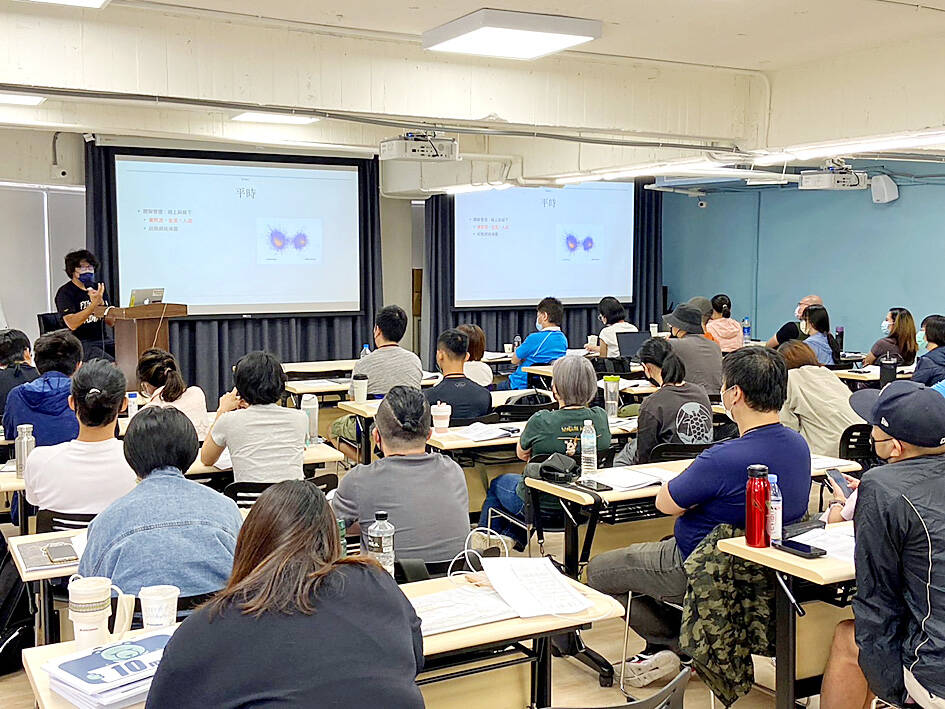
Photo: CNA
The proposal answered a growing domestic appetite for civilians to be better prepared for a Chinese invasion.
Beijing has pledged to annex Taiwan under a disputed claim that it is a province of China. Officials emphasize they prefer peaceful means, but with a majority of Taiwanese opposed to unification, that would mean surrender, which Taiwan has vowed it will not do.
Russia’s invasion of Ukraine and the efforts of the far smaller country to defend itself have only further inspired Taiwanese, many of whom are signing up to military and urban workshops and seminars.
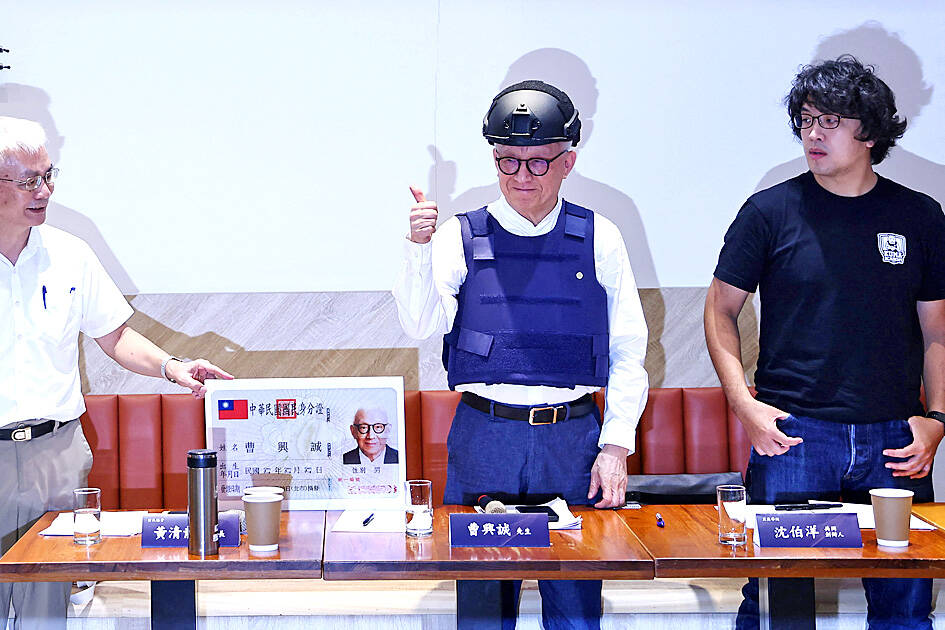
Photo: Ann Wang, Reuters
Tsao, 75, who made his fortune as founder of United Microelectronics Corp (UMC), Taiwan’s second-largest microchip manufacturer, and as an art collector, was not always on this side.
Raised in Taiwan under the military rule of the Chinese Nationalist Party (KMT), Tsao says he was taught to be wary of communism, but was reassured “when they started to reform.”
He has had extensive business dealings with China, and in 2007 lobbied for a unification referendum. In 2011 he renounced his Taiwanese citizenship and split his time between Singapore and Hong Kong, angry at investigations into his business.
He was in Hong Kong when the pro-democracy protests began in the territory, and it was the Yuen Long incident, when gangs of thugs attacked commuters without punishment, which ended any goodwill Tsao still had toward Beijing.
“That especially told me that in any talk or deal with the Chinese Communist Party [CCP] you will get nothing, that it’s very dangerous,” he said, describing it as a “crime syndicate disguised as a nation.”
“It has shrunk free speech, arrested human rights lawyers, persecuted Uighurs, cracked down on freedom in Hong Kong and now they threaten Taiwan any way they can,” he added.
This year, Tsao returned to Taiwan, regained his citizenship and committed to its defense, announcing a US$100 million donation in August for “whatever was helpful.”
He was introduced to the Kuma Academy, one of the more organized grassroots training groups to spring up in recent years. Last month, he announced the pledge for warrior training and plans to develop drones for the military.
Kuma proposed training up to 20,000, Tsao said.
“But from what I know [Chinese President] Xi Jinping (習近平) may start an invasion in five years, so I said we need to train 3 million people, in three years,” he said.
Back at the academy, one 20-year-old student tells the Observer that she decided to attend when China launched military drills around Taiwan after a visit to Taipei by US House of Representatives Speaker Nancy Pelosi in August.
“The best thing I learned today was about understanding conspiracies, and now I can identify what is fake and what is trustable,” she says, adding that her fears for war are exacerbated by what she reads online.
“The information today has settled my heart, made me panic less and I can help others,” she says.
It is basic stuff, but the Kuma Academy and Tsao hope participants will be inspired to specialize their skills and develop local defense units, perhaps in line with Taiwan’s existing network of volunteer emergency responders.
“We want to decentralize civil defense, and they should work with their neighborhoods to create their own groups and plans,” course trainer He Chung-hui says.
The government has not answered calls for a formal civilian militia. It is prioritizing weapons procurement and bolstering the existing armed services. Mandatory conscription was being phased out, but is likely returning in preparation for a Chinese attack.
Chinese officials recently said that Taiwanese would be subject to “re-education” after invasion and that independence advocates would be punished.
Tsao, potentially high on that list, sometimes wears a bulletproof vest in public. He will neither return to nor transit through Hong Kong or China out of security concerns, and says he is committed to Taiwan.
“China is marching to disaster, like [Russian President Vladimir] Putin, but they can’t stop,” he says. “My message to local Taiwanese is: Our fate is in our hands. If you fight as bravely as Ukrainians, you will preserve your freedom and democracy.”
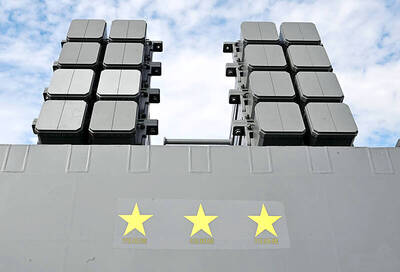
UPGRADE: The Kang Ding-class frigate is replacing its Chaparall missiles with Tien Chien II and Hua Yang VLS, which would provide it with long-range, 360° air defense Taiwan plans to produce 1,200 to 1,376 Hai Chien II missiles (海劍二, Sea Sword II) — also known as TC-2N — to serve as the standard air defense system of the navy’s surface combatant fleet, a source said yesterday. Last week, the Hai Chien II, the naval version of the Tien Kung II missile (天劍二, Sky Sword II), completed a live-fire test in waters off the National Chungshan Institute of Science and Technology’s Jiupeng facility (九鵬) in Pingtung County’s Manjhou Township (滿州). The MIM72 Chaparral and other dated air defense missiles that currently arm Taiwanese ships have inadequate range to combat Chinese

REASONS FOR TRAVEL: An assistant professor said that proposed amendments to penalize drivers if they used drugs overseas would not deter people from traveling People who operate a motor vehicle under the influence of marijuana would have their driver’s license revoked, even if they used the substance while overseas, the Ministry of Transportation and Communications said yesterday, citing proposed amendments to the Road Traffic Management and Penalty Act (道路交通管理處罰條例). The amendments would also authorize the government to revoke the licenses of people determined to have used Category 1 or Category 2 narcotics, even if they were not operating a vehicle while under the influence of drugs, as well as ban them from taking the license test for three years, the ministry said. People aged 18 or

HEAVY WEATHER: Typhoon Jangmi is due to crash straight into the Ryukyus as airlines look to shift flights to larger aircraft or cancel flights to Okinawa entirely Taiwan’s international air carriers announced flight adjustments over the weekend as Typhoon Jangmi is forecast to hit the Ryukyu Islands today and tomorrow. The Central Weather Administration (CWA) upgraded Jangmi from a tropical storm to a typhoon at 8am yesterday, with the eye located 580km south of Naha city. It was moving north at 19kph. Today, China Airlines’ CI-120, CI-121, CI-122 and CI-123 flights between Taoyuan and Naha, Okinawa, have been canceled as well as CI-132 and CI-133 between Kaohsiung and Naha. EVA Air’s BR-112, BR-113, BR-186 and BR-185 flights between Taoyuan and Naha are also canceled. Low-cost carrier Tigerair Taiwan canceled IT-230,
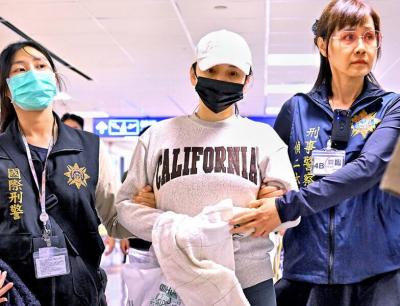
Johanne Liou (劉喬安), a Taiwanese woman who shot to unwanted fame during the Sunflower movement protests in 2014, returned to Taiwan last night after being deported from the US. She is to stand trial in Taiwan for charges involving embezzlement, fraud and drug crimes. The Criminal Investigation Bureau (CIB) said it took her into custody at Taiwan Taoyuan International Airport and would first question her before transferring her to the New Taipei District Prosecutors’ Office. She was arrested upon disembarking a flight from San Francisco that landed shortly before 7pm. Liou absconded to the US in 2019 after jumping bail


 RSS
RSS