


Taiwan People’s Party (TPP) Legislator Ann Kao (高虹安), the party’s Hsinchu mayoral candidate, yesterday drew criticism for remarks she made during a news conference the day before, at which she denied accusations that she used material for her doctoral thesis without proper citations, including work she had authored herself.
Kao, who holds a doctoral degree from the University of Cincinnati, touted her academic credentials, saying she is “not like someone attending night school at Chung Hua University, who then needed to attend National Taiwan University (NTU) to obtain a master’s degree,” an apparent reference to former Hsinchu mayor Lin Chih-chien (林智堅), whose master’s degree from NTU was revoked over plagiarism of content for his thesis.
Kao’s remarks were widely seen as belittling Hsinchu-based Chung Hua University as an inferior school to NTU — one of Taiwan’s top schools, from which she holds a master’s degree.
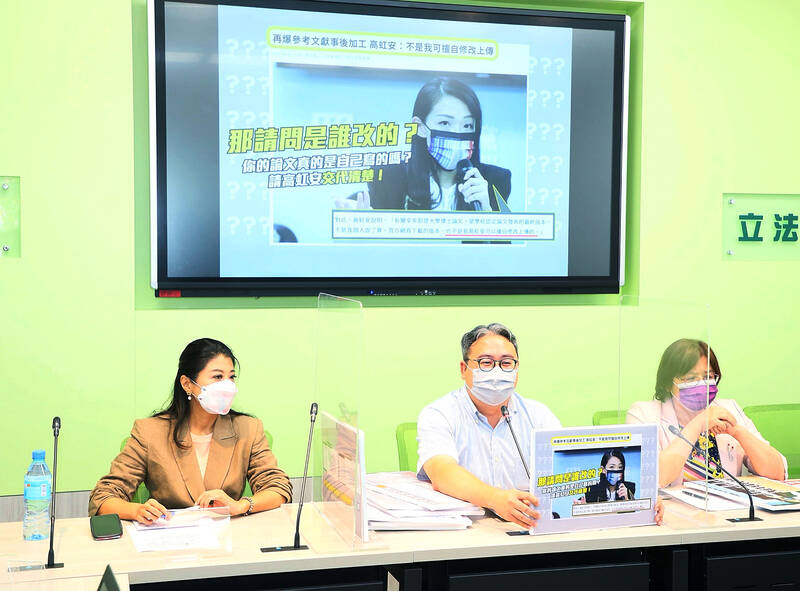
Photo: CNA
Kao said she graduated from Taipei First Girls’ High School and was admitted to NTU after scoring high in an entrance exam, before continuing her education in the US.
After her remarks were widely seen as elitist, she yesterday apologized to Chung Hua University.
“Voters in Hsinchu are to choose a mayor who will speak up for them,” Democratic Progressive Party (DPP) spokeswoman Huang Tsai-ling (黃彩玲) said. “How can someone so arrogant serve the people and attend to their needs?”
DPP Hsinchu mayoral candidate Shen Hui-hung (沈慧虹) said Kao has hurt the feelings of Hsinchu residents by belittling the local university, calling her an “egocentric person.”
“We know the TPP is good at idol-worshipping,” Shen said, likening Kao’s behavior to that of Taipei Mayor Ko Wen-je (柯文哲), the TPP’s chairman.
New Power Party Legislator Claire Wang (王婉諭) said she is also proud of her academic achievements, “but I never viewed myself as better or smarter than other people... I was just more lucky than others.”
She urged political candidates not to attack their opponents based on their academic credentials, as this would show that “an outdated belief of academic degrees being the most important” prevails in Taiwan.
“In past decades, many teenagers could not take university entrance exams, not because they were not smart, but because of their family background, she added.
Taipei City Councilor Miao Po-ya (苗博雅) of the Social Democratic Party said that Taiwan is “blind to academic elitism,” calling it the “root of many conflicts in society.”
“The government provides funding to top schools such as NTU, my own alma mater, while people from rural communities hardly have a chance to get into such top schools,” she said, adding that without being from Taipei and having a middle-class background, she might also not have been admitted.

Actor Darren Wang (王大陸) was sentenced to six months in prison, commutable to a fine, by the New Taipei District Court today for contravening the Personal Data Protection Act (個人資料保護法) in a case linked to an alleged draft-dodging scheme. Wang allegedly paid NT$3.6 million (US$114,380) to an illegal group to help him evade mandatory military service through falsified medical documents, prosecutors said. He transferred the funds to Chen Chih-ming (陳志明), the alleged mastermind of a draft-evasion ring, although he lost contact with him as he was already in detention on fraud charges, they said. Chen is accused of helping a

SECURITY: Starlink owner Elon Musk has taken pro-Beijing positions, and allowing pro-China companies to control Taiwan’s critical infrastructure is risky, a legislator said Starlink was reluctant to offer services in Taiwan because of the nation’s extremely high penetration rates in 4G and 5G services, the Ministry of Digital Affairs said yesterday. The ministry made the comments at a meeting of the legislature’s Transportation Committee, which reviewed amendments to Article 36 of the Telecommunications Management Act (電信管理法). Article 36 bans foreigners from holding more than 49 percent of shares in public telecommunications networks, while shares foreigners directly and indirectly hold are also capped at 60 percent of the total, unless specified otherwise by law. The amendments, sponsored by Chinese Nationalist Party (KMT) Legislator Ko

‘SAME OLD TRICK’: Even if Beijing resumes individual travel to Taiwan, it would only benefit Chinese tourism companies, the Economic Democracy Union convener said China’s 10 new “incentives” are “sugar-coated poison,” an official said yesterday, adding that Taiwanese businesses see them clearly for what they are, but that Beijing would inevitably find some local collaborators to try to drums up support. The official, speaking on condition of anonymity, made the remark ahead of a news conference the General Chamber of Commerce is to hold today. The event, titled “Industry Perspectives on China’s Recent Pro-Taiwan Policies,” is expected to include representatives from industry associations — such as those in travel, hotels, food and agriculture — to request the government cooperate with China’s new measures, people familiar with
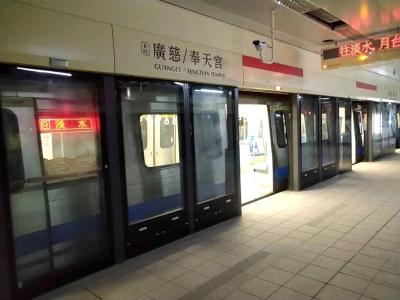
The eastern extension of the Taipei MRT Red Line could begin operations as early as late June, the Taipei Department of Rapid Transit Systems said yesterday. Taipei Rapid Transit Corp said it is considering offering one month of free rides on the new section to mark its opening. Construction progress on the 1.4km extension, which is to run from the current terminal Xiangshan Station to a new eastern terminal, Guangci/Fengtian Temple Station, was 90.6 percent complete by the end of last month, the department said in a report to the Taipei City Council's Transportation Committee. While construction began in October 2016 with an


 RSS
RSS