


HEALTH
Cases stay above 40,000
Daily new COVID-19 cases in Taiwan exceeded 40,000 for the third consecutive day yesterday, as the nation confirmed 45,269 new local infections and 57 deaths from the disease, the Central Epidemic Command Center (CECC) said. The deceased ranged in age from their teens to their 90s, and all but four had underlying health issues, such as cancer and kidney-related diseases, CECC data showed. New Taipei City reported the highest number of new cases, with 9,775, followed by Taichung with 5,854, Taipei with 5,401, Taoyuan with 4,758, Kaohsiung with 3,704 and Tainan with 2,662, the CECC said in a statement. Changhua County had 2,091 new cases, Hsinchu County 1,304, Hsinchu City 1,204, Pingtung County 1,140, Miaoli County 1,089, Yilan County 1,050, Keelung 975 and Yunlin County 972. Nantou County had 842 cases, Hualien County 689, Chiayi County 685, Chiayi City 461, Taitung County 289, Kinmen County 161, Penghu County 142, and Lienchiang County 21, the CECC said.
TRANSPORTATION
Truck stops rail services
Train services between New Taipei City’s Fulong (福隆) and Yilan County’s Dali (大里) were briefly suspended yesterday after a tractor-trailer truck traveling along Provincial Highway No. 2 overturned and became stuck on a hillside above the railway tracks, the Taiwan Railways Administration (TRA). Police said the incident occurred near the highway’s 116km marker at about 7:48am, when the truck’s driver lost control of his vehicle and slammed through the guardrails along the roadside. The truck overturned and crashed into a thicket of trees, coming to rest on a hillside just 10m above the tracks. Service was restored on the outer track at 1pm and on the inner track at about 2:30pm, the TRA said. The driver, surnamed Huang (黃), freed himself after the incident and was treated in a hospital for minor injuries. A breath alcohol test conducted at the scene came back negative, police said.
TRADE
Deals signed for US crops
An agricultural mission on an official trip to Washington on Wednesday signed three letters of intent with US exporters to buy US$3.2 billion of crops next year and in 2024. Witnessed by 28 US lawmakers and several legislators from Taiwan, the delegation, led by Council of Agriculture Deputy Minister Huang Chin-cheng (黃金城), signed the pacts with US agricultural industry associations to purchase soybeans, corn and wheat. Representative to the US Hsiao Bi-khim (蕭美琴) said agricultural products play an important role in the US-Taiwan Initiative on 21st Century Trade. Taipei and Washington are scheduled to hold the first round of negotiations this fall on the trade initiative covering 11 areas with the goal of working toward a trade agreement.
DIPLOMACY
Pact signed with Belize
Belize yesterday signed a coast guard cooperation agreement with Taiwan covering search and rescue, fisheries enforcement and combating transnational crime at sea. Belizean Minister of National Defense and Border Security Florencio Marin Jr said the pact is part of Belize’s military diplomacy to strengthen partnership with its allies, the Belizean Ministry of National Defense and Border Security said in a statement. Due to the COVID-19 pandemic, the agreement was first signed by then-Ocean Affairs Council minister Lee Chung-wei (李仲威) in Taiwan and sent to Marin Jr to be signed in Belize.


UPGRADE: The Kang Ding-class frigate is replacing its Chaparall missiles with Tien Chien II and Hua Yang VLS, which would provide it with long-range, 360° air defense Taiwan plans to produce 1,200 to 1,376 Hai Chien II missiles (海劍二, Sea Sword II) — also known as TC-2N — to serve as the standard air defense system of the navy’s surface combatant fleet, a source said yesterday. Last week, the Hai Chien II, the naval version of the Tien Kung II missile (天劍二, Sky Sword II), completed a live-fire test in waters off the National Chungshan Institute of Science and Technology’s Jiupeng facility (九鵬) in Pingtung County’s Manjhou Township (滿州). The MIM72 Chaparral and other dated air defense missiles that currently arm Taiwanese ships have inadequate range to combat Chinese

REASONS FOR TRAVEL: An assistant professor said that proposed amendments to penalize drivers if they used drugs overseas would not deter people from traveling People who operate a motor vehicle under the influence of marijuana would have their driver’s license revoked, even if they used the substance while overseas, the Ministry of Transportation and Communications said yesterday, citing proposed amendments to the Road Traffic Management and Penalty Act (道路交通管理處罰條例). The amendments would also authorize the government to revoke the licenses of people determined to have used Category 1 or Category 2 narcotics, even if they were not operating a vehicle while under the influence of drugs, as well as ban them from taking the license test for three years, the ministry said. People aged 18 or
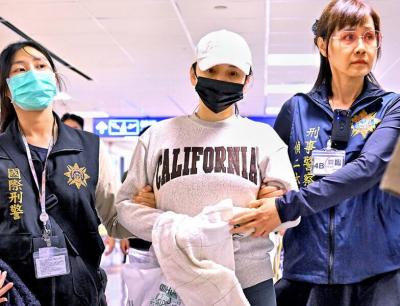
Johanne Liou (劉喬安), a Taiwanese woman who shot to unwanted fame during the Sunflower movement protests in 2014, returned to Taiwan last night after being deported from the US. She is to stand trial in Taiwan for charges involving embezzlement, fraud and drug crimes. The Criminal Investigation Bureau (CIB) said it took her into custody at Taiwan Taoyuan International Airport and would first question her before transferring her to the New Taipei District Prosecutors’ Office. She was arrested upon disembarking a flight from San Francisco that landed shortly before 7pm. Liou absconded to the US in 2019 after jumping bail
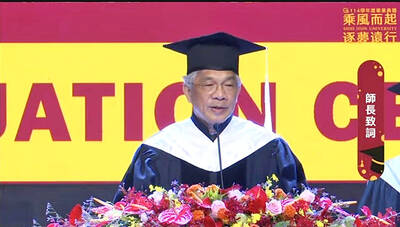
Shih Hsin University President Chen Ching-he (陳清河) yesterday issued a public apology for comments made in his commencement speech last week, stating that he has asked the school to suspend his duties and halt his wages for two months as a show of contrition. At the commencement ceremony on May 30, Chen said, “If you don’t manage your time well, or your own emotions, or your health, then I am telling every one of you — put a quick end to ‘you,’ because the world has no need for ‘you.’” The comments have sparked significant controversy online, and Chen through an open


 RSS
RSS