


A Hong Kong bookseller who in 2019 relocated to Taipei after being prosecuted by Chinese authorities recently applied for permanent residency in Taiwan, a government source said on Monday last week.
The move came after Lam Wing-kei (林榮基), a former manager of Hong Kong’s Causeway Bay Books, initially did not accept the “humanitarian aid” political asylum offered by the government.
In 2015, Lam, another shareholder of Causeway Bay Books and three staff members were reported missing and later confirmed to be detained by mainland Chinese authorities, which accused them of selling books about the Chinese Communist Party (CCP) that are prohibited in mainland China.
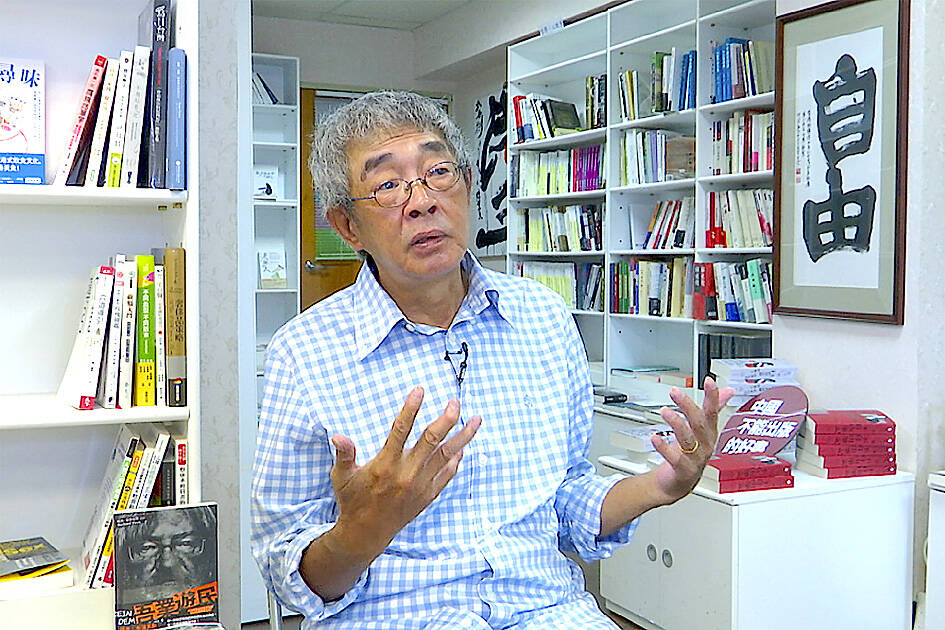
Photo: Johnson Lai, AP
Lam was imprisoned for nearly eight months, and the CCP asked him to disclose the bookstore’s customers and their orders in exchange for his release. Lam in June 2016 returned to Hong Kong, with his criminal record showing a conviction in China for “illegal operation of book sales.”
When widespread protests over a proposed extradition bill to mainland China rocked the territory in 2019, Lam on April 25 fled to Taiwan, saying that he feared being prosecuted again by mainland authorities.
With the support of a crowdfunding campaign, Lam in April 2020 reopened Causeway Bay Books in Taipei.
An unnamed official in Taipei last week said that the central government had helped Lam apply for permanent residency.
In addition to helping other Taiwan-based Hong Kongers, Lam has been working hard to run his bookstore in Taipei, conveying his principles and ideas to Taiwanese one book at a time, the official said.
While often speaking out about his experiences in China, Lam helps Taiwan protect its freedom and democracy, they said.
Lam, as a “modest gentleman,” initially refused to accept the offer of political asylum and has since 2019 been staying in the nation on a temporary residence permit, they added.
Lam had applied with the Ministry of Culture for permanent residency as a “special professional” in the field of culture, the official said.
If the ministry approves his application, it would forward the case to the National Immigration Agency, which would issue a permanent residency card, the official said.
Government data show that 11,173 Hong Kongers hold residence permits in Taiwan, including 1,685 who were granted permanent residency last year, an annual record.
In the first seven months of this year, 4,143 Hong Kongers received temporary residence permits and 892 received permanent residency, the data show.

More than half of the bamboo vipers captured in Tainan in the past few years were found in the city’s Sinhua District (新化), while other districts had smaller catches or none at all. Every year, Tainan captures about 6,000 snakes which have made their way into people’s homes. Of the six major venomous snakes in Taiwan, the cobra, the many-banded krait, the brown-spotted pit viper and the bamboo viper are the most frequently captured. The high concentration of bamboo vipers captured in Sinhua District is puzzling. Tainan Agriculture Bureau Forestry and Nature Conservation Division head Chu Chien-ming (朱健明) earlier this week said that the

NAMING SPAT: The foreign ministry called on Denmark to propose an acceptable solution to the erroneous nationality used for Taiwanese on residence permits Taiwan has revoked some privileges for Danish diplomatic staff over a Danish permit that lists “Taiwan” as “China,” Eric Huang (黃鈞耀), head of the Ministry of Foreign Affairs’ Department of European Affairs, told a news conference in Taipei yesterday. Reporters asked Huang whether the Danish government had responded to the ministry’s request that it correct the nationality on Danish residence permits of Taiwanese, which has been listed as “China” since 2024. Taiwan’s representative office in Denmark continues to communicate with the Danish government, and the ministry has revoked some privileges previously granted to Danish representatives in Taiwan and would continue to review
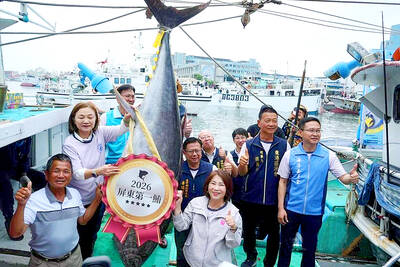
The first bluefin tuna of the season, brought to shore in Pingtung County and weighing 190kg, was yesterday auctioned for NT$10,600 (US$333.5) per kilogram, setting a record high for the local market. The auction was held at the fish market in Donggang Fishing Harbor, where the Siaoliouciou Island-registered fishing vessel Fu Yu Ching No. 2 delivered the “Pingtung First Tuna” it had caught for bidding. Bidding was intense, and the tuna was ultimately jointly purchased by a local restaurant and a local company for NT$10,600 per kilogram — NT$300 ,more than last year — for a total of NT$2.014 million. The 67-year-old skipper

China has reserved offshore airspace over the Yellow Sea and East China Sea from March 27 to May 6, issuing alerts that are usually used to warn of military exercises, although no such exercises have been announced, the Wall Street Journal (WSJ) reported on Sunday. Reserving such a large area for 40 days without explanation is an “unusual step,” as military exercises normally only last a few days, the paper said. The alerts, known as notice to air missions (NOTAMs), “are intended to inform pilots and aviation authorities of temporary airspace hazards or restrictions,” the article said. The airspace reserved in the alert


 RSS
RSS