


A proposal by the US government to extend a contract for an early warning facility in Hsinchu County aims to ensure that the system performs well, a military source said.
The proposal involves Leshan Radar Station in Wufeng Township (五峰), the source said, but declined to comment on whether the package would involve upgrades to the system.
The US$655.4 million extension is part of a planned US$1.1 billion arms sale package to Taiwan, which also includes 60 AGM-84L Harpoon Block II missiles for US$355 million and 100 AIM-9X Block II Sidewinder missiles at a price of NT$85.6 million, the Pentagon’s Defense Security Cooperation Agency said on Friday.
The US Department of State has approved the proposed arms sale and forwarded it to the US Congress for review, the cooperation agency said.
The Leshan radar proved effective when it detected 11 Dongfeng ballistic missiles that China fired into waters around Taiwan during the military exercises it conducted early last month, Lin Ying-yu (林穎佑), an assistant professor at Tamkang University’s Graduate Institute of International Affairs and Strategic Studies, said on Saturday.
It is worth watching whether the contract extension will involve upgrades, Lin said.
Possible upgrades include boosting the system’s range, increasing its processing speed, raising the number of targets it can simultaneously track and linking it to systems used by local or foreign military units, thereby shortening its response time and boosting its accuracy, he said.
The Leshan station sits at an altitude of 2,620m and can detect missiles fired within a range of 5,000km. It can also track cruise missiles, ballistic missiles, drones and ships within a 2,000km range.
The station employs an AN/FPS-115 Pave Paws system, which, thanks to the facility’s altitude, has a long range and early warning capabilities, said Su Tzu-yun (蘇紫雲), an analyst at the Institute for National Defense and Security Research.
Considering the time that the system has been in use, the contract extension could entail the renewal of transceivers and software maintenance, he said.
Chieh Chung (揭仲), a research fellow at the Association of Strategic Foresight, said the proposed extension might seem expensive, but with the Leshan system turning 10 next year, a mid-life upgrade or the procurement of replacement parts is in order.
While the proposed arms sale does not include new weapons, it would narrow the gap between Taiwan and China regarding the number of precision-strike missiles, bolstering the nation’s defense capabilities, he said.
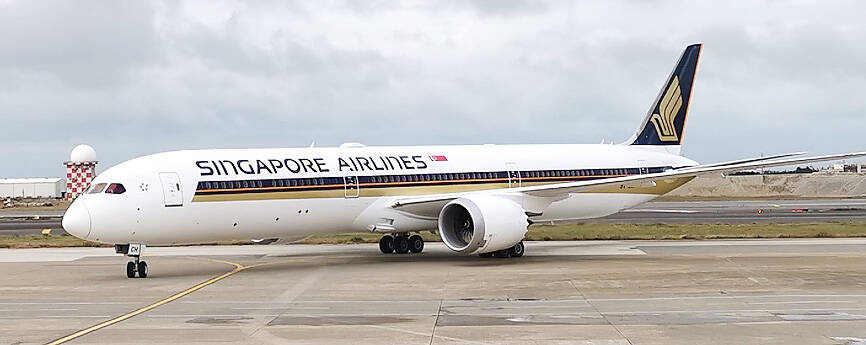
INCREASED CAPACITY: The flights on Mondays, Wednesdays, Fridays and Sundays would leave Singapore in the morning and Taipei in the afternoon Singapore Airlines is adding four supplementary flights to Taipei per week until May to meet increased tourist and business travel demand, the carrier said on Friday. The addition would raise the number of weekly flights it operates to Taipei to 18, Singapore Airlines Taiwan general manager Timothy Ouyang (歐陽漢源) said. The airline has recorded a steady rise in tourist and business travel to and from Taipei, and aims to provide more flexible travel arrangements for passengers, said Ouyang, who assumed the post in July last year. From now until Saturday next week, four additional flights would depart from Singapore on Monday, Wednesday, Friday

Taiwan’s three major international carriers are increasing booking fees, with EVA Airways having already increased the charge to US$28 per flight segment from US$25, while China Airlines (CAL) and Starlux Airlines are set to follow suit. Booking fees are charged by airlines through a global distribution system (GDS) and passed on to passengers. Carriers that apply the fees include CAL, EVA, Starlux and Tigerair Taiwan. A GDS is a computerized network operated by a company that connects airlines with travel agents and ticketing platforms, allowing reservations to be made and processed in real time. Major players include Amadeus, Sabre and Travelport. EVA Air began
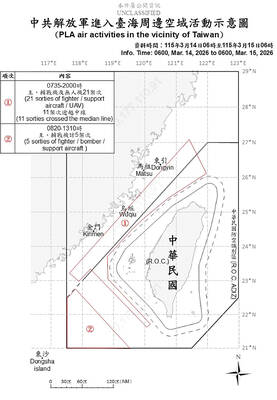
The Ministry of National Defense yesterday reported the return of large-scale Chinese air force activities after their unexplained absence for more than two weeks, which had prompted speculation regarding Beijing’s motives. China usually sends fighter jets, drones and other military aircraft around the nation on a daily basis. Interruptions to such routine are generally caused by bad weather. The Ministry of National Defense said it had detected 26 Chinese military aircraft in the Taiwan Strait over the previous 24 hours. It last reported that many aircraft on Feb. 25, when it spotted 30 aircraft, saying Beijing was carrying out another “joint combat

WATCH FOR HITCHHIKERS: The CDC warned those returning home from Japan to be alert for any contagious diseases that might have come back with them People who have returned from Japan following the World Baseball Classic (WBC) games during the weekend are recommended to watch for symptoms of infectious gastroenteritis, flu and measles for two weeks, the Centers for Disease Control (CDC) said. Flu viruses remain the most common respiratory pathogen in Taiwan in the past four weeks and the influenza B virus accounted for 55.7 percent of the tested cases, exceeding the percentage of influenza A (H3N2) infections and becoming the local dominant strain, CDC Epidemic Intelligence Center Deputy Director Lee Chia-lin (李佳琳) said at a news conference on Tuesday. There were 82,187 hospital visits for


 RSS
RSS