


The Economic Democracy Union yesterday called on the Ministry of Economic Affairs to fine Hon Hai Precision Industry Co (鴻海精密) and reject its investment in a Chinese state-backed chip company.
Hon Hai, which is known as Foxconn globally, last month announced a 5.38 billion yuan (US$778 million) investment in China’s Tsinghua Unigroup (紫光集團) by its subsidiary, Foxconn Industrial Internet Co Ltd (富士康工業互聯網), through several smaller investments in Chinese companies.
The company did not obtain prior regulatory approval in Taiwan for the purchase, leading to calls for punishment and greater scrutiny.
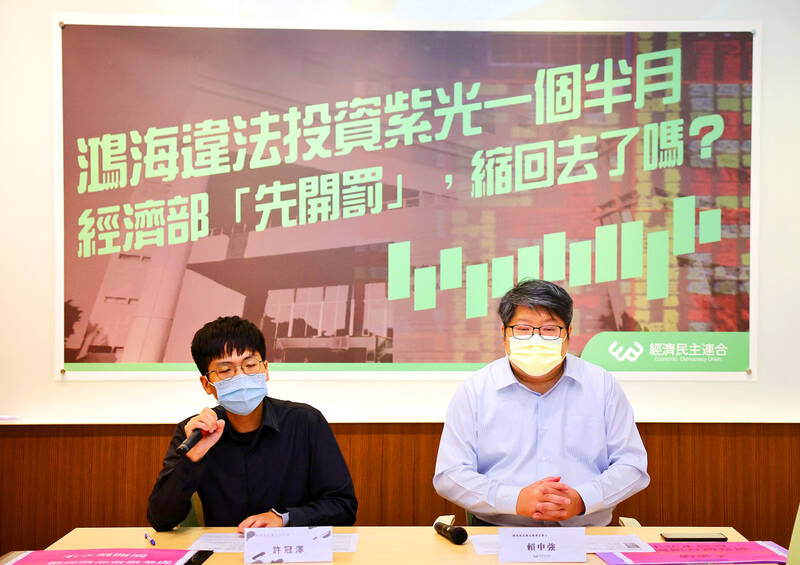
Photo: CNA
The ministry’s Investment Commission said at the time that it was reviewing the application and might fine the company for failing to apply for approval in advance.
A month and a half has passed, and the ministry has yet to issue any fines, the union told a news conference at the Legislative Yuan in Taipei.
“Does the state’s power retract when it encounters a large conglomerate?” union researcher Hsu Kuan-tze (許冠澤) asked.
The commission mandates that investments in China involving chip design or other sensitive industries in excess of US$50 million must first obtain regulatory approval, meaning that this case clearly warrants a fine, Hsu said.
Hon Hai’s claim that the investment does not involve any chip fabs due to Tsinghua’s new corporate structure is a smokescreen, Hsu said.
The semiconductor industry is not just about making chips, but involves the entire process from design to packaging and testing, he said, adding that no matter Tsinghua’s structure, as long as it is part of the supply chain, it is a chipmaker.
The Chinese-language Economic Daily News reported that hundreds of companies were included in the information Hon Hai submitted to the commission about its investment, Hsu said.
A separate investigation by Business Today in 2020 found that three of Tsinghua’s top five businesses were chip design, manufacturing and packaging/testing, he said, adding that it is in direct competition with Taiwan’s chip industry.
Union convener Lai Chung-chiang (賴中強) criticized the timing of the purchase, as the US is aiming to bolster its chip industry to compete against China.
Under the US’ CHIPS and Science Act signed into law earlier this month, companies that receive subsidies from Washington to support semiconductor manufacturing are barred from signing any “major deals” to expand production in China for 10 years, Lai said, calling Hon Hai’s investment a pawn in China’s effort to break through the US technological barricade.
Through the firm’s other ventures, Hon Hai engineers would learn from close cooperation with the US, but if the company also works with Tsinghua, these trade secrets could feasibly be passed along to China, he said, recommending that the ministry reject the investment.

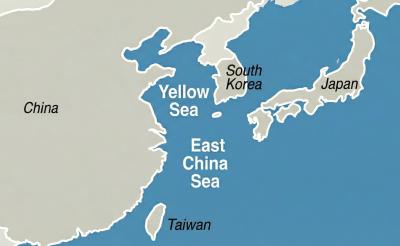
China has reserved offshore airspace in the Yellow Sea and East China Sea from March 27 to May 6, issuing alerts usually used to warn of military exercises, although no such exercises have been announced, the Wall Street Journal (WSJ) reported yesterday. Reserving such a large area for 40 days without explanation is an “unusual step,” as military exercises normally only last a few days, the paper said. These alerts, known as Notice to Air Missions (Notams), “are intended to inform pilots and aviation authorities of temporary airspace hazards or restrictions,” the article said. The airspace reserved in the alert is
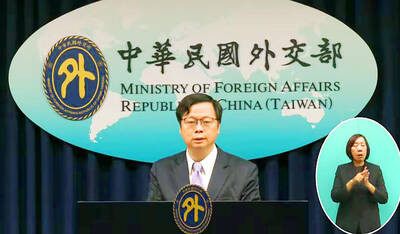
NAMING SPAT: The foreign ministry called on Denmark to propose an acceptable solution to the erroneous nationality used for Taiwanese on residence permits Taiwan has revoked some privileges for Danish diplomatic staff over a Danish permit that lists “Taiwan” as “China,” Eric Huang (黃鈞耀), head of the Ministry of Foreign Affairs’ Department of European Affairs, told a news conference in Taipei yesterday. Reporters asked Huang whether the Danish government had responded to the ministry’s request that it correct the nationality on Danish residence permits of Taiwanese, which has been listed as “China” since 2024. Taiwan’s representative office in Denmark continues to communicate with the Danish government, and the ministry has revoked some privileges previously granted to Danish representatives in Taiwan and would continue to review
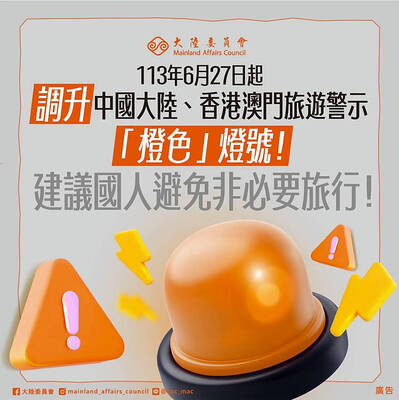
More than 6,000 Taiwanese students have participated in exchange programs in China over the past two years, despite the Mainland Affairs Council’s (MAC) “orange light” travel advisory, government records showed. The MAC’s publicly available registry showed that Taiwanese college and university students who went on exchange programs across the Strait numbered 3,592 and 2,966 people respectively. The National Immigration Agency data revealed that 2,296 and 2,551 Chinese students visited Taiwan for study in the same two years. A review of the Web sites of publicly-run universities and colleges showed that Taiwanese higher education institutions continued to recruit students for Chinese educational programs without

A bipartisan group of US senators has introduced a bill to enhance cooperation with Taiwan on drone development and to reduce reliance on supply chains linked to China. The proposed Blue Skies for Taiwan Act of 2026 was introduced by Republican US senators Ted Cruz and John Curtis, and Democratic US senators Jeff Merkley and Andy Kim. The legislation seeks to ease constraints on Taiwan-US cooperation in uncrewed aerial systems (UAS), including dependence on China-sourced components, limited access to capital and regulatory barriers under US export controls, a news release issued by Cruz on Wednesday said. The bill would establish a "Blue UAS


 RSS
RSS