

The government’s decision to increase the minimum wage for live-in migrant caregivers and domestic workers might help ease a labor shortage, but it would not do much to make Taiwan an internationally competitive destination for such workers, Taiwan International Workers’ Association member Chen Hsiu-lien (陳秀蓮) said on Wednesday.
The new policy, which was announced by the Ministry of Labor earlier in the day, increased the monthly minimum wage for migrant domestic workers to NT$20,000 from NT$17,000 — a 17 percent increase, but still well below Taiwan’s standard minimum wage of NT$25,250.
The change applies only to newly arrived migrant workers and those in Taiwan who sign new contracts. It does not affect people with existing contracts.
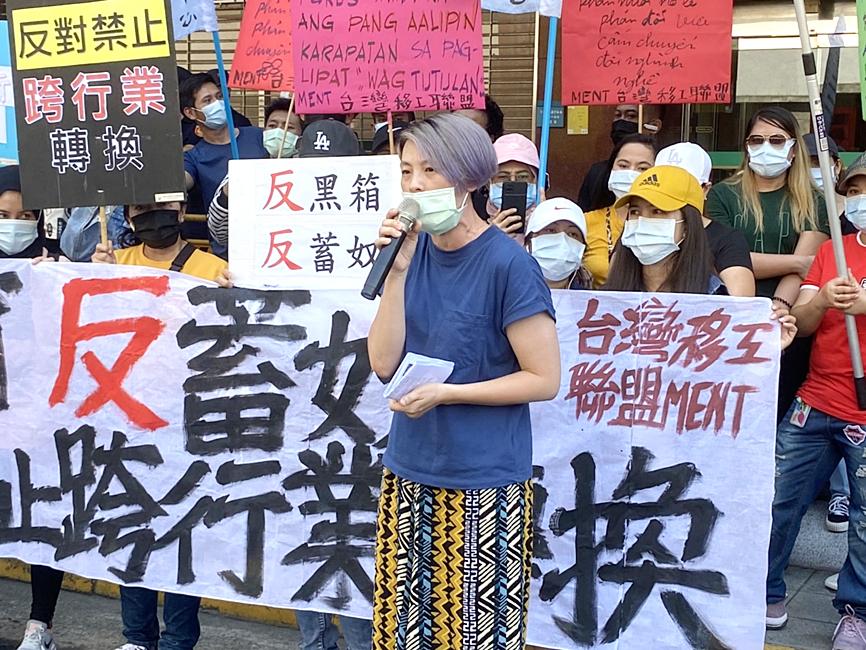
Photo: CNA
While the increase might help attract workers in the short term, it fails to address the real reasons behind Taiwan’s failure to recruit enough caregivers on the international labor market, Chen said.
To improve Taiwan’s competitiveness, live-in migrant workers need to receive the same minimum wage and labor protections as Taiwanese, and employers should also provide better working conditions, she said.
A monthly salary of NT$20,000 is still “extremely low,” considering that by the ministry’s own calculations, migrant domestic workers are on the clock for 13 hours a day on average, she said.
If employers are unable to pay the salaries needed to recruit and retain such workers, the government needs to consider using more of its long-term healthcare budget to subsidize them, Chen said.
Chang Heng-yen (張姮燕), an adviser to a group that advocates for disabled families and employers of migrant domestic workers, said that the minimum wage hike only affects the immediate problem of recruiting new workers.
What it does not address is the more pressing issue of worker retention, as live-in caregivers frequently leave their positions for higher-paying factory jobs, Chang said.
What employers care about is not the amount of an increase, but that it is introduced in stages, giving workers an incentive to stay in their jobs, she said.
Separately, the ministry yesterday said that employers who already pay migrant domestic workers more than NT$20,000 amonth cannot unilaterally reduce the pay to the minimum wage.
Changes to an employment contract without the consent of both parties is a finable offense and might lead to the permit to employ foreign workers being revoked, ministry official Chuang Kuo-liang (莊國良) said.

The National Police Agency’s Third Special Police Corps yesterday said that from May to July, it intercepted five smuggling operations from China, seizing more than 70,000 counterfeit Beyblades with an estimated infringement value of NT$34.45 million (US$1.08 million). It added that any bootleg unit that reached the local market could present hidden health hazards to players. Beyblades, a line of spinning toy tops used in competitive gaming and developed in Japan by toy company Takara Tomy, have become popular in Taiwan, making them a target for fraudsters. The Third Special Police Corps, dedicated to safeguarding maritime borders and trade lines,
Five customers who made purchases at 7-Eleven stores across Taiwan won the top NT$10 million (US$313,716) special prize in the July-August uniform invoice lottery, including one who spent just NT$27 on photocopying, the convenience store chain said today. The five special prize winners made their purchases at stores in Taoyuan, Taipei, Taichung and Kaohsiung, 7-Eleven operator President Chain Store Corp said. The five winning purchases included NT$29 spent on snacks at a store in Taoyuan's Zhongli District (中壢), NT$27 on photocopying at a store in Taipei's Zhongzheng District (中正), NT$139 on City Cafe coffee and daily necessities at a store in Taipei's
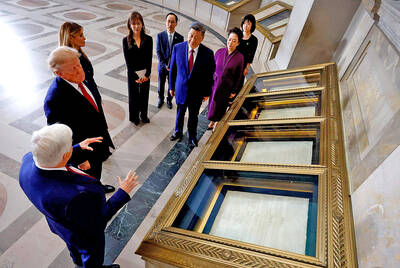
Chinese President Xi Jinping (習近平) reportedly cut short his visit to the National Archives in Washington after the Chinese delegation objected to plans to view the Treaty of San Francisco, sources in Washington’s media circles said. Xi and his wife, Peng Liyuan (彭麗媛), concluded their three-day state visit to the US on Friday after having tea with US President Donald Trump and first lady Melania Trump at the White House and visiting the archives. Chinese democracy advocates and members of pro-China groups gathered outside the venue during Xi’s visit, with the two groups exchanging competing slogans while police kept them separated. The US

TRICKY ISSUE: Taiwan’s defense of the ROC in WWII could conflict with the government’s narrative on Taiwanese history and identity, an academic said Chinese President Xi Jinping (習近平) had no standing to discuss US-China relations in World War II (WWII), as the People’s Republic of China did not exist at that time, Mainland Affairs Council (MAC) Deputy Minister Shen Yu-chung (沈有忠) said yesterday. Taipei would ensure that Washington has a clear understanding that it was the Republic of China (ROC), not the People’s Republic of China (PRC), that was a steadfast ally of the US in WWII, Shen said. Shen was referring to a White House fact sheet released on Friday about Xi’s meeting with US President Donald Trump in Washington. It said that “the two


 RSS
RSS