


Former Tainan County commissioner and Taiwan Renewal Party convener Su Huan-chih (蘇煥智) yesterday announced his bid for Taipei mayor in the Nov. 26 elections.
Su, who was Tainan County commissioner from 2001 to 2010, announced in 2018 that he would leave the Democratic Progressive Party (DPP) and run for Taipei mayor, but ended up running as an independent candidate for Tainan mayor, which he lost to current Mayor Huang Wei-che (黃偉哲).
Despite fierce opposition from his wife, Huang said he has a responsibility to “history and to the land,” and after hesitating for three months, decided to devote himself to the campaign.
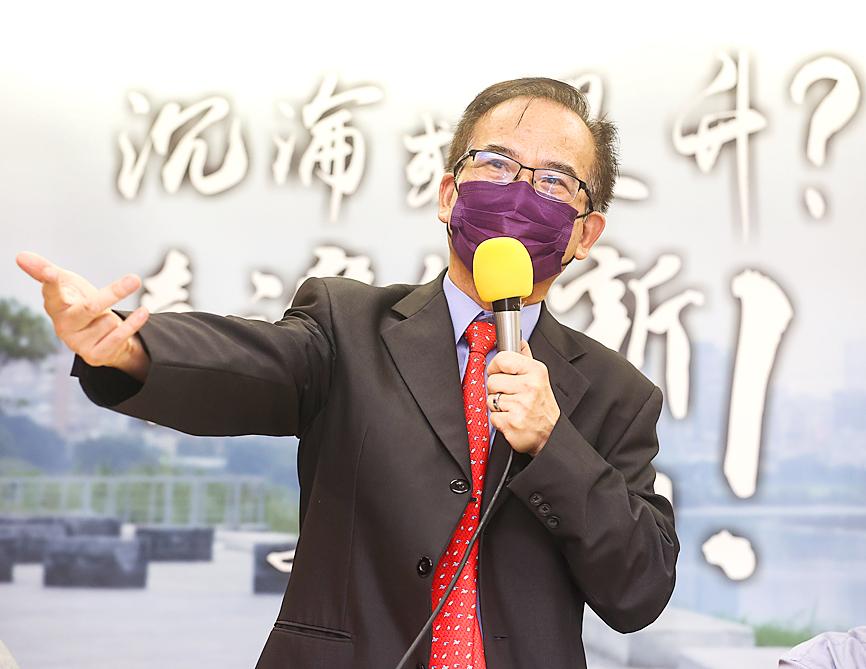
Photo: CNA
Su presented his platform of government, aimed at solving the difficulties facing young people and the nation’s low birthrate.
Comparing himself to “Don Quixote,” Su said he would undertake the mission of speaking out for Taipei’s young residents.
“Taiwan should take more drastic measures against the lowest birthrate in the world,” he said, proposing to make Taipei the first city to provide full financial support for child-rearing until the age of six.
He proposed strategies to solve the housing problem, such as imposing an empty homes tax, making the rental market completely transparent, implementing rent control and prioritizing turning public land into social housing.
Taipei should take the lead in reviving Taiwan’s film industry by turning Chiang Kai-shek Memorial Hall and nearby venues into a movie creative park, he said.
Following the example of Tokyo, London, Paris, Berlin and Seoul, Taipei should allow self-governance for its 12 districts, he said.
“Taipei needs a mayor who is willing to listen to the people and accept diversity,” he added.
With the nation’s two major political parties, and possibly the Taiwan People’s Party (TPP), having nominated strong candidates for the position, Su said the votes he gets might be embarrassingly low.
However, he said he hoped his run would raise public awareness about the difficult position young Taiwanese are in and the low birthrate, which is a threat to national security.
In addition to Su, DPP candidate Chen Shih-chung (陳時中), Chinese Nationalist Party (KMT) Legislator Chiang Wan-an (蔣萬安) and lawyer Winifred Tung (童文薰) are vying for the Taipei mayoral seat.
Taipei Deputy Mayor Vivian Huang (黃珊珊) has signaled her intention to run, but has yet to officially declare her candidacy and whether she would run as an independent or represent the TPP.
Additional reporting by CNA

SECURITY: Starlink owner Elon Musk has taken pro-Beijing positions, and allowing pro-China companies to control Taiwan’s critical infrastructure is risky, a legislator said Starlink was reluctant to offer services in Taiwan because of the nation’s extremely high penetration rates in 4G and 5G services, the Ministry of Digital Affairs said yesterday. The ministry made the comments at a meeting of the legislature’s Transportation Committee, which reviewed amendments to Article 36 of the Telecommunications Management Act (電信管理法). Article 36 bans foreigners from holding more than 49 percent of shares in public telecommunications networks, while shares foreigners directly and indirectly hold are also capped at 60 percent of the total, unless specified otherwise by law. The amendments, sponsored by Chinese Nationalist Party (KMT) Legislator Ko

The eastern extension of the Taipei MRT Red Line could begin operations as early as late June, the Taipei Department of Rapid Transit Systems said yesterday. Taipei Rapid Transit Corp said it is considering offering one month of free rides on the new section to mark its opening. Construction progress on the 1.4km extension, which is to run from the current terminal Xiangshan Station to a new eastern terminal, Guangci/Fengtian Temple Station, was 90.6 percent complete by the end of last month, the department said in a report to the Taipei City Council's Transportation Committee. While construction began in October 2016 with an
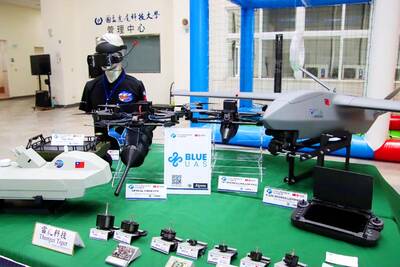
NON-RED SUPPLY: Boosting the nation’s drone industry is becoming increasingly urgent as China’s UAV dominance could become an issue in a crisis, an analyst said Taiwan’s drone exports to Europe grew 41.7-fold from 2024 to last year, with demand from Ukraine’s fight against Russian aggression the most likely driver of growth, a study showed. The Institute for Democracy, Society and Emerging Technology (DSET) in a statement on Wednesday said it found that many of Taiwan’s uncrewed aerial vehicle (UAV) sales were from Poland and the Czech Republic. These countries likely transferred the drones to Ukraine to aid it in its fight against the Russian invasion that started in 2022, it said. Despite the gains, Taiwan is not the dominant drone exporter to these markets, ranking second and fourth

Japanese Prime Minister Sanae Takaichi’s comment last year on Tokyo’s potential reaction to a Taiwan-China conflict has forced Beijing to rewrite its invasion plans, a retired Japanese general said. Takaichi told the Diet on Nov. 7 last year that a Chinese naval blockade or military attack on Taiwan could constitute a “survival-threatening situation” for Japan, potentially allowing Tokyo to exercise its right to collective self-defense. Former Japan Ground Self-Defense Force general Kiyofumi Ogawa said in a recent speech that the remark has been interpreted as meaning Japan could intervene in the early stages of a Taiwan Strait conflict, undermining China’s previous assumptions


 RSS
RSS