


Former Japanese prime minister Shinzo Abe, known for his pro-Taiwan stance, had always viewed Taiwan as an important friend to his country, regardless of whether he was in office, Taiwanese officials said yesterday.
Abe — who served two terms as prime minister from Sept. 26, 2006, to Sept. 26, 2007, and from Dec. 26, 2012, to Sept. 16, 2020 — died yesterday after he was shot while giving a speech.
Abe had always been on friendly terms with Taiwanese politicians and had visited the country several times.
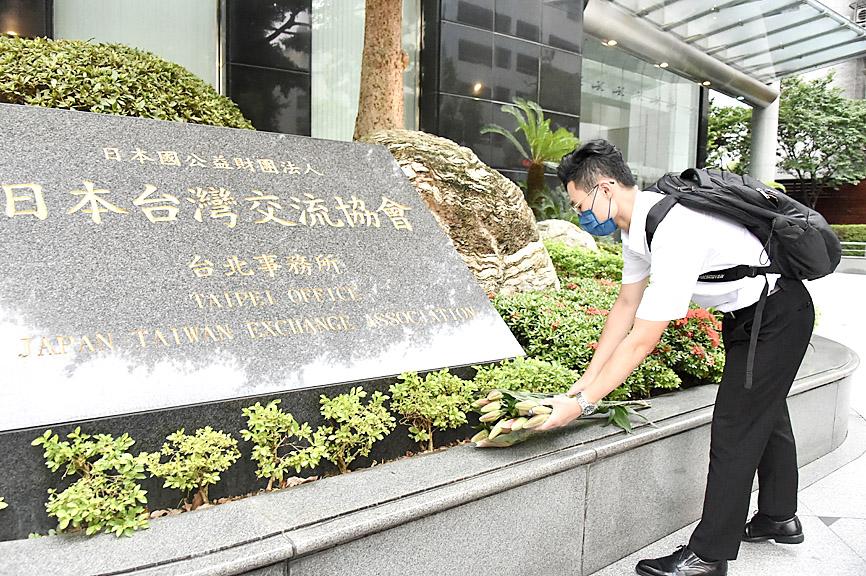
Photo: Tu Chien-jung, Taipei Times
In 2010, Abe met with then-legislative speaker Wang Jin-pyng (王金平) with members of the All-Party Parliamentary Group of the Japanese Diet. When asked by reporters about the Diaoyutai Islands (釣魚台) — which are also claimed by Japan, where they are known as the Senkaku Islands — he said that “given Japan and Taiwan’s deep friendship, there are no unsolvable problems.”
Former president Ma Ying-jeou’s (馬英九) office issued a statement yesterday saying that he met with Abe at the Presidential Office in 2010 and 2011 during visits to Taiwan.
Establishing the Sapporo branch of the Taipei Economic and Cultural Representative Office in Japan in 2009, resuming direct flights between Taipei International Airport (Songshan airport) and Tokyo’s Haneda Airport in 2010, and signing the Taiwan-Japan Fisheries Accord in 2013 were major milestones in Taiwan-Japan relations and proof of Abe’s friendliness toward Taiwan, the office said.
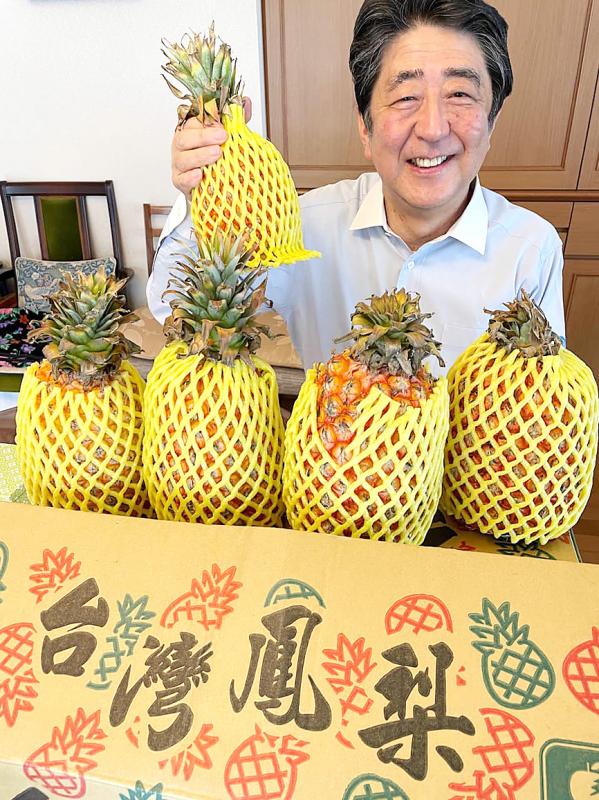
Photo: screen grab from Twitter
During Abe’s second term, he said that “Taiwan is Japan’s friend” when answering inquiries from the Diet, and later said that “Taiwan is an important partner and friend, which shares [Japan’s] general values.”
Abe still closely followed Taiwanese issues after stepping down in 2020, notably saying in February that a “Taiwan emergency is a Japan emergency,” and calling on the US to abandon its “strategic ambiguity” policy by declaring that it would defend Taiwan in the event of an attack.
Last year, Abe was instrumental in Tokyo donating 1.24 million doses of the AstraZeneca COVID-19 vaccine to Taiwan.
“Taiwan is Japan’s important, old friend. It’s only natural to provide vaccines when such a country is facing difficulties,” he said at the time.
Ten years before, Taiwan made the largest donation of money after a massive earthquake struck Japan on March 11, 2011, and the nation donated masks to Japan after the start of the COVID-19 pandemic in 2020, which Abe said that “Japan must not forget.”
In addition to befriending cross-party politicians, Abe’s friendly relationship with former president Lee Teng-hui (李登輝) is also well-known.
Lee’s daughter, Annie Lee (李安妮), yesterday said the Lee Teng-hui Foundation had planned to invite Abe to a seminar this month.
While Taipei and Tokyo lack official diplomatic ties, informal diplomatic relations are stronger than ever thanks to Abe’s support, Annie Lee said, adding that news of his assassination was “heartrending.”
Agriculture and Food Agency Director-General Hu Jong-i (胡忠一), who had been posted in Japan for several years, said that Abe and his brother Japanese Minister of Defense Nobuo Kishi used to attend national day celebrations arranged by the Taipei Economic and Cultural Representative Office in Japan, adding that Abe particularly loved Taiwanese fruit.
Pingtung County Commissioner Pan Men-an (潘孟安) wrote on Facebook that Abe strongly supported the county’s pineapples and groupers, and sent a letter to thank Pan in May after receiving pineapples grown in Pingtung.
Abe’s death was “was not only Japan’s loss, but a loss for the world,” Pan said.
Additional reporting by Yang Yuan-ting and Lo Hsin-chen

NATIONAL SECURITY: Authorities are working to confirm the identities of the military personnel involved and investigating possible illegal conduct and regulatory violations Authorities are probing possible national security implications after Kinmen police and immigration officers on Sunday found a Chinese woman allegedly posing as a tourist while engaging in prostitution involving more than 10 military personnel. The woman, surnamed Chen (陳), has since been deported, authorities said, adding that investigators are still working to confirm the identities of those implicated, as the records only listed code names and aliases. The case stemmed from a report received by the Kinmen District Prosecutors’ Office on Friday last week from the Jinhu Precinct of the Kinmen County Police Bureau. On Sunday, police, along with the National Immigration

GLOBALGIVING: ‘ Caving to external pressure is not acceptable for an organization that has cultivated justice reform and human rights for 30 years,’ one NGO said A slew of non-government organizations (NGOs) have withdrawn from the GlobalGiving fundraising platform after it announced it would use “Chinese Taipei” instead of “Taiwan” from next month. The Taiwan Good Rice Association wrote on Facebook on Friday that it was informed on April 28 via a teleconference call of the change, which was made because the platform wanted to operate in China. Taiwan Good Rice is to terminate all cooperative relationships with GlobalGiving in response to the platform’s “unilateral and non-negotiable” decision to remove references to Taiwan, the NGO said. “Taiwan is in the official name of Taiwan Good Rice Association and the

HEAVY WEATHER: Typhoon Jangmi is due to crash straight into the Ryukyus as airlines look to shift flights to larger aircraft or cancel flights to Okinawa entirely Taiwan’s international air carriers announced flight adjustments over the weekend as Typhoon Jangmi is forecast to hit the Ryukyu Islands today and tomorrow. The Central Weather Administration (CWA) upgraded Jangmi from a tropical storm to a typhoon at 8am yesterday, with the eye located 580km south of Naha city. It was moving north at 19kph. Today, China Airlines’ CI-120, CI-121, CI-122 and CI-123 flights between Taoyuan and Naha, Okinawa, have been canceled as well as CI-132 and CI-133 between Kaohsiung and Naha. EVA Air’s BR-112, BR-113, BR-186 and BR-185 flights between Taoyuan and Naha are also canceled. Low-cost carrier Tigerair Taiwan canceled IT-230,
MULTIPRONGED APPROACH: China has sought to pressure Palau across a number of fronts, but the island nation has staunchly resisted overtures to ditch Taiwan Palau has been firm in backing Taiwan despite Chinese pressure that uses tourism economics, cyberattacks and criminal infiltration as tools to threaten the Pacific ally into renouncing its recognition of Taiwan as a sovereign state. The Presidential Office yesterday announced that Vice President Hsiao Bi-khim (蕭美琴) would visit Palau from Saturday to Wednesday next week at the invitation of Palauan President Surangel Whipps Jr. Whipps in April said in an interview that China had outspokenly asked Palau to “denounce Taiwan.” “And we have said: ‘We have no enemies, but nobody tells us who our friends are,’” he said. Whipps has told reporters multiple times


 RSS
RSS