


The Ministry of Foreign Affairs yesterday condemned “untruthful statements” from Moscow two days after Russian First Deputy Chief of Staff Sergey Kiriyenko seems to have described Taiwan as a “non-negotiable” part of China.
Ministry spokeswoman Joanne Ou (歐江安) made the comment at a routine news briefing in Taipei, adding: “Taiwan and China are two mutually non-subordinating governments.”
An article published on Sunday commemorating Russia Day in the Russian newspaper Izvestia, seemingly written by Kiriyenko, first deputy chief of staff to Russian President Vladimir Putin, said that “the Chinese Taiwan problem is not a negotiable issue.”
The Multimedia Information Center Izvestia, which oversees the newspaper and other Izvestia outlets, on Monday denied ever publishing the article, saying it was the result of a hacker attack, Deutsche Welle reported.
The article has since been removed from the paper’s Web site.
Drawing a comparison between the Russia-Ukraine war to China’s claims over Taiwan, as well as Turkish President Recep Tayyip Erdogan’s claims over islands in the Mediterranean Sea, the article expressed support for Chinese President Xi Jinping’s (習近平) Global Security Initiative, saying the West should “stop interfering with the internal affairs of other peoples and governments.”
The creation of a US-led military alliance in the Indo-Pacific region is a threat to Russia’s national security, it added.
The Institute for the Study of War, a nonprofit policy research organization, said the article was likely published early by mistake.
The outlet probably had the story in reserve and intended to use it when Russia has annexed the Donbas region, it said.
It also cited Kremlin sources as saying that Kiriyenko has been tapped to lead the Russian district that would encompass Donbas and other occupied regions.
Ou condemned the “distortion of facts and insult to Taiwanese sovereignty,” saying that “the Chinese government has never ruled Taiwan and only a government elected by Taiwanese can be the legitimate representative of that people in international relations.”
“Beijing’s efforts to spread the fictitious narrative that Taiwan is part of China and its campaign of intimation through the deployment of warplanes and warships only deepens the antipathy of the Taiwanese,” she added.
Already, Beijing’s actions have raised alarm and drawn condemnation from Japan, the US and the EU while causing heightened awareness of the threat China represents to freedom and peace, she said.
Taiwan continues to safeguard freedom and democracy as the most crucial asset in its opposition to China’s totalitarian regime, she said.
“This government calls on like-minded international partners to join forces in defending the shared values of freedom and democracy from the Sino-Russian authoritarian alliance, which poses a grave threat to global freedoms and peace,” she said.


UPGRADE: The Kang Ding-class frigate is replacing its Chaparall missiles with Tien Chien II and Hua Yang VLS, which would provide it with long-range, 360° air defense Taiwan plans to produce 1,200 to 1,376 Hai Chien II missiles (海劍二, Sea Sword II) — also known as TC-2N — to serve as the standard air defense system of the navy’s surface combatant fleet, a source said yesterday. Last week, the Hai Chien II, the naval version of the Tien Kung II missile (天劍二, Sky Sword II), completed a live-fire test in waters off the National Chungshan Institute of Science and Technology’s Jiupeng facility (九鵬) in Pingtung County’s Manjhou Township (滿州). The MIM72 Chaparral and other dated air defense missiles that currently arm Taiwanese ships have inadequate range to combat Chinese

REASONS FOR TRAVEL: An assistant professor said that proposed amendments to penalize drivers if they used drugs overseas would not deter people from traveling People who operate a motor vehicle under the influence of marijuana would have their driver’s license revoked, even if they used the substance while overseas, the Ministry of Transportation and Communications said yesterday, citing proposed amendments to the Road Traffic Management and Penalty Act (道路交通管理處罰條例). The amendments would also authorize the government to revoke the licenses of people determined to have used Category 1 or Category 2 narcotics, even if they were not operating a vehicle while under the influence of drugs, as well as ban them from taking the license test for three years, the ministry said. People aged 18 or

Johanne Liou (劉喬安), a Taiwanese woman who shot to unwanted fame during the Sunflower movement protests in 2014, returned to Taiwan last night after being deported from the US. She is to stand trial in Taiwan for charges involving embezzlement, fraud and drug crimes. The Criminal Investigation Bureau (CIB) said it took her into custody at Taiwan Taoyuan International Airport and would first question her before transferring her to the New Taipei District Prosecutors’ Office. She was arrested upon disembarking a flight from San Francisco that landed shortly before 7pm. Liou absconded to the US in 2019 after jumping bail
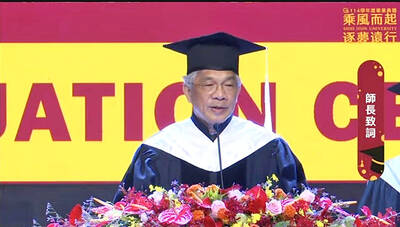
Shih Hsin University President Chen Ching-he (陳清河) yesterday issued a public apology for comments made in his commencement speech last week, stating that he has asked the school to suspend his duties and halt his wages for two months as a show of contrition. At the commencement ceremony on May 30, Chen said, “If you don’t manage your time well, or your own emotions, or your health, then I am telling every one of you — put a quick end to ‘you,’ because the world has no need for ‘you.’” The comments have sparked significant controversy online, and Chen through an open


 RSS
RSS