


The National Security Council (NSC) should block any sale of the Apple Online news Web site to foreign owners backed by Chinese capital, as the news site could be used to influence domestic media or incriminate writers, the New Power Party (NPP) said yesterday.
Apple Online, which is linked to Hong Kong’s shuttered Apple Daily newspaper, on Wednesday announced that it had secured new ownership, although it has not yet identified who is behind the deal.
Citing sources from within Apple Online, Chinese-language media reported that Singaporean entrepreneur Joseph Phua (潘杰賢), cofounder of streaming platform 17Live, and Hong Kong businessman Kenny Wee (黃浩) are the new owners.
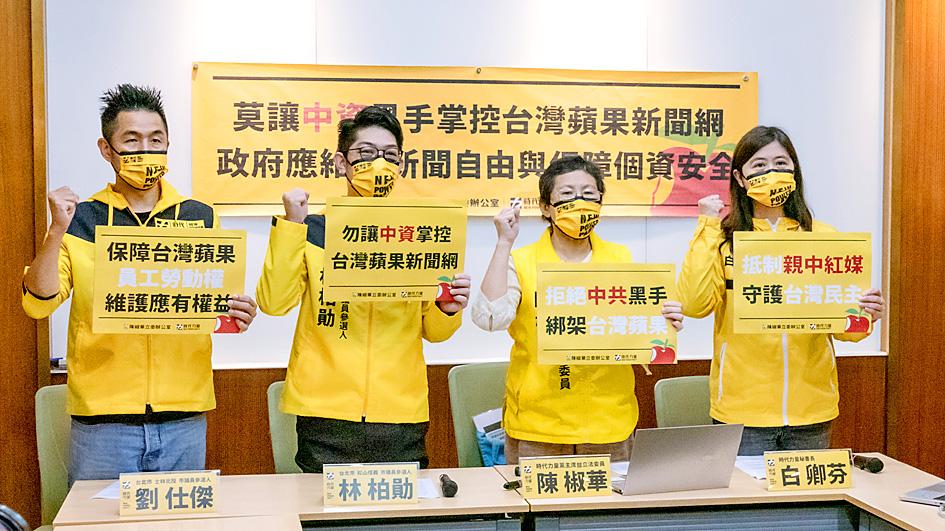
Photo courtesy of Chen Jiau-hua’s office
Many have raised concerns about the deal, leading Mainland Affairs Council spokesman Chiu Chui-cheng (邱垂正) to say on Thursday that a change in ownership would be subject to “strict scrutiny.”
NPP members yesterday urged further action, calling on the government to block the sale to avoid being “condemned by history” for allowing the news site to fall under the control of Chinese.
Apple Online has accumulated years of personal information and interviews with the nation’s politicians and business leaders, including sensitive unpublished content, NPP Legislator Chen Jiau-hua (陳椒華) told a news conference at the legislature in Taipei.
People trusted Apple Online when it was controlled by Next Digital and many people writing under pseudonyms were critical of the Chinese government, said Jerry Liu (劉仕傑), an NPP candidate for Taipei City councilor.
If a hostile foreign power received their identities, their safety could not be guaranteed, Liu said.
Although the site is subject to Taiwanese law and its sale must be approved by the Investment Commission, the issue of its ownership has bigger implications than for other acquisitions, so any deal should be handled by the NSC, he said.
Private data from Apple Online could also be used to sow discord in Taiwan, as any information that is released — regardless of its veracity — could influence the direction of domestic politics and discourse, said Lin Pai-hsun (林柏勛), another NPP candidate for Taipei City councilor.
If sensitive information falls into Chinese hands, “they would not need to fire a single bullet or missile to destabilize Taiwan,” Lin said.
Chinese capital has long sought to infiltrate Taiwanese industry and academia disguised as foreign investment, NPP Secretary-General Christy Pai (白卿芬) said.
The government should look at the US Committee on Foreign Investment — an interagency entity that reviews the national security implications of foreign investments in US companies — and consider upgrading the Investment Commission to give it the authority to review national security cases, set penalties and conduct investigations, Pai said.
Then-US president Barack Obama in 2016 signed an executive order on the committee’s recommendation, which cited national security concerns, to block the acquisition of Aixtron — a California-based subsidiary of German semiconductor firm Aixtron SE — by a German limited liability company backed by Chinese investors, Pai said.
As it is a matter of national security, the government should publicly oppose a sale of Apple Online, Chen said, adding that the NSC should establish a committee to investigate any deal and block it.
“The media has become a battleground for the Chinese Communist Party,” she said. “Our government cannot sit idly by as the Apple Online acquisition takes place.”
Defending the nation’s democracy starts with stopping this sale, Liu said, adding that “if we do not act today, Taiwan will be the next Hong Kong tomorrow.”

NATIONAL SECURITY: Authorities are working to confirm the identities of the military personnel involved and investigating possible illegal conduct and regulatory violations Authorities are probing possible national security implications after Kinmen police and immigration officers on Sunday found a Chinese woman allegedly posing as a tourist while engaging in prostitution involving more than 10 military personnel. The woman, surnamed Chen (陳), has since been deported, authorities said, adding that investigators are still working to confirm the identities of those implicated, as the records only listed code names and aliases. The case stemmed from a report received by the Kinmen District Prosecutors’ Office on Friday last week from the Jinhu Precinct of the Kinmen County Police Bureau. On Sunday, police, along with the National Immigration

GLOBALGIVING: ‘ Caving to external pressure is not acceptable for an organization that has cultivated justice reform and human rights for 30 years,’ one NGO said A slew of non-government organizations (NGOs) have withdrawn from the GlobalGiving fundraising platform after it announced it would use “Chinese Taipei” instead of “Taiwan” from next month. The Taiwan Good Rice Association wrote on Facebook on Friday that it was informed on April 28 via a teleconference call of the change, which was made because the platform wanted to operate in China. Taiwan Good Rice is to terminate all cooperative relationships with GlobalGiving in response to the platform’s “unilateral and non-negotiable” decision to remove references to Taiwan, the NGO said. “Taiwan is in the official name of Taiwan Good Rice Association and the

HEAVY WEATHER: Typhoon Jangmi is due to crash straight into the Ryukyus as airlines look to shift flights to larger aircraft or cancel flights to Okinawa entirely Taiwan’s international air carriers announced flight adjustments over the weekend as Typhoon Jangmi is forecast to hit the Ryukyu Islands today and tomorrow. The Central Weather Administration (CWA) upgraded Jangmi from a tropical storm to a typhoon at 8am yesterday, with the eye located 580km south of Naha city. It was moving north at 19kph. Today, China Airlines’ CI-120, CI-121, CI-122 and CI-123 flights between Taoyuan and Naha, Okinawa, have been canceled as well as CI-132 and CI-133 between Kaohsiung and Naha. EVA Air’s BR-112, BR-113, BR-186 and BR-185 flights between Taoyuan and Naha are also canceled. Low-cost carrier Tigerair Taiwan canceled IT-230,

Chinese Nationalist Party (KMT) Chairwoman Cheng Li-wun (鄭麗文) yesterday briefed her party’s Central Standing Committee regarding her scheduled visit to the US between Monday next week and June 16, saying that her purpose would be to persuade the US that the Republic of China (ROC) Constitution was a “one China” constitution that would foster stable and peaceful cross-strait relations. The ROC Constitution is the most important defense for all Taiwanese citizens, as it upholds our democracy and has contributed to our robust economy, which aligns with international and US interests, she said. “We would not be troublemakers and drag the US under,”


 RSS
RSS