


The shadowing of a Taiwanese research vessel carrying Philippine researchers by Chinese coast guard vessels earlier this year contravened a UN convention, the Ministry of Foreign Affairs said yesterday.
At the time, the R/V Legend was in the South China Sea carrying out a research project sponsored by Taiwan and the Philippines under the terms of the UN Convention on the Law of the Sea, ministry spokeswoman Joanne Ou (歐江安) said.
The “harassment” by Chinese coast guard vessels not only jeopardized regional security and stability, but also contravened the UN convention, which sets out the rights and obligations of countries to conduct scientific research in the world’s oceans, Ou said.
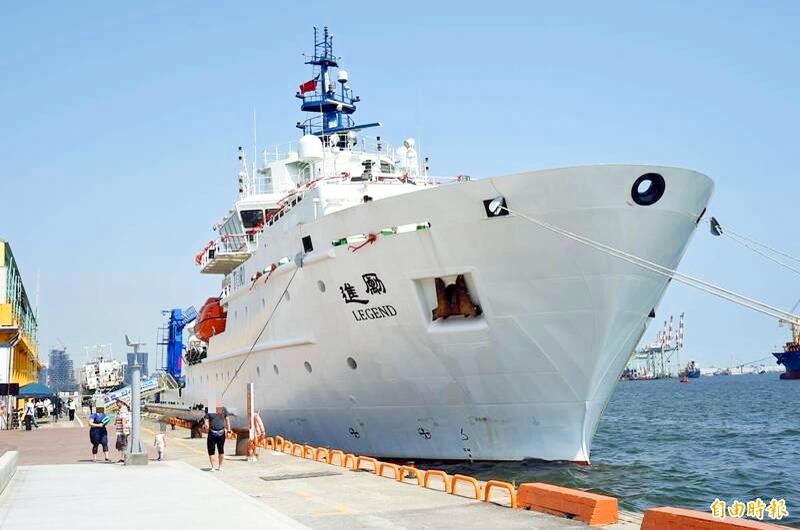
Photo: Yang Mien-chieh, Taipei Times
The ministry condemns the Chinese coast guard’s shadowing of the Legend in March, she said, without giving details of the coast guard’s actions.
Disputes in the region should be settled peacefully by all parties concerned in accordance with international law and the law of the sea, Ou said.
The ministry issued the statement a day after the Philippine Department of Foreign Affairs said that on April 13, it had summoned a senior official from China’s embassy in Manila to protest the alleged “harassment” of the Legend, which was conducting research in the “West Philippine Sea.”
Manila uses the “West Philippine Sea” to designate the parts of the South China Sea included in its exclusive economic zone.
On Thursday last week, US-based research organization Asia Maritime Transparency Initiative said in a report that separate incidents had been recorded of Chinese law enforcement vessels challenging “marine research and hydrocarbon exploration activities within the Philippines’ exclusive economic zone in the South China Sea.”
In the report, titled Three Rounds of Coercion, the organization said that on March 23, Chinese Coast Guard vessel 5203 departed from Mischief Reef (Meiji Reef, 美濟礁) in the Spratly Islands (Nansha Islands, 南沙群島) and “began shadowing” the Legend at a distance of 2 to 3 nautical miles (3.7km to 5.6km) while the Legend was conducting research in Philippine territory.
On April 6, the same Chinese coast guard boat again tailed the Legend, which was accompanied by a Philippine coast guard patrol vessel, the BRP Capones, the report said.
The Chinese vessel stopped shadowing the other two vessels only after the Capones returned to port in San Fernando and the Legend sailed back to Taiwan three days later, it said.
An article by The Associated Press (AP) in April said the Legend was carrying five Philippine scientists and an unspecific number of Taiwanese researchers on a month-long voyage to map faults and other geological features to help assess earthquake, tsunami and other potential risks in the region.
The mapping project, which concluded on April 13, was partly funded by the Philippine Department of Science and Technology, and was conducted by Taoyuan-based National Central University and the University of the Philippines’ National Institute of Geological Sciences, the AP report said.

Actor Darren Wang (王大陸) was sentenced to six months in prison, commutable to a fine, by the New Taipei District Court today for contravening the Personal Data Protection Act (個人資料保護法) in a case linked to an alleged draft-dodging scheme. Wang allegedly paid NT$3.6 million (US$114,380) to an illegal group to help him evade mandatory military service through falsified medical documents, prosecutors said. He transferred the funds to Chen Chih-ming (陳志明), the alleged mastermind of a draft-evasion ring, although he lost contact with him as he was already in detention on fraud charges, they said. Chen is accused of helping a

SECURITY: Starlink owner Elon Musk has taken pro-Beijing positions, and allowing pro-China companies to control Taiwan’s critical infrastructure is risky, a legislator said Starlink was reluctant to offer services in Taiwan because of the nation’s extremely high penetration rates in 4G and 5G services, the Ministry of Digital Affairs said yesterday. The ministry made the comments at a meeting of the legislature’s Transportation Committee, which reviewed amendments to Article 36 of the Telecommunications Management Act (電信管理法). Article 36 bans foreigners from holding more than 49 percent of shares in public telecommunications networks, while shares foreigners directly and indirectly hold are also capped at 60 percent of the total, unless specified otherwise by law. The amendments, sponsored by Chinese Nationalist Party (KMT) Legislator Ko

‘SAME OLD TRICK’: Even if Beijing resumes individual travel to Taiwan, it would only benefit Chinese tourism companies, the Economic Democracy Union convener said China’s 10 new “incentives” are “sugar-coated poison,” an official said yesterday, adding that Taiwanese businesses see them clearly for what they are, but that Beijing would inevitably find some local collaborators to try to drums up support. The official, speaking on condition of anonymity, made the remark ahead of a news conference the General Chamber of Commerce is to hold today. The event, titled “Industry Perspectives on China’s Recent Pro-Taiwan Policies,” is expected to include representatives from industry associations — such as those in travel, hotels, food and agriculture — to request the government cooperate with China’s new measures, people familiar with

The eastern extension of the Taipei MRT Red Line could begin operations as early as late June, the Taipei Department of Rapid Transit Systems said yesterday. Taipei Rapid Transit Corp said it is considering offering one month of free rides on the new section to mark its opening. Construction progress on the 1.4km extension, which is to run from the current terminal Xiangshan Station to a new eastern terminal, Guangci/Fengtian Temple Station, was 90.6 percent complete by the end of last month, the department said in a report to the Taipei City Council's Transportation Committee. While construction began in October 2016 with an


 RSS
RSS