


Taiwan People’s Party (TPP) lawmakers yesterday touted their legislative achievements and outlined the party’s agenda for the upcoming legislative session in September.
The TPP’s five lawmakers helped revise and pass 37 laws this session through their membership in the various legislative committees, TPP Legislator Andy Chiu (邱臣遠) told a news conference at the legislature in Taipei.
For the upcoming legislative session, which is to run until December, the party will focus on five core issues — national security, housing justice, fiscal discipline, economic development and environmental sustainability, he said.
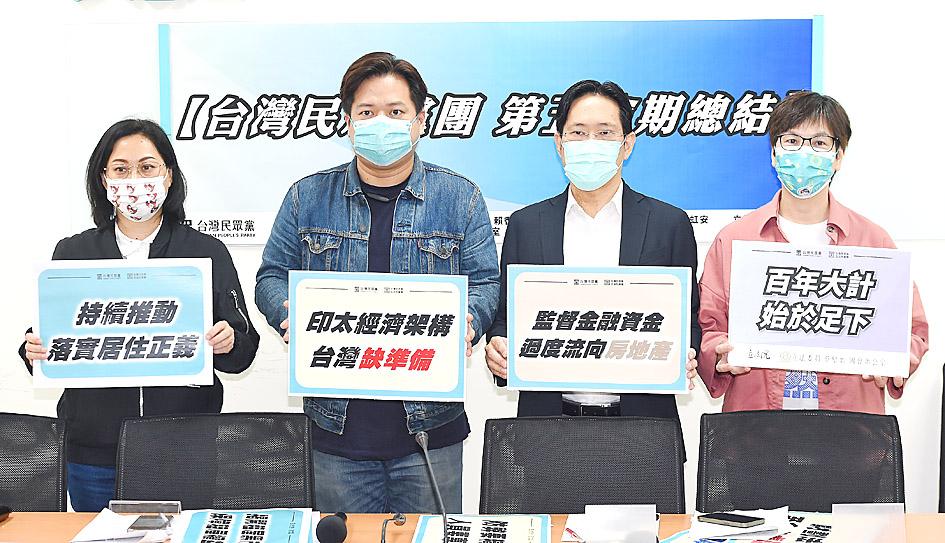
Photo: Liao Chen-huei, Taipei Times
Particular attention would be given to the nation’s burgeoning defense budget of NT$240 billion (US$8.26 billion) allotted over five years, he said, adding that corruption allegations have caused delays in the implementation of the program.
Soaring rent and property values are an issue of concern to ordinary Taiwanese, TPP Legislator Lai Hsiang-ling (賴香伶) said, adding that she would focus on passing a bill to regulate presale property transfers in the next session.
This legislation had stalled after Democratic Progressive Party (DPP) lawmakers showed a lack of interest, which runs counter to President Tsai Ing-wen’s (蔡英文) promise during her 2020 presidential election campaign to promote housing justice, she said.
Lawmakers must lean on the central bank to regulate the flow of investment to the housing market, which is the underlying cause of unaffordable housing prices, TPP Legislator Jang Chill (張其祿) said.
In addition, tax credit for renters should be listed as a special deduction under the Income Tax Act (所得稅法) to ease the pressure on renters, he said.
The Directorate-General of Budget, Accounting and Statistics should be prompted to list COVID-19 pandemic stimulus as a regular part of the budget to allow oversight by lawmakers, he said.
The government must make appropriate plans for the Carbon Border Adjustment Mechanism, which is to be implemented in the EU starting next year, TPP Legislator Ann Kao (高虹安) said.
The effects of the regulation would be felt in Taiwan’s export-oriented economy, especially as 70 percent of the country’s enterprises reportedly do not understand that legal mechanism, she said, citing a study by the Ministry of Economic Affairs.
Taiwan’s carbon credit scheme needs to be improved urgently if the country wants to keep a favorable negotiating position in trading with the EU, she said.
The TPP caucus will continue to work on amending the Mental Health Act (精神衛生法), the Tobacco Hazard Prevention Act (菸害防制法), the Greenhouse Gas Reduction and Management Act (溫室氣體減量及管理法) and other laws pertaining to the environment and public health, TPP Legislator Tsai Pi-ru (蔡壁如) said.
The TPP and other political parties have reached a consensus on overhauling parts of the Mining Act (礦業法), including doing away with a stipulation that the government must compensate mine operators after revoking a license, he said.
Additionally, legislation for creating a carbon-neutral cement sector by 2050 and a road map to reducing emissions should be prioritized for the next legislative session, he said.


UPGRADE: The Kang Ding-class frigate is replacing its Chaparall missiles with Tien Chien II and Hua Yang VLS, which would provide it with long-range, 360° air defense Taiwan plans to produce 1,200 to 1,376 Hai Chien II missiles (海劍二, Sea Sword II) — also known as TC-2N — to serve as the standard air defense system of the navy’s surface combatant fleet, a source said yesterday. Last week, the Hai Chien II, the naval version of the Tien Kung II missile (天劍二, Sky Sword II), completed a live-fire test in waters off the National Chungshan Institute of Science and Technology’s Jiupeng facility (九鵬) in Pingtung County’s Manjhou Township (滿州). The MIM72 Chaparral and other dated air defense missiles that currently arm Taiwanese ships have inadequate range to combat Chinese

REASONS FOR TRAVEL: An assistant professor said that proposed amendments to penalize drivers if they used drugs overseas would not deter people from traveling People who operate a motor vehicle under the influence of marijuana would have their driver’s license revoked, even if they used the substance while overseas, the Ministry of Transportation and Communications said yesterday, citing proposed amendments to the Road Traffic Management and Penalty Act (道路交通管理處罰條例). The amendments would also authorize the government to revoke the licenses of people determined to have used Category 1 or Category 2 narcotics, even if they were not operating a vehicle while under the influence of drugs, as well as ban them from taking the license test for three years, the ministry said. People aged 18 or
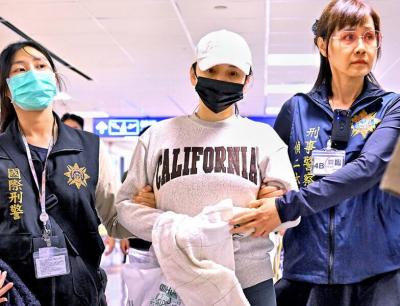
Johanne Liou (劉喬安), a Taiwanese woman who shot to unwanted fame during the Sunflower movement protests in 2014, returned to Taiwan last night after being deported from the US. She is to stand trial in Taiwan for charges involving embezzlement, fraud and drug crimes. The Criminal Investigation Bureau (CIB) said it took her into custody at Taiwan Taoyuan International Airport and would first question her before transferring her to the New Taipei District Prosecutors’ Office. She was arrested upon disembarking a flight from San Francisco that landed shortly before 7pm. Liou absconded to the US in 2019 after jumping bail
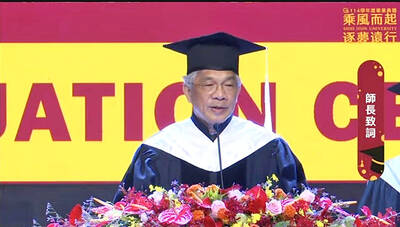
Shih Hsin University President Chen Ching-he (陳清河) yesterday issued a public apology for comments made in his commencement speech last week, stating that he has asked the school to suspend his duties and halt his wages for two months as a show of contrition. At the commencement ceremony on May 30, Chen said, “If you don’t manage your time well, or your own emotions, or your health, then I am telling every one of you — put a quick end to ‘you,’ because the world has no need for ‘you.’” The comments have sparked significant controversy online, and Chen through an open


 RSS
RSS