


The Taiwan Public Opinion Foundation and the Asia-Pacific Elite Interchange Association yesterday released separate polls on Taiwanese satisfaction with President Tsai Ing-wen’s (蔡英文) governance over the past six years.
About 63.9 percent of respondents said that coexisting with COVID-19 is a suitable policy for Taiwan, 11.5 percent preferred the “zero COVID” model adopted by the Shanghai City Government and 24.6 percent declined to provide an answer, the association’s poll showed.
The poll also showed that 48.3 percent of respondents were confident that Tsai is handling cross-strait relations appropriately, while 36.1 percent said that they lacked confidence in her approach.
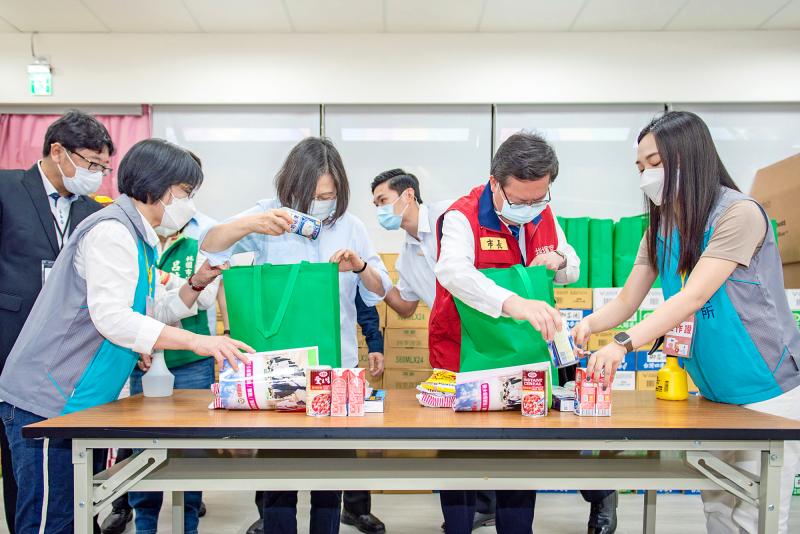
Photo courtesy of the Taoyuan City Government
Overall, the poll showed that 49.2 percent of respondents were satisfied with the governance of the Tsai administration, while 29.1 percent expressed dissatisfaction.
The association’s poll was conducted on Wednesday and Thursday, interviewing 1,073 adults in telephone interviews after calling randomized landline numbers.
It has a confidence level of 95 percent and a margin of error of 2.98 percentage points.
The association’s poll was weighted based on gender, age and region.
Taiwan Thinktank member Tung Li-wen (董立文) said that she was impressed by the Tsai administration’s ability to maintain high satisfaction ratings, even amid unprecedented political, economic and military turmoil.
The foundation’s poll separately showed that 26.8 percent of respondents were “extremely satisfied” with the performance of Tsai’s administration, 16.5 were “satisfied,” 23.1 percent were “ambivalent,” 13.1 percent were “moderately dissatisfied” and 16.2 percent were “extremely dissatisfied.”
In descending order, 56.7 percent were satisfied with the performance of the administration’s foreign relations, 51.1 percent were satisfied with national defense, 49.5 percent were satisfied with cross-strait policies, 47.3 percent were satisfied with economic performance, 42.4 percent were satisfied that Taiwan had developed its own COVID-19 vaccine and 37.3 percent were satisfied with the administration’s judiciary reforms, the foundation’s poll showed.
Measuring dissatisfaction, 48.5 percent cited Taiwan’s vaccine development, 44.8 percent said economic performance, 43.9 percent said judicial reforms, 39.2 percent said cross-strait policies, 35 percent said national defense policies and 33.9 percent said foreign relations, it showed.
The foundation said that 46 percent supported Tsai’s handling of national affairs, while 40 percent were unhappy in that regard.
The narrow difference of 6.7 percentage points between the national affairs numbers should be a warning for the administration, the foundation said.
The foundation’s poll was conducted on Monday and Tuesday, interviewing people aged 20 or older via telephone.
It obtained 1,077 valid responses and has a 95 percent confidence level with a margin of error of 2.99 percentage points.

More than half of the bamboo vipers captured in Tainan in the past few years were found in the city’s Sinhua District (新化), while other districts had smaller catches or none at all. Every year, Tainan captures about 6,000 snakes which have made their way into people’s homes. Of the six major venomous snakes in Taiwan, the cobra, the many-banded krait, the brown-spotted pit viper and the bamboo viper are the most frequently captured. The high concentration of bamboo vipers captured in Sinhua District is puzzling. Tainan Agriculture Bureau Forestry and Nature Conservation Division head Chu Chien-ming (朱健明) earlier this week said that the

NAMING SPAT: The foreign ministry called on Denmark to propose an acceptable solution to the erroneous nationality used for Taiwanese on residence permits Taiwan has revoked some privileges for Danish diplomatic staff over a Danish permit that lists “Taiwan” as “China,” Eric Huang (黃鈞耀), head of the Ministry of Foreign Affairs’ Department of European Affairs, told a news conference in Taipei yesterday. Reporters asked Huang whether the Danish government had responded to the ministry’s request that it correct the nationality on Danish residence permits of Taiwanese, which has been listed as “China” since 2024. Taiwan’s representative office in Denmark continues to communicate with the Danish government, and the ministry has revoked some privileges previously granted to Danish representatives in Taiwan and would continue to review
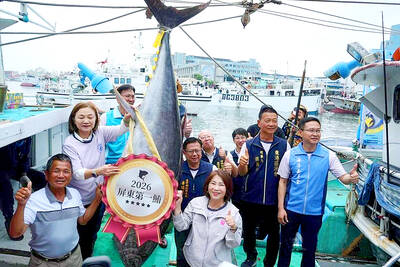
The first bluefin tuna of the season, brought to shore in Pingtung County and weighing 190kg, was yesterday auctioned for NT$10,600 (US$333.5) per kilogram, setting a record high for the local market. The auction was held at the fish market in Donggang Fishing Harbor, where the Siaoliouciou Island-registered fishing vessel Fu Yu Ching No. 2 delivered the “Pingtung First Tuna” it had caught for bidding. Bidding was intense, and the tuna was ultimately jointly purchased by a local restaurant and a local company for NT$10,600 per kilogram — NT$300 ,more than last year — for a total of NT$2.014 million. The 67-year-old skipper

China has reserved offshore airspace over the Yellow Sea and East China Sea from March 27 to May 6, issuing alerts that are usually used to warn of military exercises, although no such exercises have been announced, the Wall Street Journal (WSJ) reported on Sunday. Reserving such a large area for 40 days without explanation is an “unusual step,” as military exercises normally only last a few days, the paper said. The alerts, known as notice to air missions (NOTAMs), “are intended to inform pilots and aviation authorities of temporary airspace hazards or restrictions,” the article said. The airspace reserved in the alert


 RSS
RSS