


Taiwan might not see a significant drop in COVID-19 transmissions until September, a health expert said yesterday, while highlighting two “weaknesses” the country faces as it shifts from a strategy based on COVID-19 elimination to one based on mitigation.
“The experience of other countries shows that once you ease prevention measures, the number of cases typically rises above 10,000 per day,” Lee Ping-ing (李秉穎), convener of Taiwan’s Advisory Committee on Immunization Practices (ACIP), said during a radio interview.
“The number of cases rises sharply, but then it also declines in a short period of time,” said Lee, who is also a pediatrician at National Taiwan University Hospital.

Photo: CNA
“Taiwan is in the process of relaxing its prevention measures, but it is doing so in stages and not all at once, as some other countries have done,” he said, adding that this will drag out both the rise and fall in daily infection numbers.
Lee estimated that Taiwan would go through “a painful period” over the next four to five months, before large-scale community transmission rates give way to lower levels of infection.
The government is considering ways to ease this process, he said, such as possibly reducing the mandatory 10-day quarantine for health workers exposed to COVID-19 to ensure hospitals remain adequately staffed.
Taiwan’s two main “weaknesses” as it enters this period are the “relatively low” rates of vaccination among older people and the situation of children aged 5 to 11 who are not yet eligible for vaccination against COVID-19.
As of Monday, 79.6 percent of people over the age of 65 have received two COVID-19 vaccine shots, while 64.9 percent have received a third shot, Central Epidemic Command Center (CECC) data showed.
Among people aged 75 or older, 71.7 percent have received two shots, while 56.1 percent have received a third shot, compared with national rates of 79 percent and 52.9 percent respectively, the data showed.
On Wednesday, Lee explained at the CECC news briefing how he assessed risks posed by pediatric COVID-19 cases, as well as the issue of vaccination.
From Jan. 1 to Wednesday, of the 1,604 children younger than 18 who contracted COVID-19 in Taiwan, none developed moderate or severe symptoms or died, Lee said.
By contrast, from the start of the year to the end of last month in the US, 962 children younger than 19 died of COVID-19, with about 0.01 percent of cases — or one in 10,000 — resulting in death, Lee said, citing statistics from the American Academy of Pediatrics.
Based on the US data, Taiwan could see the number of pediatric COVID-19 deaths rise to double digits as the overall number of cases continues to climb, he said.
Aside from the risk of illness, there is also a significant “social cost” when children are infected or classes are suspended, because their parents have to stay home to take care of them, he added.
Lee said he believed conditions had changed from late last month, when the ACIP decided to temporarily hold off on vaccinating children aged 5 to 11 against COVID-19, citing insufficient data on whether it was necessary.
At the time, the number of COVID-19 cases in Taiwan was relatively low, and the government had yet to authorize any COVID-19 vaccines for children in that age group, Lee said.
However, he now believes that “the positives” of proceeding with vaccination “outweigh the negatives.”
As of yesterday, Taiwan was in negotiations with Pfizer- BioNTech and Moderna to purchase vaccines for children aged 5 to 11, and is preparing to review the companies’ applications for emergency use authorization, said Minister of Health and Welfare Chen Shih-chung (陳時中), who heads the CECC.

The military has spotted two Chinese warships operating in waters near Penghu County in the Taiwan Strait and sent its own naval and air forces to monitor the vessels, the Ministry of National Defense (MND) said. Beijing sends warships and warplanes into the waters and skies around Taiwan on an almost daily basis, drawing condemnation from Taipei. While the ministry offers daily updates on the locations of Chinese military aircraft, it only rarely gives details of where Chinese warships are operating, generally only when it detects aircraft carriers, as happened last week. A Chinese destroyer and a frigate entered waters to the southwest
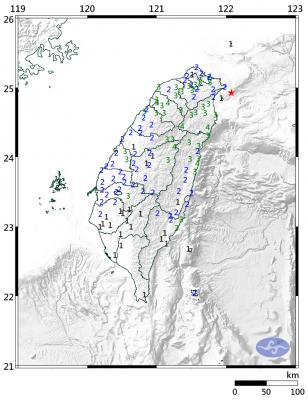
A magnitude 6.1 earthquake struck off the coast of Yilan County at 8:39pm tonight, the Central Weather Administration (CWA) said, with no immediate reports of damage or injuries. The epicenter was 38.7km east-northeast of Yilan County Hall at a focal depth of 98.3km, the CWA’s Seismological Center said. The quake’s maximum intensity, which gauges the actual physical effect of a seismic event, was a level 4 on Taiwan’s 7-tier intensity scale, the center said. That intensity level was recorded in Yilan County’s Nanao Township (南澳), Hsinchu County’s Guansi Township (關西), Nantou County’s Hehuanshan (合歡山) and Hualien County’s Yanliao (鹽寮). An intensity of 3 was

Japanese Prime Minister Sanae Takaichi’s comment last year on Tokyo’s potential reaction to a Taiwan-China conflict has forced Beijing to rewrite its invasion plans, a retired Japanese general said. Takaichi told the Diet on Nov. 7 last year that a Chinese naval blockade or military attack on Taiwan could constitute a “survival-threatening situation” for Japan, potentially allowing Tokyo to exercise its right to collective self-defense. Former Japan Ground Self-Defense Force general Kiyofumi Ogawa said in a recent speech that the remark has been interpreted as meaning Japan could intervene in the early stages of a Taiwan Strait conflict, undermining China’s previous assumptions
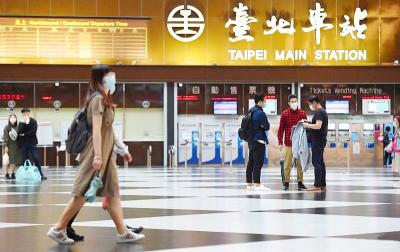
Taiwan Railways Corp (TRC) today announced that Shin Kong Mitsukoshi has been selected as the preferred bidder to operate the Taipei Railway Station shopping mall, replacing the current operator, Breeze Development Co Ltd. Among eight qualified firms that delivered presentations and were evaluated by a review committee, Shin Kong Mitsukoshi was ranked first, while Breeze was named the runner-up, the rail company said in a statement. Contract negotiations are to proceed in accordance with regulations, it said, adding that if negotiations with the top bidder fail, it could invite the second-ranked applicant to enter talks. Breeze in a statement today expressed doubts over


 RSS
RSS