


A bill introduced in the US Senate on Friday would make US policy on arms sales to Taiwan more consistent, a Taiwanese defense expert said on Saturday.
The bill, dubbed the Taiwan Weapons Exports Act, would “fast-track weapons to Taiwan” by expediting congressional approval and eliminating administrative roadblocks amid increasing tensions between Taiwan and China, US Senator Josh Hawley, who proposed the bill, said in a statement.
In particular, the bill seeks to redesignate Taiwan from Country Group A:5 to Country Group A:6 so that it can receive a strategic trade authorization license exception under the Export Administration Regulations, the statement said.
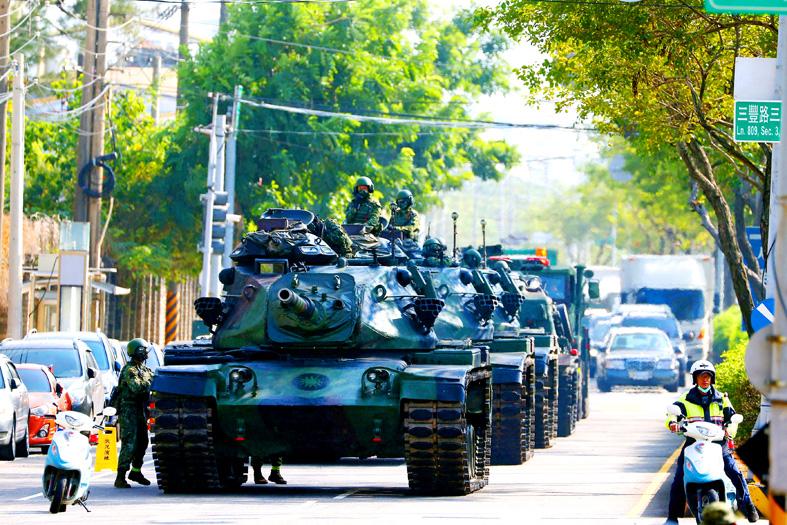
Photo: Ann Wang, Reuters
Other countries in Country Group A:5 include NATO member states Australia, India, Japan and South Korea, the statement said.
Su Tzu-yun (蘇紫雲), an analyst at the government-funded Institute for National Defense and Security Research, said that the proposed legislation would make the US’ policy of arms sales to Taiwan more consistent.
US arms sales to Taiwan are currently reviewed by the US Department of State on a case-by-case basis and the time spent on each sale can differ greatly, he said.
The bill, if passed and signed into law, would bring the review process in line with that for NATO members and other US allies, Su said, adding that it would also prevent disruptions in sales of defense products to Taiwan due to political factors.
Meanwhile, Chieh Chung (揭仲), an associate research fellow at the National Policy Foundation in Taipei, said that the bill would also shorten the congressional review of US arms sales to Taiwan from 30 days to 15 days.
Arms sales to major US allies, such as NATO members, Israel, Japan and South Korea, require approval from the US Congress if a single deal is estimated to cost more than US$25 million, Chieh said, adding that congressional review takes about 15 days.
Any US arms sales to Taiwan worth more than US$14 million currently require congressional approval, with the review process taking up to 30 days, he said.
When it comes to the sale of major defense articles and strategic technologies, the US government tends to prioritize major allies, Chieh said.
The proposed legislation would pave the way for Taiwan to acquire advanced weapons and technologies like other major US allies, he added.
The Ministry of Foreign Affairs on Saturday thanked Hawley for his consistent support of Taiwan, saying in a statement that it would closely follow the proposed bill’s progress.
Taiwan would continue working with the US Congress and US President Joe Biden’s administration to further improve bilateral ties and contribute to stability in the Indo-Pacific region, it added.

Actor Darren Wang (王大陸) was sentenced to six months in prison, commutable to a fine, by the New Taipei District Court today for contravening the Personal Data Protection Act (個人資料保護法) in a case linked to an alleged draft-dodging scheme. Wang allegedly paid NT$3.6 million (US$114,380) to an illegal group to help him evade mandatory military service through falsified medical documents, prosecutors said. He transferred the funds to Chen Chih-ming (陳志明), the alleged mastermind of a draft-evasion ring, although he lost contact with him as he was already in detention on fraud charges, they said. Chen is accused of helping a

SECURITY: Starlink owner Elon Musk has taken pro-Beijing positions, and allowing pro-China companies to control Taiwan’s critical infrastructure is risky, a legislator said Starlink was reluctant to offer services in Taiwan because of the nation’s extremely high penetration rates in 4G and 5G services, the Ministry of Digital Affairs said yesterday. The ministry made the comments at a meeting of the legislature’s Transportation Committee, which reviewed amendments to Article 36 of the Telecommunications Management Act (電信管理法). Article 36 bans foreigners from holding more than 49 percent of shares in public telecommunications networks, while shares foreigners directly and indirectly hold are also capped at 60 percent of the total, unless specified otherwise by law. The amendments, sponsored by Chinese Nationalist Party (KMT) Legislator Ko

UNREASONABLE SURVEILLANCE: A camera targeted on an road by a neighbor captured a man’s habitual unsignaled turn into home, netting him dozens of tickets The Taichung High Administrative Court has canceled all 45 tickets given to a man for failing to use a turn signal while driving, as it considered long-term surveillance of his privacy more problematic than the traffic violations. The man, surnamed Tseng (曾), lives in Changhua County and was reported 45 times within a month for failing to signal while driving when he turned into the alley where his residence is. The reports were filed by his neighbor, who set up security cameras that constantly monitored not only the alley but also the door and yard of Tseng’s house. The surveillance occurred from July

‘SAME OLD TRICK’: Even if Beijing resumes individual travel to Taiwan, it would only benefit Chinese tourism companies, the Economic Democracy Union convener said China’s 10 new “incentives” are “sugar-coated poison,” an official said yesterday, adding that Taiwanese businesses see them clearly for what they are, but that Beijing would inevitably find some local collaborators to try to drums up support. The official, speaking on condition of anonymity, made the remark ahead of a news conference the General Chamber of Commerce is to hold today. The event, titled “Industry Perspectives on China’s Recent Pro-Taiwan Policies,” is expected to include representatives from industry associations — such as those in travel, hotels, food and agriculture — to request the government cooperate with China’s new measures, people familiar with


 RSS
RSS