


The government should consider implementing energy-efficient certification for new buildings to meet its carbon neutrality goal by 2050, experts said yesterday at an online forum hosted by the Delta Electronics Foundation.
A legal mechanism is required to compel developers to meet clearly defined standards, National Cheng Kung University architecture professor Lin Hsien-te (林憲德) said.
The UN Intergovernmental Panel on Climate Change Sixth Assessment Report (AR6), released on Monday, shows that regulatory guidelines for architectural design and building materials would help urban areas reduce carbon emissions, Lin said.
The university’s Sun Yun-suan (孫運璿) Research Building is one of seven model carbon-zero structures mentioned in the AR6 report, Lin added.
Taiwan’s residential and commercial buildings comprise 35 to 37 percent of the nation’s energy expenditure, second only to industry, Lin said, citing the National Development Council’s Roadmap to 2050: A Manual for Nations to Decarbonize by Mid-Century.
More than 85 percent of older buildings must be as close to carbon zero as possible by 2050, Lin said, quoting from the manual, adding that his proposal for an energy efficiency certificate would help achieve this goal.
The government should model a policy on the US’ and EU’s gradation of energy efficiency, he said.
The EU has seven categories of building energy efficiency certificates, and any construction, sale or lease documents must include a copy of the certificate, Lin said, adding that selling prices or rental fees of certified buildings have increased 3 percent to 5 percent.
Half of all buildings in New York are required to show their Energy Star certificate, and their certification is reviewed on an annual basis, allowing people to know how much energy their buildings are using, Lin said.
Buildings adopting the Energy Star program on average use 7 percent less energy, with rental value increasing 2 percent to 3 percent, and selling value increasing 13 percent to 16 percent, Lin said.

POLAM KOPITIAM CASE: Of the two people still in hospital, one has undergone a liver transplant and is improving, while the other is being evaluated for a liver transplant A fourth person has died from bongkrek acid poisoning linked to the Polam Kopitiam (寶林茶室) restaurant in Taipei’s Far Eastern Sogo Xinyi A13 Department Store, the Ministry of Health and Welfare said yesterday, as two other people remain seriously ill in hospital. The first death was reported on March 24. The man had been 39 years old and had eaten at the restaurant on March 22. As more cases of suspected food poisoning involving people who had eaten at the restaurant were reported by hospitals on March 26, the ministry and the Taipei Department of Health launched an investigation. The Food and
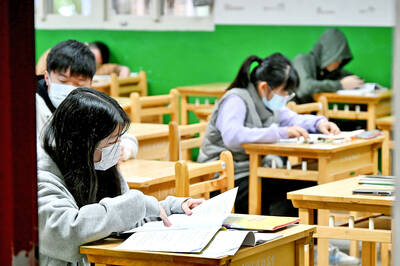
CHANGES: After-school tutoring periods, extracurricular activities during vacations or after-school study periods must not be used to teach new material, the ministry said The Ministry of Education yesterday announced new rules that would ban giving tests to most elementary and junior-high school students during morning study and afternoon rest periods. The amendments to regulations governing public education at elementary schools and junior high schools are to be implemented on Aug. 1. The revised rules stipulate that schools are forbidden to use after-school tutoring periods, extracurricular activities during summer or winter vacation or after-school study periods to teach new course material. In addition, schools would be prohibited from giving tests or exams to students in grades one to eight during morning study and afternoon break periods, the
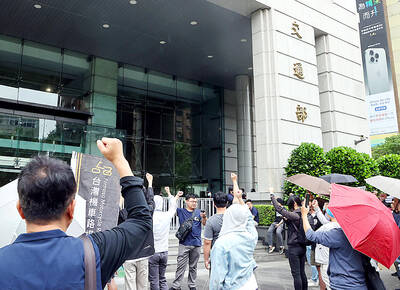
Advocates of the rights of motorcycle and scooter riders yesterday protested in front of the Ministry of Transportation and Communications in Taipei, making three demands. They were joined by 30 passenger vehicles, which surrounded the ministry to make three demands related to traffic regulations — that motorcycles and scooters above 250cc be allowed on highways, that all motorcycles and scooters be allowed on inside lanes, and that driver and rider training programs be reformed. The ministry said that it has no plans to allow motorcycles on national highways for the time being, and said that motorcycles would be allowed on the inner

AMENDMENT: Contact with certain individuals in China, Hong Kong and Macau must be reported, and failure to comply could result in a prison sentence, the proposal stated The Chinese Nationalist Party (KMT) and the Taiwan People’s Party (TPP) yesterday voted against a proposed bill by Democratic Progressive Party (DPP) lawmakers that would require elected officials to seek approval before visiting China. DPP Legislator Puma Shen’s (沈伯洋) proposed amendments to the Act Governing Relations Between the People of the Taiwan Area and the Mainland Area (臺灣地區與大陸地區人民關係條例), stipulate that contact with certain individuals in China, Hong Kong and Macau should be reported, while failure to comply would be punishable by prison sentences of up to three years, alongside a fine of NT$10 million (US$309,041). Fifty-six voted with the TPP in opposition


 RSS
RSS