

Using nanoprinting technology, Taiwanese orchid vendors have produced white orchids printed in blue and yellow to resemble the Ukrainian flag and are to sell them for charity at the Taiwan International Orchid Show.
The “Ukraine-color orchids” have been presented to President Tsai Ing-wen (蔡英文) and Vice President William Lai (賴清德) as gifts, Taiwan Orchid Growers Association secretary-general Tseng Chun-pi (曾俊弼) said.
This is another gesture to show Taiwan’s support for Ukraine, which is under attack by Russia, following a government-led effort to collect donations, which have reached more than NT$330 million (US$11.64 million) in just five days.
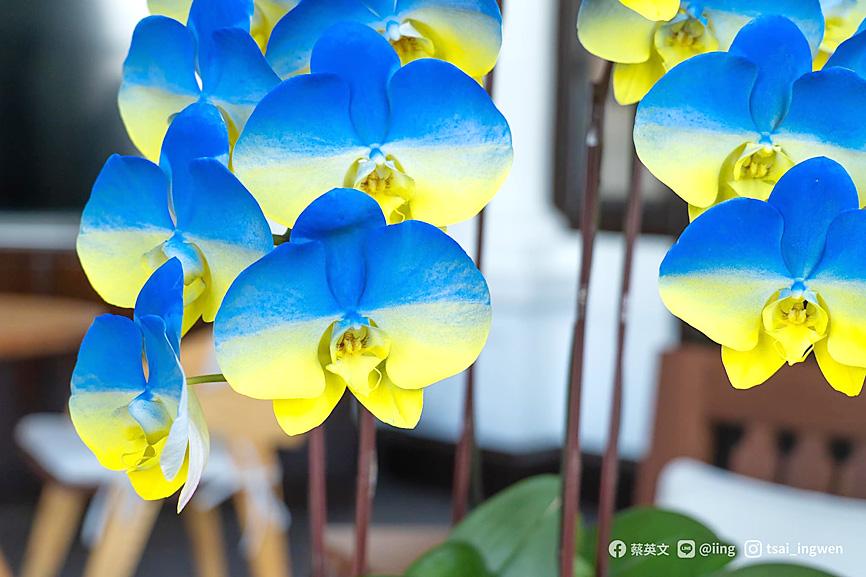
Photo: Screen grab from President Tsai Ing-wen’s Facebook
Taiwanese orchids are exported to 63 countries, making it one of the nation’s most important agricultural products, Tseng said, adding that 14,020 tonnes were sold for nearly NT$4.5 billion last year.
Despite the COVID-19 pandemic, the export volume and value of Taiwan’s moth orchids still increased 8.5 percent and 14.7 percent respectively, thanks to the pro-export policy adopted by the Council of Agriculture.
Taiwan holds the biggest market share of nanoprinted orchids, Tseng said.
In comparison to the traditional printing method that dyes flowers through capillary action, inkjet nanoprinting is able to produce softer colors without blocking stomata on the petals, Tseng said.
The technology is risk-free for plants and humans, he added.
However, the time-consuming and labor-intensive procedure of inkjet nanoprinting doubles or triples the price of the printed orchids, which are therefore mostly used in exhibitions.
Taiwanese nanoprinted orchids are very popular in Australia, which accounts for more than 60 percent of the market, Tseng said.
Among the nearly 4,000 types of orchids, inkjet printing is only used on 500 that are more commonly seen on the market, with the global bestseller “V3” moth orchids topping the production list, he said.
In addition to the charity sale, Taiwanese inkjet printing company Symon Agricultural Biotech is to display nanoprinted orchids at the show, which runs from March 26 to April 5.

The National Police Agency’s Third Special Police Corps yesterday said that from May to July, it intercepted five smuggling operations from China, seizing more than 70,000 counterfeit Beyblades with an estimated infringement value of NT$34.45 million (US$1.08 million). It added that any bootleg unit that reached the local market could present hidden health hazards to players. Beyblades, a line of spinning toy tops used in competitive gaming and developed in Japan by toy company Takara Tomy, have become popular in Taiwan, making them a target for fraudsters. The Third Special Police Corps, dedicated to safeguarding maritime borders and trade lines,

Five customers who made purchases at 7-Eleven stores across Taiwan won the top NT$10 million (US$313,716) special prize in the July-August uniform invoice lottery, including one who spent just NT$27 on photocopying, the convenience store chain said today. The five special prize winners made their purchases at stores in Taoyuan, Taipei, Taichung and Kaohsiung, 7-Eleven operator President Chain Store Corp said. The five winning purchases included NT$29 spent on snacks at a store in Taoyuan's Zhongli District (中壢), NT$27 on photocopying at a store in Taipei's Zhongzheng District (中正), NT$139 on City Cafe coffee and daily necessities at a store in Taipei's

GROWING TIES: The CGA is planning a goodwill mission to the Philippines, in what would be the first time since 1975 a Taiwanese paramilitary vessel has visited the country The Coast Guard Administration (CGA) plans to significantly expand its participation in international security cooperative frameworks and its operational capabilities, a budget proposal for next year showed. The budget indicates a transformation of the CGA from a maritime law enforcement arm into a national defense and intelligence gathering entity capable of tackling larger regional security matters. The proposal showed that personnel from the coast guard’s Intelligence Division and Special Action Support Center are to participate in high-level national security talks with the US. As the CGA has dealt with China’s rising “gray zone” threats around Taiwan, it has become a valuable asset to
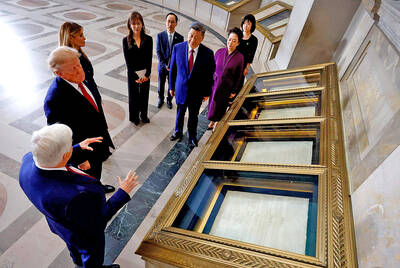
Chinese President Xi Jinping (習近平) reportedly cut short his visit to the National Archives in Washington after the Chinese delegation objected to plans to view the Treaty of San Francisco, sources in Washington’s media circles said. Xi and his wife, Peng Liyuan (彭麗媛), concluded their three-day state visit to the US on Friday after having tea with US President Donald Trump and first lady Melania Trump at the White House and visiting the archives. Chinese democracy advocates and members of pro-China groups gathered outside the venue during Xi’s visit, with the two groups exchanging competing slogans while police kept them separated. The US


 RSS
RSS