


Controversy over Taiwanese speedskater Huang Yu-ting (黃郁婷) wearing the China national team’s skinsuit continued as Democratic Progressive Party Legislator Hsu Chih-chieh (許智傑) yesterday said that Huang lacked awareness of her role as the flagbearer of the Taiwanese team at the Beijing Winter Olympics’ opening ceremony last night.
Huang, one of the four athletes competing for Taiwan at this year’s Winter Olympics, faced a backlash on social media on Thursday after posting a training video of her wearing a Chinese national team skinsuit.
Hsu yesterday said that Huang’s choice of uniform was extremely inappropriate, given that she is Taiwan’s flagbearer and that the Five Eyes countries — the US, the UK, Canada, New Zealand and Australia — are not sending representatives to the Games.

Photo: EPA-EFE
Hsu said Huang was free to be the commercial ambassador for a Chinese in-line skate brand, but that she made an error in judgement wearing China’s national team skinsuit.
Huang responded on Thursday, writing on Facebook that the uniform was a gift from a friend on the Chinese team.
“There is no nationality in the world of sports. Every athlete is a friend when we are not competing against each other,” she wrote.

Photo: EPA-EFE
Taipei Mayor Ko Wen-je (柯文哲) said yesterday that it is his understanding of international sports culture that team members exchange uniforms as gifts to different national teams.
Ko suggested that since the incident has passed, “we could gift each member of the Chinese team one of Taiwan’s team uniforms.”
Huang’s father, Huang Jin-lung (黃錦龍), commented on Thursday about his hosting of an in-line skating summer camp in China in 2018.
He said that he promoted skating as a sport in different countries, and that he did not focus his efforts solely in China, nor was he doing so for profit.
Any mention of his profits were rumors, he said.
The 33-year-old Huang Yu-ting is scheduled to compete in the speed skating women’s 1,500m event on Monday, the 500m on Feb. 13, and the 1,000m on Feb. 17.
Meanwhile, announced as "Chinese Taipei," Huang and skier Ho Ping-jui (何秉睿) carried the Chinese Taipei Olympic flag in the opening ceremony of the Winter Olympics at the National Stadium in Beijing last night.
Additional reporting by Kuo An-chia and CNA
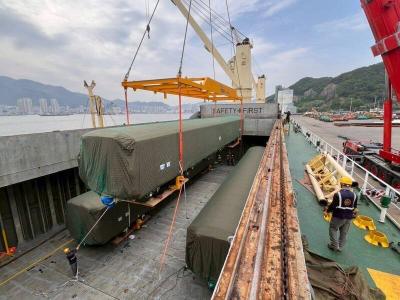
The first of 10 new high-capacity trains purchased from South Korea’s Hyundai Rotem arrived at the Port of Taipei yesterday to meet the demands of an expanding metro network, Taipei Rapid Transit Corp (TRTC) said yesterday. The train completed a three-day, 1,200km voyage from the Port of Masan in South Korea, the company said. Costing NT$590 million (US$18.79 million) each, the new six-carriage trains feature a redesigned interior based on "human-centric" transportation concepts, TRTC said. The design utilizes continuous longitudinal seating to widen the aisles and optimize passenger flow, while also upgrading passenger information displays and driving control systems for a more comfortable
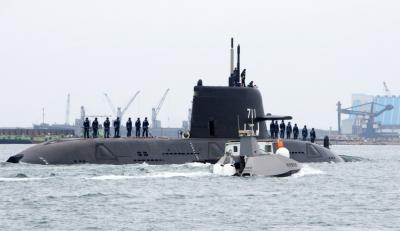
Taiwan's first indigenous defense submarine, the SS-711 Hai Kun (海鯤, or Narwhal), departed for its 13th sea trial at 7am today, marking its seventh submerged test, with delivery to the navy scheduled for July. The outing also marked its first sea deployment since President William Lai (賴清德) boarded the submarine for an inspection on March 19, drawing a crowd of military enthusiasts who gathered to show support. The submarine this morning departed port accompanied by CSBC Corp’s Endeavor Manta (奮進魔鬼魚號) uncrewed surface vessel and a navy M109 assault boat. Amid public interest in key milestones such as torpedo-launching operations and overnight submerged trials,
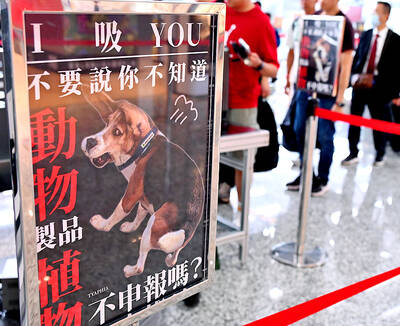
Quarantine awareness posters at Taiwan Taoyuan International Airport have gone viral for their use of wordplay. Issued by the airport branch of the Animal and Plant Health Inspection Agency, the posters feature sniffer dogs making a range of facial expressions, paired with advisory messages built around homophones. “We update the messages for holidays and campaign needs, periodically refreshing materials to attract people’s attention,” quarantine officials said. “The aim is to use the dogs’ appeal to draw focus to quarantine regulations.” A Japanese traveler visiting Taiwan has posted a photo on X of a poster showing a quarantine dog with a

SECURITY RISK: A university student sent a general alarm signal to THSRC’s control center on April 5, causing four operating trains to temporarily halt services The Ministry of Transportation and Communications yesterday pledged to submit a report on ways to harden the communication security of railway systems after a university student hacked into Taiwan High Speed Rail Corp’s (THSRC) radio communications system and disrupted operations of four high-speed rail trains last month. Investigation by the police and prosecutors found that the university student and radio enthusiast, surnamed Lin (林), first used a software-defined radio (SDR) filter to analyze THSRC signals, downloaded the data to a computer, cracked the parameters and then programmed the codes into his radio devices. Lin then sent a general alarm signal to


 RSS
RSS