


The re-election of Hong Kong Chief Executive Carrie Lam (林鄭月娥) could lead the territory to become “another Shenzhen,” an Institute for National Defense and Security Research academic said.
Hong Kong is to elect its next chief executive in March from a pool of 1,500 candidates including incumbent Lam.
Lam is unpopular among Hong Kongers, and has had difficulty demonstrating her administrative ability, but if she were re-elected, it is likely the territory would become more like nearby Shenzhen, which is directly under Beijing’s control, researcher Shih Chien-yu (侍建宇) wrote in the institute’s latest defense security report.
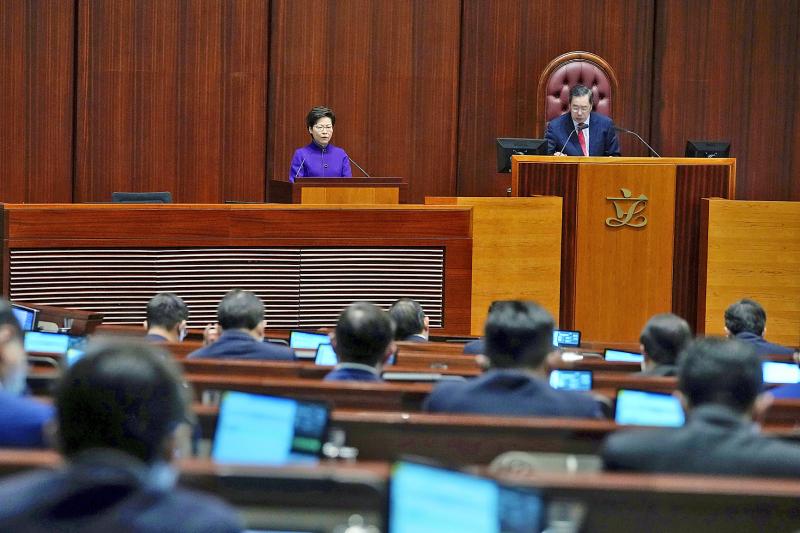
Photo: AP
Beijing might allow two strong candidates to run against Lam to set expectations in Hong Kong, and thereby bolster the Chinese Communist Party’s (CCP) rule over the territory, Shih said.
The idea of a “South Shenzhen” was first raised by investment banker Alex Shiu (蕭少滔), who cited arbitrary arrests, seizures of assets and monitoring of individuals as becoming the norm in Hong Kong, as it is in China, Shih said.
“Beijing’s overhaul of the Hong Kong electoral system was an attempt to secure the legitimacy of its rule over Hong Kong in the short term,” he said. “The most recent Legislative Council elections shattered that legitimacy, but created two developments.”
Democratic legislators still exist, but they have largely chosen to either act as agents of the CCP or become “voiceless,” he said, adding that if they dare to provoke China’s authority, Beijing would simply tighten the restrictions further.
“Beijing is oscillating in its control over Hong Kong, between rule by the chief executive and rule by CCP committee members,” he said. “If the unpopular Lam is re-elected, the CCP will just govern Hong Kong directly, effectively turning it into a South Shenzhen.”
If the CCP wanted to maintain the illusion of a “one party, two systems” framework for Hong Kong, then it would likely not allow Lam to be re-elected, he said, adding that a candidate would be chosen that gives the illusion of political participation in the territory.
“Politics in Hong Kong are already bound to the CCP, regardless of what approach is taken. However, feigning competition in the chief executive election might help the CCP garner a sense of legitimacy,” he said.
“However, if the Legislative Council is not responsible for its own performance, then all political responsibility would fall on the CCP — a responsibility it cannot shirk,” he said.
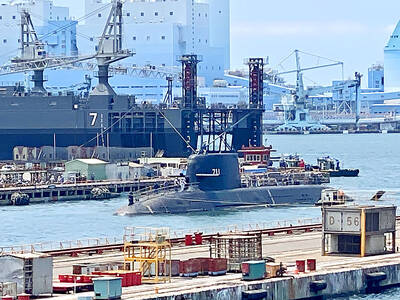
AGING: While Japan has 22 submarines, Taiwan only operates four, two of which were commissioned by the US in 1945 and 1946, and transferred to Taiwan in 1973 Taiwan would need at least 12 submarines to reach modern fleet capabilities, CSBC Corp, Taiwan chairman Chen Cheng-hung (陳政宏) said in an interview broadcast on Friday, citing a US assessment. CSBC is testing the nation’s first indigenous defense submarine, the Hai Kun (海鯤, Narwhal), which is scheduled to be delivered to the navy next month or in July. The Hai Kun has completed torpedo-firing tests and is scheduled to undergo overnight sea trials, Chen said on an SET TV military affairs program. Taiwan would require at least 12 submarines to establish a modern submarine force after assessing the nation’s operational environment and defense

Yangmingshan National Park authorities yesterday urged visitors to respect public spaces and obey the law after a couple was caught on a camera livestream having sex at the park’s Qingtiangang (擎天崗) earlier in the day. The Shilin Police Precinct in Taipei said it has identified a suspect and his vehicle registration number, and would summon him for questioning. The case would be handled in accordance with public indecency charges, it added. The couple entered the park at about 11pm on Thursday and began fooling around by 1am yesterday, the police said, adding that the two were unaware of the park’s all-day live
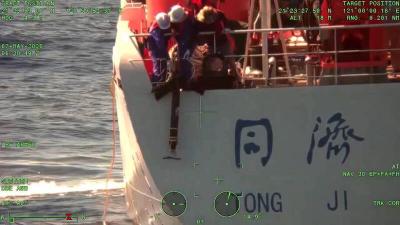
The coast guard today said that it had disrupted "illegal" operations by a Chinese research ship in waters close to the nation and driven it away, part of what Taipei sees a provocative pattern of China's stepped up maritime activities. The coast guard said that it on Thursday last week detected the Chinese ship Tongji (同濟號), which was commissioned only last year, 29 nautical miles (54km) southeast of the southern tip of Taiwan, although just outside restricted waters. The ship was observed lowering ropes into the water, suspected to be the deployment of scientific instruments for "illegal" survey operations, and the coast

A former soldier and an active-duty army officer were yesterday indicted for allegedly selling classified military training materials to a Chinese intelligence operative for a total of NT$79,440. The Taipei District Prosecutors’ Office indicted Chen Tai-yin (陳泰尹) and Lee Chun-ta (李俊達) for contravening the National Security Act (國家安全法) and the Anti-Corruption Act (貪污治罪條例). Chen left the military in September 2013 after serving alongside then-staff sergeant Lee, now an army lieutenant, at the 21st Artillery Command of the army’s Sixth Corps from 2011 to 2013, according to the indictment. Chen met a Chinese intelligence operative identified as “Wang” (王) through a friend in November


 RSS
RSS