


The navy yesterday held a public event to display the tactical capabilities of its indigenously built corvettes and minelaying ships ahead of the Lunar New Year.
The vessels, built by Lungteh Shipbuilding in Yilan County, appeared at the Weihai Naval Base (威海營區) in Keelung, but due to bad weather, only the two Tuo Chiang-class stealth multimission corvettes demonstrated their capabilities.
The corvettes conducted tracking and firing simulations using Sea Sword II air-defense missiles, 76mm naval guns, their close-in weapon systems and jamming shells, while also showing off their maneuverability by hitting 35 knots in rough waters.
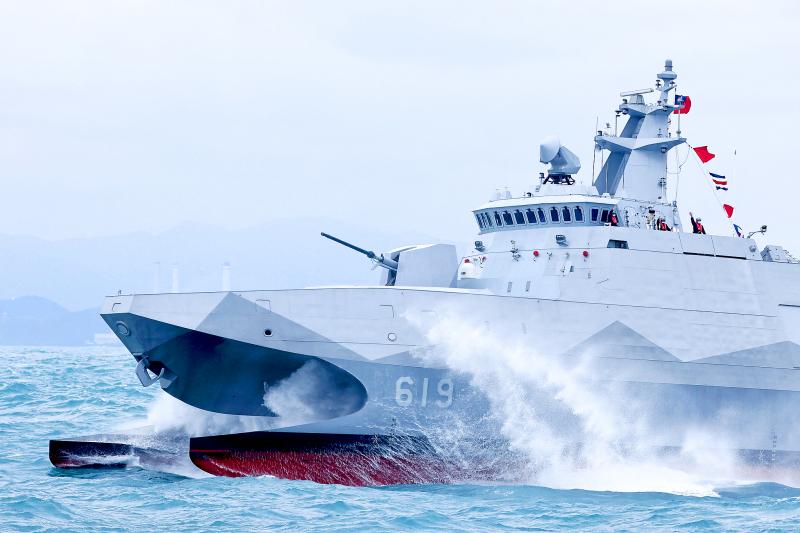
Photo: Ann Wang, Reuters
The Sea Sword II missile was developed by the Chungshan Institute of Science and Technology, which also designed the automatic minelaying system used aboard the navy’s new Min Jiang-class vessels.
Although the minelayers did not go out to sea, its minelaying system was shown publicly for the first time.
The system aims to lessen the pressure and workload on small crews, while also covering a greater area to lay mines.
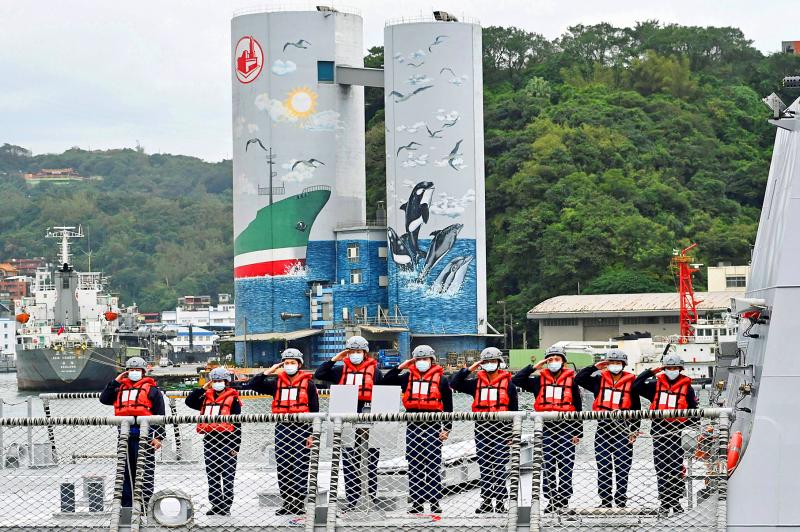
Photo: AFP
The nation currently has four minelayers, completed and delivered last month, and two of the Tuo Chiang-class corvettes — the Tuo Chiang and Ta Chiang — with up to 12 more of the corvettes on order.

Considering that most countries issue more than five denominations of banknotes, the central bank has decided to redesign all five denominations, the bank said as it prepares for the first major overhaul of the banknotes in more than 24 years. Central bank Governor Yang Chin-lung (楊金龍) is expected to report to the Legislative Yuan today on the bank’s operations and the redesign’s progress. The bank in a report sent to the legislature ahead of today’s meeting said it had commissioned a survey on the public’s preferences. Survey results showed that NT$100 and NT$1,000 banknotes are the most commonly used, while NT$200 and NT$2,000

The Centers for Disease Control (CDC) yesterday reported the first case of a new COVID-19 subvariant — BA.3.2 — in a 10-year-old Singaporean girl who had a fever upon arrival in Taiwan and tested positive for the disease. The girl left Taiwan on March 20 and the case did not have a direct impact on the local community, it said. The WHO added the BA.3.2 strain to its list of Variants Under Monitoring in December last year, but this was the first imported case of the COVID-19 variant in Taiwan, CDC Deputy Director-General Lin Ming-cheng (林明誠) said. The girl arrived in Taiwan on

South Korea is planning to revise its controversial electronic arrival card, a step Taiwanese officials said prompted them to hold off on planned retaliatory measures, a South Korean media report said yesterday. A Yonhap News Agency report said that the South Korean Ministry of Foreign Affairs is planning to remove the “previous departure place” and “next destination” fields from its e-arrival card system. The plan, reached after interagency consultations, is under review and aims to simplify entry procedures and align the electronic form with the paper version, a South Korean ministry official said. The fields — which appeared only on the electronic form

The Ministry of Foreign Affairs (MOFA) is suspending retaliation measures against South Korea that were set to take effect tomorrow, after Seoul said it is updating its e-arrival system, MOFA said today. The measures were to be a new round of retaliation after Taiwan on March 1 changed South Korea's designation on government-issued alien resident certificates held by South Korean nationals to "South Korea” from the "Republic of Korea," the country’s official name. The move came after months of protests to Seoul over its listing of Taiwan as "China (Taiwan)" in dropdown menus on its new online immigration entry system. MOFA last week


 RSS
RSS