


Taipei’s annual Lunar New Year market, which is to start on Saturday next week, is to be expanded to 10 streets and market areas, including the popular Dihua Street shopping area.
In addition to Dihua Street, the event is to be held at Rongbin Market (榮濱商店街), Taipei City Mall, Taipei Station Wholesale Market District (後車站商圈) and Huayin Street Shopping District (華陰街).
It would also cover Siping Yangguang Shopping District (四平陽光), Yuanlin Shopping District (沅陵街), Dongmen Yongkang Shopping District (東門永康), Ningxia Night Market (寧夏夜市) and Bangka Night Market (艋舺夜市), the Taipei Office of Commerce said in a statement, adding that it hopes the event would encourage people to visit the shopping areas and help counter a COVID-19 pandemic-induced business slump.
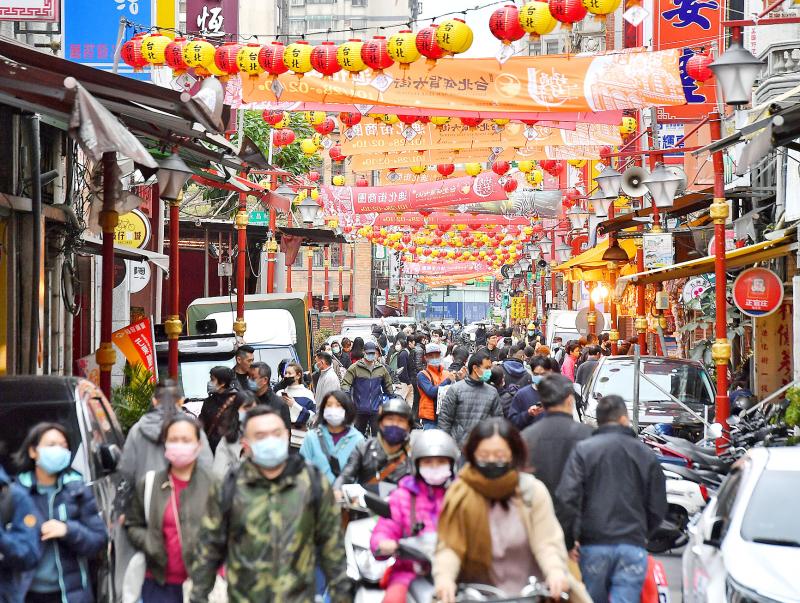
Photo: CNA
Taipei Deputy Mayor Huang Shan-shan (黃珊珊) told a news event to promote Lunar New Year shopping that the 10 areas each have their own unique character.
Huang would visit some of the areas to hand out “fortune money” envelopes to shoppers, wishing them good luck in the new lunar year, the office said.
The red envelopes, featuring a tiger design, would contain NT$1 and symbolize good fortune for the year of the tiger, the office said, adding that it hopes shoppers would welcome the new year with hope and optimism.
The annual market was first held in Dihua Street in 1996, as it is one of the most festive streets in Taiwan during the Lunar New Year holiday.
However, Dihua Street, which usually invites vendors from across Taiwan to set up stalls during the annual event, would not do so this year, Huang said, adding that the area would focus mainly on local shops.
Dihua Shopping District Development Association chairman Hsu Ching-chi (徐慶棋) said that not allowing additional stalls would help prevent the spread of COVID-19.
The move would also enable pedestrians to stroll along the street more easily, Hsu added.
The Lunar New Year market was canceled last year due to COVID-19.
More information about the event, which is to run through Jan. 30, can be found on the commerce office’s Facebook page.

LOUD AND PROUD Taiwan might have taken a drubbing against Australia and Japan, but you might not know it from the enthusiasm and numbers of the fans Taiwan might not be expected to win the World Baseball Classic (WBC) but their fans are making their presence felt in Tokyo, with tens of thousands decked out in the team’s blue, blowing horns and singing songs. Taiwanese fans have packed out the Tokyo Dome for all three of their games so far and even threatened to drown out home team supporters when their team played Japan on Friday. They blew trumpets, chanted for their favorite players and had their own cheerleading squad who dance on a stage during the game. The team struggled to match that exuberance on the field, with
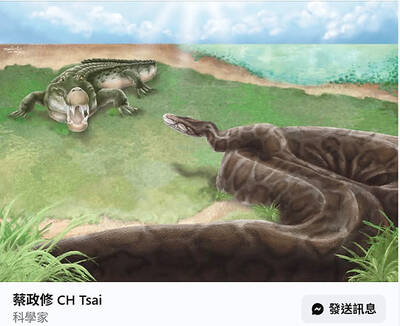
Taiwanese paleontologists have discovered fossil evidence that pythons up to 4m long inhabited Taiwan during the Pleistocene epoch, reporting their findings in the international scientific journal Historical Biology. National Taiwan University (NTU) Institute of Ecology and Evolutionary Biology associate professor Tsai Cheng-hsiu (蔡政修) led the team that discovered the largest snake fossil ever found in Taiwan. The single trunk vertebra was discovered in Tainan at the Chiting Formation, dated to between 400,000 and 800,000 years ago in the Middle Pleistocene, the paper said. The area also produced Taiwan’s first avian fossil, as well as crocodile, mammoth, saber-toothed cat and rhinoceros fossils, it said. Discoveries

Taiwanese paleontologists have discovered fossil evidence that pythons up to 4m long inhabited Taiwan during the Pleistocene epoch, reporting their findings in the international scientific journal Historical Biology. National Taiwan University (NTU) Institute of Ecology and Evolutionary Biology associate professor Tsai Cheng-hsiu (蔡政修) led the team that discovered the largest snake fossil ever found in Taiwan. A single trunk vertebra was discovered in Tainan at the Chiting Formation, dated to between 800,000 to 400,000 years ago in the Middle Pleistocene, the paper said. The area also produced Taiwan’s first avian fossil, as well as crocodile, mammoth, sabre-toothed cat and rhinoceros fossils, it said. Discoveries

Whether Japan would help defend Taiwan in case of a cross-strait conflict would depend on the US and the extent to which Japan would be allowed to act under the US-Japan Security Treaty, former Japanese minister of defense Satoshi Morimoto said. As China has not given up on the idea of invading Taiwan by force, to what extent Japan could support US military action would hinge on Washington’s intention and its negotiation with Tokyo, Morimoto said in an interview with the Liberty Times (sister paper of the Taipei Times) yesterday. There has to be sufficient mutual recognition of how Japan could provide


 RSS
RSS