


Former ambassador to Nicaragua Jaime Wu (吳進木) had not informed the government of his decision to accept Nicaraguan citizenship, the Ministry of Foreign Affairs (MOFA) said yesterday, urging Wu to respond to public queries about his continued stay in the country despite the severance of diplomatic ties.
The Nicaraguan government on Dec. 9 switched diplomatic recognition from Taipei to Beijing. The following day it announced that Wu and his wife, Liu Chun-chiao (劉春嬌), were granted Nicaraguan citizenship in recognition of their contributions to the country for more than a decade.
While Wu had officially applied for retirement before the two nations cut ties, his decision to stay in the country has sparked controversy.
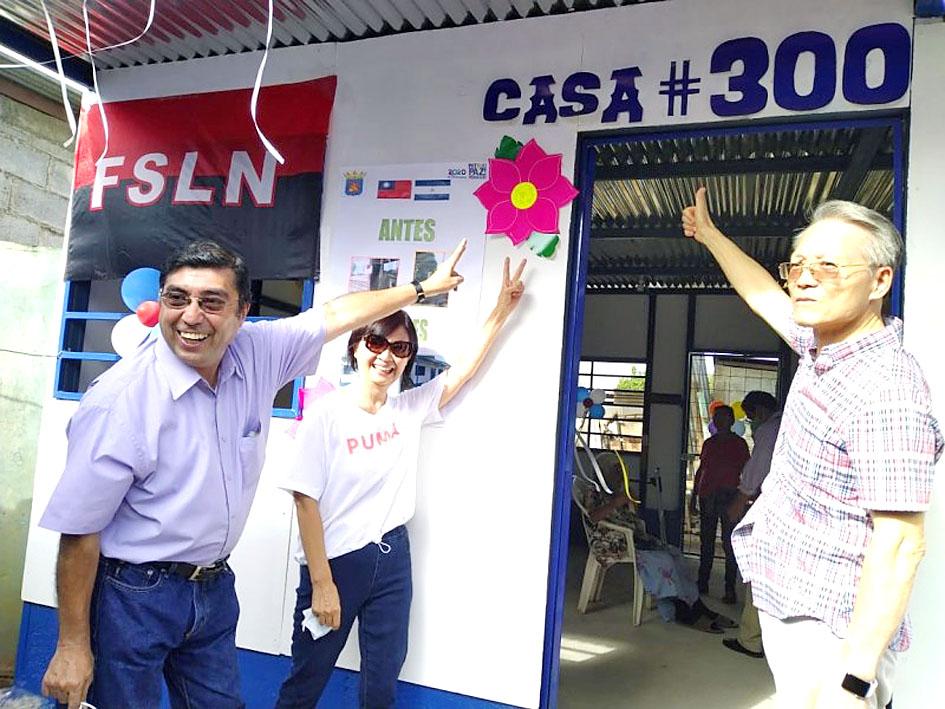
Photo taken from the Web site of the Republic of China embassy in Nicaragua
Wu had since 2020 applied for retirement several times and his application was approved on Sept. 28 last year, ministry spokeswoman Joanne Ou (歐江安) told a news briefing in Taipei yesterday.
However, the ministry had not been informed of his decision to receive Nicaraguan citizenship in advance, she said.
Wu had told the ministry that his wife could not travel long distances due to health issues, so the couple could not return to Taiwan for the time being, she said, adding that the ministry would not comment further on Liu’s health condition.
The ministry has contacted Wu through private channels and called on him to respond to public questions, she said.
Wu is still subject to the Classified National Security Information Protection Act (國家機密保護法), Ou said.
The ministry is holding interagency discussions regarding calls to amend the law to prevent a similar incident, Ou said.
As a former diplomat, Wu should have striven for the greater good of the nation, Democratic Progressive Party (DPP) Legislator Wang Ting-yu (王定宇) said separately in a video on Facebook yesterday.
However, his actions, including accepting Nicaraguan citizenship and staying in the Central American country after it cut ties with Taiwan, show that he has no professional ethics at all, which should be condemned by the public, Wang said.
It is questionable whether Wu did his utmost to protect the nation’s benefits and secrets during his tenure as a diplomat, he added.
The authorities should discuss whether to freeze Wu’s pension or take legal action, Wang said, urging Wu to return to Taiwan and explain his actions to the public.
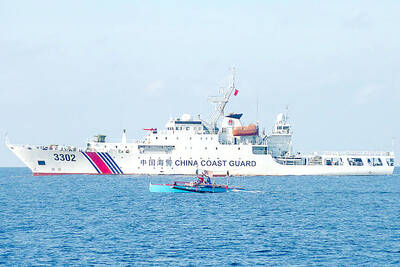
EXPANSIONIST: China deploys an average of 40 to 50 warships and coast guard vessels daily in the South China Sea, despite pledges not to militarize the region, an official said China is attempting to expand its influence across the First Island Chain and increase pressure on Japan by sending coast guard vessels into waters off of Taiwan under the pretext of maritime negotiations with Japan and the Philippines, a national security official said yesterday. China’s recent actions in the waters east of Taiwan and Japan and the Philippines’ exclusive economic zones (EEZ) are attempts to establish dominance in First Island Chain waters, said the official who declined to be named, adding that this is “expansion disguised as law enforcement.” Framing China’s actions solely as a cross-strait issue is a serious misjudgment that
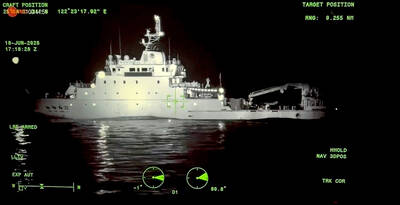
EXCUSES: Beijing is using government and research vessels as a pretext to harass the nation and enter its EEZ, and engage in ‘hegemonic expansion,’ the coast guard said The Coast Guard Administration yesterday said it drove away Chinese oceanographic research vessel Xiang Yang Hong 22 (向陽紅33) from restricted waters after warning it that it was in Taiwan’s exclusive economic zone (EEZ). The Chinese vessel entered restricted waters off the coast of Yilan County’s Suao (蘇澳) at 11:35pm on Thursday, the coast guard said, adding that it dispatched the Lanyu patrol vessel and the boat PP-10077 to shadow the Chinese ship and issue radio warnings ordering it to leave. China has no sovereignty over waters off Taiwan’s east coast, Lanyu’s crew told Xiang Yang Hong 22 over the radio, and demanded
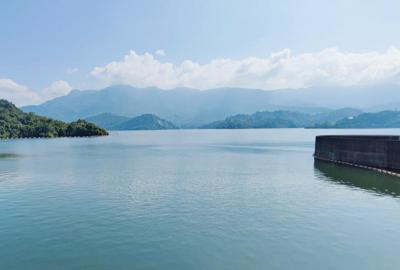
Several major reservoirs are estimated to have received 590 million tonnes of water inflow from June 4 to this morning, with storage levels at Wushantou Reservoir exceeding 50 percent and Zengwen Reservoir approaching 30 percent as of 9am today, data from the Water Resources Agency showed. Of the estimated 590 million tonnes, 450 million have already been stored in reservoirs, the data showed. As of 9am today, Baoshan Reservoir storage levels reached 100 percent, while Baoshan Second Reservoir, Yongheshan Reservoir and Techi Reservoir all exceeded 90 percent, data on the Water Resources Agency’s Web site showed. In addition, the Shimen Reservoir is at
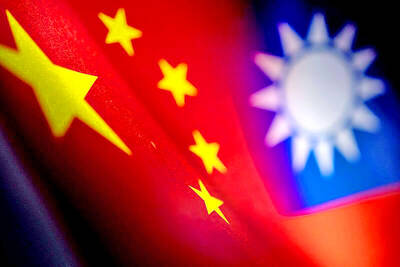
BAIT AND SWITCH: Allowing KMT-run counties to sell to China while the threat of abrupt cancelations hangs overhead is another form of coercion, officials said Beijing is using agricultural purchase offers announced during the Straits Forum to deepen Taiwan’s dependence on the Chinese market, a Taiwanese official said yesterday as they criticized the Taitung County commissioner’s participation in the initiative. During the Straits Forum held in Xiamen on Saturday, Chinese officials announced a sales and purchase agreement for agricultural products from some counties led by the Chinese Nationalist Party (KMT). Taitung County Commissioner Yao Ching-ling (饒慶鈴), who was barred from attending the event in person by the Mainland Affairs Council, participated via video. Under the agreement, China would purchase atemoyas, pomeloes, tea and grouper harvested in Taitung,


 RSS
RSS