


Drone detectors at Taipei International Airport (Songshan airport) have helped catch 17 offenders since they were installed in late 2020, leading to NT$1.65 million (US$59,692) in fines, the Civil Aeronautics Administration (CAA) said yesterday, as airports in Taoyuan and Kaohsiung plan to install their own systems to curtail dangerous drone activity.
Personal drones are banned from flying near airports due to safety concerns, but Songshan airport has many times been forced to halt operations for an hour or more due to drone incursions.
From 2016 to 2020, eight drones or suspected drones were found flying in the airport’s restricted airspace, delaying more than 6,000 passengers, airport director Hsu Nei-shin (徐乃新) told a news conference.
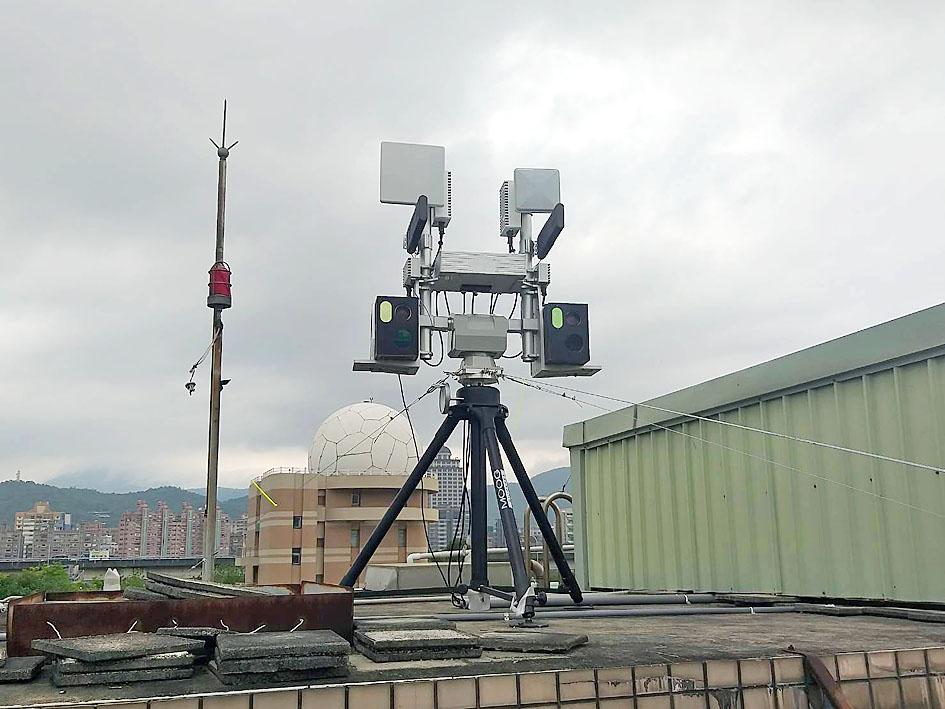
Photo courtesy of the Civil Aeronautics Administration
Songshan airport is not only responsible for passenger traffic above the capital, but also military and rescue affairs, Hsu said.
To address the issue, the airport in October 2020 installed a drone detection system to monitor for drones in the 4km2 surrounding the airport for a five-year trial period.
Since then, it has not needed to halt operations due to drone incursions, Hsu said.
The system consists of eight control stations that use radio interference and optoelectronic visualization to identify drone activity, which is then sent to police to help them track down the operator, Hsu said.
As of Dec. 22, out of the 81 incursions detected, police have identified 17 offenders, four of whom were penalized, he said, adding that the most serious offense incurred a fine of NT$480,000.
However, Hsu emphasized that ensuring aviation safety and protecting passenger rights is the goal of the initiative, not issuing fines.
A significant number of cases involved companies that had a permit, but failed to keep to the approved area or time, or used an unapproved operator or drone, Hsu said.
“Fly safely, fly legally,” he said, calling on drone operators to observe regulations.
Tenders are out to install similar systems at Taiwan Taoyuan International Airport and Kaohsiung International Airport, CAA Airport Operation and Management Unit Director Hsieh Jin-mei (謝金玫) said.
The Kaohsiung airport is expected to complete installation this year, while Taoyuan airport’s would be completed by next year at the earliest, Hsieh said.

The military has spotted two Chinese warships operating in waters near Penghu County in the Taiwan Strait and sent its own naval and air forces to monitor the vessels, the Ministry of National Defense (MND) said. Beijing sends warships and warplanes into the waters and skies around Taiwan on an almost daily basis, drawing condemnation from Taipei. While the ministry offers daily updates on the locations of Chinese military aircraft, it only rarely gives details of where Chinese warships are operating, generally only when it detects aircraft carriers, as happened last week. A Chinese destroyer and a frigate entered waters to the southwest

A magnitude 6.1 earthquake struck off the coast of Yilan County at 8:39pm tonight, the Central Weather Administration (CWA) said, with no immediate reports of damage or injuries. The epicenter was 38.7km east-northeast of Yilan County Hall at a focal depth of 98.3km, the CWA’s Seismological Center said. The quake’s maximum intensity, which gauges the actual physical effect of a seismic event, was a level 4 on Taiwan’s 7-tier intensity scale, the center said. That intensity level was recorded in Yilan County’s Nanao Township (南澳), Hsinchu County’s Guansi Township (關西), Nantou County’s Hehuanshan (合歡山) and Hualien County’s Yanliao (鹽寮). An intensity of 3 was
Japanese Prime Minister Sanae Takaichi’s comment last year on Tokyo’s potential reaction to a Taiwan-China conflict has forced Beijing to rewrite its invasion plans, a retired Japanese general said. Takaichi told the Diet on Nov. 7 last year that a Chinese naval blockade or military attack on Taiwan could constitute a “survival-threatening situation” for Japan, potentially allowing Tokyo to exercise its right to collective self-defense. Former Japan Ground Self-Defense Force general Kiyofumi Ogawa said in a recent speech that the remark has been interpreted as meaning Japan could intervene in the early stages of a Taiwan Strait conflict, undermining China’s previous assumptions

Instead of focusing solely on the threat of a full-scale military invasion, the US and its allies must prepare for a potential Chinese “quarantine” of Taiwan enforced through customs inspections, Stanford University Hoover fellow Eyck Freymann said in a Foreign Affairs article published on Wednesday. China could use various “gray zone” tactics in “reconfiguring the regional and ultimately the global economic order without a war,” said Freymann, who is also a nonresident research fellow at the US Naval War College. China might seize control of Taiwan’s links to the outside world by requiring all flights and ships entering or leaving Taiwan


 RSS
RSS